

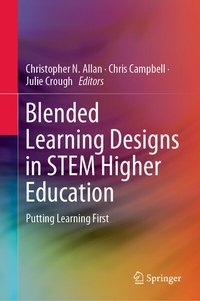
Blended Learning Designs in STEM Higher Education
Description

This book offers a set of learning principles to support the design of rich learning experiences in Science, Technology, Engineering and Mathematics (STEM) higher education, including detailed evaluations and discussions for a variety of science subjects. Further, it presents a professional learning framework that can be used to support the implementation of blended learning technologies to increase buy-in from academic staff, to support grass roots initiatives, to develop a sense of community, and to sustain change. The principles developed here will help readers to think about blended learning from a learner's perspective, put learning first, and develop activities that will help learners achieve better learning outcomes.
In addition, the book addresses how to design rich, evidence-based, blended learning experiences that support learning. It demonstrates a range of learning principles in practice, with step-by-step instructions, and includes templates, supporting material,instructions and other resources to help teachers embed and adapt designs in their own subject. Readers will be equipped with an expanded toolkit of resources, designs, ideas and activities that can be directly applied in a variety of subject areas.
More details
Other editions
Additional editions
Persons
Chris Campbell currently works at the Centre for Learning Futures at Griffith University, Brisbane, Australia. As an emerging research leader, she has been involved in numerous grants and projects involving digital and emerging technologies. Her skills in implementing and trialing new technologies are documented in over 70 publications, where she has conducted research on online tools in educational settings,including LAMS, Second Life and Assistive eXtra Learning Environments, as well as technology integration, mobile learning and augmented reality. Chris has previously taught first-year pre-service teachers and trialed interactive and emerging technologies in lectures. In 2016, Chris was a Queensland-Smithsonian Fellowship holder, and investigated the Smithsonian Learning Lab and its implications for teachers.
Julie Crough is a Learning and Teaching Consultant (Curriculum) for Griffith Sciences as well as a Senior Fellow of the Higher Education Academy and Griffith Learning and Teaching Academy. Her extensive experience and background in science education span more than 25 years of working collaboratively with, and for, higher education institutions and scientific research organisations on curriculum development and innovation. Her curiosity and drive to learn (BSc Hons, Grad Dip Ed, MSc and DTEM) is foregrounded by her passion for integrating active and authentic learning experiences and learning technologies in STEM higher education.
