

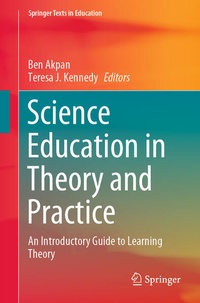
Science Education in Theory and Practice
Description

This book provides a collection of applicable learning theories and their applications to science teaching. It presents a synthesis of historical theories while also providing practical implications for improvement of pedagogical practices aimed at advancing the field into the future. The theoretical viewpoints included in this volume span cognitive and social human development, address theories of learning, and describe approaches to teaching and curriculum development. The book presents and discusses humanistic, behaviourist, cognitivist, and constructivist theories. In addition, it looks at other theories, such as multiple intelligences theory, systems thinking, gender/sexuality theory and indigenous knowledge systems. Each chapter follows a reader-motivated approach anchored on a narrative genre. The book serves as a guide for those aiming to create optional learning experiences to prepare the next generation STEM workforce.
Chapter "The Bildung Theory-From von Humboldt to Klafki and Beyond" is available open access under a Creative Commons Attribution 4.0 International License via link.springer.comMore details
Other editions
Additional editions
Persons
Ben Akpan, PhD, a professor of science education, is the Executive Director of the Science Teachers Association of Nigeria (STAN). He served as President of the International Council of Associations for Science Education (ICASE) from 2010 - 2013 and currently serves on the Executive Committee of ICASE as the Chair of World Conferences Standing Committee. Ben's areas of interest include chemistry, science education, environmental education, and support for science teacher associations. He is the editor of Science Education: A Global Perspective published by Springer and co-editor (with Keith S. Taber) of Science Education: An International Course Companion published by Sense Publishers. Ben is a member of the Editorial Boards of the Australian Journal of Science and Technology (AJST), Journal of Contemporary Educational Research (JCER), and Action Research and Innovation in Science Education (ARISE) Journal.
Teresa J. Kennedy, PhD, holds a joint appointment as Professor of International STEM and Bilingual/ELL Education in the College of Education and Psychology and in the College of Engineering at the University of Texas at Tyler, United States of America. She served as President of the International Council of Associations for Science Education (ICASE) from 2014 - 2017 and currently serves on the Executive Committee of ICASE as the Representative to UNESCO. Teresa is a two-time Fulbright Scholar, first in 1993 in Ecuador, and again during the 2014 - 15 academic year focusing on engineering education in Argentina. Her research interests include STEM Education, international comparative studies, gender equity, and brain research in relation to second language acquisition and bilingualism. She is a member of the Editorial Boards of the Journal of Educational Research and Review (JERR), the open-access journal Education Sciences, and ISCI Publishing Arts, Humanities and Social Sciences.
Content
1 Introduction - Theory into Practice; Ben Akpan and Teresa Kennedy.- Section I: Humanistic Theories.- 2 Theory of Human Motivation: Abraham Maslow; Shannon L. Navy.- 3 Glasser's Choice Theory and Science Education in British Columbia; Todd M. Milford and Robert B. Kiddell.- 4 Intrinsically Motivating Instruction- Thomas Malone; Bodil Svendsen,Fredrik MørkRøkenes&Tony Burner.- 5 The Bildung Theory - from von Humboldt to Klafki and beyond; JesperSjöström and Ingo Eilks.- Section II: Behaviourist Theories.- 6 Classical and Operant Conditioning - Ivan Pavlov; Burrhus Skinner and Ben Akpan.- 7 Social Learning Theory - Albert Bandura; Anwar Rumjaun and FawziaNarod.- 8 Connectionism - Edward Thorndike; Richard Brock.- Section III: Cognitivist Theories.- 9 New Media Technologies and Information Processing Theory - George A. Miller & Others; Patricia J. Stout and Mitchell D. Klett.- 10 Stage Theory of Cognitive Development - Jean Piaget; Brinda Oogarah-Pratap, Ajeevsing Bholoaand Yashwant Ramma.- 11 Mastery Learning - Benjamin Bloom; Ben Akpan.- 12 Meaningful Learning - David P. Ausubel; Steven S. Sexton.- 13 Discovery Learning - Jerome Bruner; Yasemin Ozdem-Yilmaz and Kader Bilican.- 14 Guided Discovery - Robert Gagné; Yashwantrao Ramma, Ajeevsing Bholoa and Mike Watts.- 15 Developing Intellectual Sophisticationand Scientific Thinking - The Schemes of William G. Perry and Deanna Kuhn ; Keith S. Taber.- Section IV: Constructivist Theories.- 16 Pragmatism - John Dewey; Fran Riga.- 17 Experiential Learning - David A. Kolb; Louise Lehane.- 18 Social Constructivism - Jerome Bruner; MiiaRannikmae, JackHolbrook and Regina Soobard.- 19 Mediated learning leading development - the social development theory of Lev Vygotsky; Keith S. Taber.- 20 Situated Cognition and Cognitive Apprenticeship Learning- Allan Collins, John Brown; Gultekin Cakmakci, Mehmet Aydeniz, Amelia Brown & Joseph M. Makokha.- 21 Activity Theory - Lev Vygotsky, AlekseiLeont'ev,YrjöEngeström; Tony Burner &BodilSvendson.- 22 Multiliteracies - New London Group; Shameem Oozeerally, Yashwantrao Ramma&AjeevsingBholoa.- 23 Project and Problem-Based Teaching and Learning; Michael Odell and Jaclyn Pedersen.- 24 Radical Constructivism - von Glasersfeld; GráinneWalshe.- 25 Constructive Alternativism: George Kelly's Personal Construct Theory; Keith S. Taber.- 26 Knowledge in Pieces - Andrea A. diSessa; David Hammer; Danielle B. Harlow & Julie A. Bianchini.- Section V: Other Theories.- 27 Multiple Intelligences Theory - Howard Gardner; Bulent Cavas& PinarCavas.- 28 Systems Thinking - Ludwig von Bertalanffy, Peter Senge, Donella Meallows; BaoHui Zhang and Salah A.M Ahmed.- 29 Gender/Sexuality Theory - Chris Beasley; Steven S. Sexton.- 30 Indigenous Knowledge Systems; Constance Khupe.- 31 STEAM Education- a Transdisciplinary Teaching and Learning Approach; Jack Holbrook, MiiaRannikmäe and Regina Soobard.- 32 21st Century Skills; Teresa Kennedy and Cheryl Sundberg.- About the Authors.- Index.
