

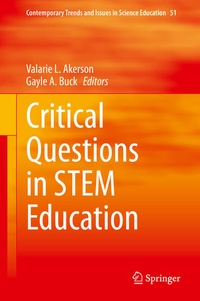
Critical Questions in STEM Education
Description

This edited volume offers a crosscutting view of STEM and is comprised of work by scholars in science, technology, engineering, and mathematics education. It offers a view of STEM from the disciplines that comprise it, while adhering to the idea that STEM itself is an interdisciplinary treatment of all the associated disciplines in a meaningful way. This book raises and answers questions regarding the meaning of STEM education and research.
This volume is divided into three sections: the first one describes the nature of the component disciplines of STEM. The next section presents work from leaders representing all STEM disciplines and deals with aspects such as K-12 and post-secondary education. The last section draws conclusions regarding the natures of the disciplines, challenges and advantages of STEM education in terms of theoretical and practical implications. The two final chapters compile arguments from the research chapters, describing themes in research results,and making recommendations for best STEM education practice, and examining areas for future research in STEM education.
More details
Other editions
Additional editions
Persons
Gayle Buck is an Associate Dean for Research, Development & Innovation, as well as a Professor of Science Education. Previously a middle level science teacher in both urban and rural schools, Professor Buck now teaches courses in science, STEM education and teacher education. Her research explores 1) student populations traditionally underserved in science education, 2) neglected epistemological assumptions in teaching and learning, and 3) pragmatic and participatory approaches to educational research.
Content
Preface.- Foreword to Critical Questions in STEM Education.- Part I: Nature of the STEM Disciplines.- Chapter 1. Nature of Scientific Knowledge and Scientific Inquiry (Norman G. Lederman and Judith Lederman).- Chapter 2. Nature of Technology (Theresa A. Cullenand and Meize Guo).- Chapter 3. Toward Defining Nature of Engineering in the Next Generation Science Standards Era (Hasan Deniz, EzgiYesilyurt, Steven Newman, and Erdogan Kaya).- Chapter 4. The Nature of Mathematics and Its Impact on K-12 Education (Rick Hudson, Mark Creager, Angela Burgess, and Alex Gerber).- Part II: Critical Questions in Teaching STEM.- Chapter 5. Inquiring into Environmental STEM: Striving for an Engaging Inquiry-Based E-STEM Experience for Preservice Teachers (Angela Burgess and Gayle Buck).- Chapter 6. Navigating Theory and Practice: Digital Video Games (DVGs) in STEM Education (Isha DeCoito and Lisa K. Briona).- Chapter 7. A Self-study on Teaching Integrated STEM Education to K-12 Science and MathematicsTeachers (Xinying Yin).- Chapter 8. Learning for the Real World: Interdisciplinary Challenge Projects to Facilitate Real World Learning in STEM (Jessica Dobrin).- Chapter 9. Collaboratively Learning to Teach STEM: A Model for Learning to Integrate STEM Education in Preservice Teacher Education (Sevil Akaygun and Fatma Aslan-Tutak).- Part III: Critical Questions in STEM.- Chapter 10. Public Portrayal of Indiana STEM Certified Schools (Steven Newman, Taukir Ahmed Khan, Meize Guo, Alex Gerber, Angela Burgess, and Valarie L. Akerson).- Chapter 11. Current Praxis and Conceptualization of STEM Education: A Call for Greater Clarity in Integrated Curriculum Development (Christopher Sgro, Trisha Bobowski, &Alandeom W. Oliveira).- Chapter 12. Future Elementary Teachers' Perspectives on the Importance of STEM (Lauren Madden, James E. R. Beyers, and Nicole Stanton).- Chapter 13. Switching Lanes or Exiting? STEM Experiences, Perceptions, and Identity Construction among College STEM Switchers (Youngjin Song, Ann Y. Kim, Lisa Martin-Hansen,and Elaine Villanueva Bernal).- Refection on Part I: Natures of the Disciplines that Make up STEM.- Reflection on Part II: Critical Questions in Teaching STEM.- Reflection on Part III: Critical Questions in STEM.- Afterward - STEM: Unrequited Dreams in a Material World.
