

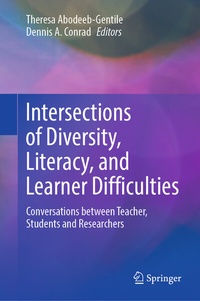
Intersections of Diversity, Literacy, and Learner Difficulties
Description

This book invites readers to challenge, corroborate, and add to the discourse on more inclusive pedagogical practice. Presenting theoretically and empirically informed research, it highlights potential considerations regarding the intersections of diversity, literacy, and learner difficulties. These three areas provide a stage where opposing paradigms often pose challenges for educators and create unnecessary barriers to providing the best education for all learners. These barriers might reveal how students are positioned through a deficit lens rather than one that recognizes individual differences and how these learner differences sometimes result in labels or put students at increased risk of encountering difficulties.
The contributing authors' goals are to start and sustain a conversation that examines these perspectives and to offer counter-narratives to the deficit lens by recognizing that individual difference does not need to be a barrier to educational access.By examining opportunities for more inclusive educational success, this book encourages discourse among key stakeholders; further, it goes beyond problematizing to offer new avenues for optimal learning and inclusive pedagogy across multiple contexts.
More details
Other editions
Additional editions
Persons
Dennis Conrad is Professor Emeritus at the State University of New York - Potsdam. Before completing his Ph.D. at Virginia Tech, he completed studies at Mausica Teachers College, Trinidad; She?eld University, and the University of London (UK). More recently he has served as Manager, Student Support Services Division, Trinidad. This volume is the fourth he has co-edited. He has taught at regular and special schools and universities in Trinidad and the USA. A former school principal, Professor Conrad earned the President's Award for Excellence in Research and Scholarship-Cultural Pluralism. He has been a Board Member of the EERA, Chair of AERA's Caribbean and African Studies in Education SIG, and Chair of the Department of Inclusive and Special Education. His main research interest is in the intersection of leadership, diversity, disability, and education.
Theresa Abodeeb-Gentile is an Associate Professor and the former Director of Elementary Education at the Universityof Hartford in West Hartford, CT. Dr. Abodeeb-Gentile received her doctorate in Literacy Language and Culture from the University of Massachusetts Amherst. Prior to her appointment at the University of Hartford, Theresa taught courses at American International College in Springfield Massachusetts, UMASS Amherst, and was an elementary inclusion classroom teacher and literacy specialist in Massachusetts for 16 years. She continues to stay active in schools, while doing both professional development and research. Her scholarship interests include the intersections of pedagogy, learning, literacy, identity, and inclusive education.