

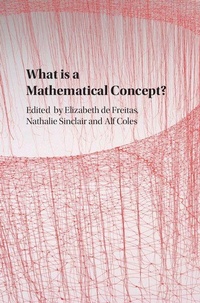
What is a Mathematical Concept?
Published on 22. June 2017
Book
Hardback
302 pages
978-1-107-13463-8 (ISBN)
Description
Responding to widespread interest within cultural studies and social inquiry, this book addresses the question 'what is a mathematical concept?' using a variety of vanguard theories in the humanities and posthumanities. Tapping historical, philosophical, sociological and psychological perspectives, each chapter explores the question of how mathematics comes to matter. Of interest to scholars across the usual disciplinary divides, this book tracks mathematics as a cultural activity, drawing connections with empirical practice. Unlike other books in this area, it is highly interdisciplinary, devoted to exploring the ontology of mathematics as it plays out in different contexts. This book will appeal to scholars who are interested in particular mathematical habits - creative diagramming, structural mappings, material agency, interdisciplinary coverings - that shed light on both mathematics and other disciplines. Chapters are also relevant to social sciences and humanities scholars, as each offers philosophical insight into mathematics and how we might live mathematically.
Reviews / Votes
'How splendid it is that this volume is devoted to so fundamental, and so grand, a question: What is a mathematical concept? And how wide a range of concepts are featured: from 'function machines' and 'the act of doubling' in their role in early education, to 'the act of halving' as it might reveal aspects of the currently developing foundations offered by homotopy type theory; from the jewels of geometry such as the stellated octahedron, to the extraordinary role that the newly fashioned concept of perfectoid spaces plays in resolving conjectures in arithmetic algebraic geometry and representation theory.' Barry Mazur, Gerhard Gade University Professor, Harvard University 'Mathematics has far too often been a discipline reserved for specialists. Even philosophers have tended to limit their focus to the foundations of mathematics, rather than the productions of contemporary mathematics. This is a wonderful book that reverses this trend. It approaches mathematical concepts from a perspective that is broadly humanistic and interdisciplinary, drawing on disciplines as diverse as history, philosophy, sociology and psychology. Each of the essays is written in a non-technical yet rigorous manner that should be accessible even to the 'mathematically challenged', and taken together they present a richly innovative approach to the ontology of mathematics. This is a timely and user-friendly collection that should help restore mathematics to its rightful place as a central discipline in the humanities.' Daniel Smith, Purdue University, IndianaMore details
Language
English
Place of publication
Cambridge
United Kingdom
Target group
Professional and scholarly
College/higher education
Product notice
sewn/stitched
Cloth over boards
Dimensions
Height: 238 mm
Width: 161 mm
Thickness: 25 mm
Weight
594 gr
ISBN-13
978-1-107-13463-8 (9781107134638)
Copyright in bibliographic data and cover images is held by Nielsen Book Services Limited or by the publishers or by their respective licensors: all rights reserved.
Schweitzer Classification
Other editions
Additional editions
Elizabeth de Freitas | Nathalie Sinclair | Alf Coles
What is a Mathematical Concept?
E-Book
07/2017
Cambridge University Press
€90.49
Available for download
Elizabeth de Freitas
What is a Mathematical Concept?
E-Book
06/2017
Cambridge University Press
€73.99
Available for download
Persons
Elizabeth de Freitas is a Professor in the Education and Social Research Institute at Manchester Metropolitan University. Her research focuses on philosophical investigations of mathematics, science and technology, pursuing the implications and applications of this work within cultural studies. She is co-author of the book Mathematics and the Body: Material Entanglements in the Classroom (with Nathalie Sinclair, Cambridge, 2014), associate editor of the journal Educational Studies in Mathematics, and has written more than fifty chapters and articles on diverse topics. Nathalie Sinclair is the Canada Research Chair in Tangible Mathematics Learning at Simon Fraser University, British Columbia. She is the author of several books, including Mathematics and the Body: Material Entanglements in the Classroom (with Elizabeth de Freitas, Cambridge, 2014) and Mathematics and the Aesthetic: Modern Approaches to an Ancient Affinity (with William Higginson and David Pimm, 2006), and over fifty articles. She has also designed educational technologies, including the touchscreen App TouchCounts and dynamic geometry microworlds for young learners at www.sfu.ca/geometry4yl. She is the founding editor of the journal Digital Experiences in Mathematics Education. Alf Coles' recently published Engaging in School Mathematics: Symbols and Experiences (2015) draws on more than twenty years of work as a teacher-researcher at both primary and secondary levels. He is on the executive committee of the British Society for Research into Learning Mathematics and is an active member of the Mathematics Education Special interest Group of the British Educational Research Association. His current interests include drawing his work in mathematics education into closer dialogue with issues of sustainability.
Content
Introduction; Part I: 1. Of polyhedra and pyjamas: platonism and induction in meaning-finitist mathematics Michael J. Barany; 2. Mathematical concepts? The view from ancient history Reviel Netz; Part II: 3. On treating mathematical drawings as artworks Juliette Kennedy; 4. Concepts as generative devices Elizabeth de Freitas and Nathalie Sinclair; Part III: 5. Bernhard Riemann's conceptual mathematics and pedagogy of mathematical concepts Arkady Plotnitsky; 6. Deleuze and the conceptualizable character of mathematical theories Simon Duffy; Part IV: 7. The vertical unity of the concept of space David Corfield; 8. The perfectoid concept: test case for an absent theory Michael Harris; Part V: 9. Queering mathematical concepts Heather Mendick; 10. Mathematics concepts in the news Richard Barwell and Yasmine Abtahi; 11. Concepts and commodities in mathematical learning Tony Brown; Part VI: 12. A relational view of mathematical concepts Alf Coles; 13. Cultural concepts concretely Wolff-Michael Roth; Part VII: 14. Ideas as species Brent Davis; 15. Inhabiting mathematical concepts Ricardo Nemirovsky; Afterword. Making a thing of it: some conceptual commentary David Pimm; Index.