

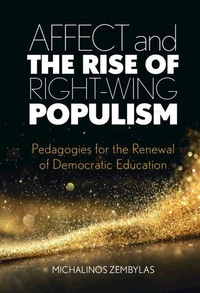
Affect and the Rise of Right-Wing Populism
Pedagogies for the Renewal of Democratic Education
Published on 6. May 2021
Book
Hardback
260 pages
978-1-108-83840-5 (ISBN)
Description
This book uses affect theory to analyze the rise of right-wing populism in recent years and discusses the pedagogical implications for democratic education. It provides examples of how affect and emotion play a crucial role in the rise and reproduction of current right-wing populism. The author suggests ideas about affective pedagogies for educators to use (along with recognizing the risks involved) to renew democratic education. The chapters lay out the importance of harnessing the power of affective experiences and adopting strategic pedagogical approaches to provide affirmative practices that move beyond simply criticizing right-wing populism. The book consequently undermines the power of fascist and right-wing tendencies in public life and educational settings without stooping to methods of indoctrination. This volume is a valuable resource for researchers and policy-makers in education, political science and other related fields, who can utilize the affective complexities involved in combatting right-wing populism to their advantage.
Reviews / Votes
'This beautifully conceived and written book demonstrates how the rise of right-wing populism is grounded in the cultural politics of affect. It also highlights how this basic realization demands new ways of imagining the possibilities of democratic education.' Fazal Rizvi, Professor Emeritus, University of Melbourne, Australia, and University of Illinois at Urbana-Champaign, USA 'This timely book explores the challenges educators face with the rise of the far right, shedding light on the affective dimensions of ideological attachments with impressive cross-disciplinary breadth. Foregrounding the role emotions play in cognition, the author's synthesis moves beyond critique to enumerate affirmative pedagogical directions.' Megan Boler, Professor of Social Justice Education, University of Toronto, Canada 'The author continues his challenging work on emotion and affect by asking how right-wing populism gains affective power. After mapping his critique, he takes up the question of the renewal of anti-fascist, democratic education. He offers the invention of affective pedagogies that are simultaneously practical, theoretical, and political.' Marie Brennan, Extraordinary Professor of Education, Stellenbosch University, South Africa, and Adjunct Professor of Education, University of South AustraliaMore details
Language
English
Place of publication
Cambridge
United Kingdom
Target group
Professional and scholarly
College/higher education
Illustrations
Worked examples or Exercises
Dimensions
Height: 235 mm
Width: 157 mm
Thickness: 19 mm
Weight
532 gr
ISBN-13
978-1-108-83840-5 (9781108838405)
Copyright in bibliographic data and cover images is held by Nielsen Book Services Limited or by the publishers or by their respective licensors: all rights reserved.
Schweitzer Classification
Other editions
Additional editions
Michalinos Zembylas
Affect and the Rise of Right-Wing Populism
Pedagogies for the Renewal of Democratic Education
E-Book
05/2021
Cambridge University Press
€26.99
Available for download
Michalinos Zembylas
Affect and the Rise of Right-Wing Populism
Pedagogies for the Renewal of Democratic Education
Book
05/2021
Cambridge University Press
€48.90
Shipment within 15-20 days
Michalinos Zembylas
Affect and the Rise of Right-Wing Populism
Pedagogies for the Renewal of Democratic Education
E-Book
04/2021
Cambridge University Press
€28.99
Available for download
Person
Michalinos Zembylas is Professorof Educational Theory and Curriculum Studies at the Open University of Cyprus.
Content
Introduction; Part I. Scanning the Political Landscape of Right-Wing Populism: 1. The politics of shame in the age of Trump; 2. 'Trump Pedagogy' and the effective modes of right-wing populism; 3. The affective grounding of post-truth claims; 4. The (un)making of microfascism in schools and classrooms; Part II. Renewing Democratic Education: 5; Affirmative critique as a response to post-truth claims; 6. Agnostic emotiions/affects to counter far right rhetoric; 7. Reinvigorating the affective atmospheres of democratic education; Part III. Inventing Affective Pedagogies for Democratic Education: 8; Nuturing political emotions in the classroom; 9. Towards shared responsibility without invoking collective spirit; 10. Re-invisioning the sentimental in pedagogical discourse and practice; 11. For an anti-complicity pedagogy; Epilogue.