

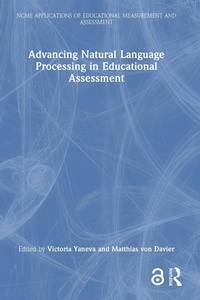
Advancing Natural Language Processing in Educational Assessment
1st Edition
Published on 5. June 2023
Book
Hardback
250 pages
978-1-032-20390-4 (ISBN)
Description
Advancing Natural Language Processing in Educational Assessment examines the use of natural language technology in educational testing, measurement, and assessment. Recent developments in natural language processing (NLP) have enabled large-scale educational applications, though scholars and professionals may lack a shared understanding of the strengths and limitations of NLP in assessment as well as the challenges that testing organizations face in implementation. This first-of-its-kind book provides evidence-based practices for the use of NLP-based approaches to automated text and speech scoring, language proficiency assessment, technology-assisted item generation, gamification, learner feedback, and beyond. Spanning historical context, validity and fairness issues, emerging technologies, and implications for feedback and personalization, these chapters represent the most robust treatment yet about NLP for education measurement researchers, psychometricians, testing professionals, and policymakers.
The Open Access version of this book, available at www.taylorfrancis.com, has been made available under a Creative Commons Attribution-NonCommercial-No Derivatives 4.0 license.
The Open Access version of this book, available at www.taylorfrancis.com, has been made available under a Creative Commons Attribution-NonCommercial-No Derivatives 4.0 license.
More details
Series
Language
English
Place of publication
London
United Kingdom
Publishing group
Taylor & Francis Ltd
Target group
College/higher education
Professional and scholarly
Postgraduate and Professional
Illustrations
52 s/w Abbildungen, 49 s/w Photographien bzw. Rasterbilder, 3 farbige Zeichnungen, 48 s/w Tabellen
48 Tables, black and white; 3 Line drawings, color; 49 Halftones, black and white; 52 Illustrations, black and white
Dimensions
Height: 260 mm
Width: 183 mm
Thickness: 19 mm
Weight
694 gr
ISBN-13
978-1-032-20390-4 (9781032203904)
Copyright in bibliographic data and cover images is held by Nielsen Book Services Limited or by the publishers or by their respective licensors: all rights reserved.
Schweitzer Classification
Other editions
Additional editions
Victoria Yaneva | Matthias Von Davier
Advancing Natural Language Processing in Educational Assessment
E-Book
06/2023
1st Edition
Routledge
€0.00
Available for download
Victoria Yaneva | Matthias Von Davier
Advancing Natural Language Processing in Educational Assessment
E-Book
06/2023
1st Edition
Routledge
€0.00
Available for download
Victoria Yaneva | Matthias Von Davier
Advancing Natural Language Processing in Educational Assessment
Book
06/2023
1st Edition
Routledge
€63.50
Shipment within 10-20 days
Persons
Victoria Yaneva is Senior NLP Scientist at the National Board of Medical Examiners, USA.
Matthias von Davier is Monan Professor of Education in the Lynch School of Education and Executive Director of TIMSS & PIRLS International Study Center at Boston College, USA.
Matthias von Davier is Monan Professor of Education in the Lynch School of Education and Executive Director of TIMSS & PIRLS International Study Center at Boston College, USA.
Content
Preface
by Victoria Yaneva and Matthias von Davier
Section I: Automated Scoring
Chapter 1: The Role of Robust Software in Automated Scoring
by Nitin Madnani, Aoife Cahill, and Anastassia Loukina
Chapter 2: Psychometric Considerations when Using Deep Learning for Automated Scoring
by Susan Lottridge, Chris Ormerod, and Amir Jafari
Chapter 3: Speech Analysis in Assessment
by Jared C. Bernstein and Jian Cheng
Chapter 4: Assessment of Clinical Skills: A Case Study in Constructing an NLP-Based Scoring System for Patient Notes
by Polina Harik, Janet Mee, Christopher Runyon, and Brian E. Clauser
Section II: Item Development
Chapter 5: Automatic Generation of Multiple-Choice Test Items from Paragraphs Using Deep Neural Networks
by Ruslan Mitkov, Le An Ha, Halyna Maslak, Tharindu Ranasinghe, and Vilelmini Sosoni
Chapter 6: Training Optimus Prime, M.D.: A Case Study of Automated Item Generation using Artificial Intelligence - From Fine-Tuned GPT2 to GPT3 and Beyond
by Matthias von Davier
Chapter 7: Computational Psychometrics for Digital-first Assessments: A Blend of ML and Psychometrics for Item Generation and Scoring
by Geoff LaFlair, Kevin Yancey, Burr Settles, Alina A von Davier
Section III: Validity and Fairness
Chapter 8: Validity, Fairness, and Technology-based Assessment
by Suzanne Lane
Chapter 9: Evaluating Fairness of Automated Scoring in Educational Measurement
by Matthew S. Johnson and Daniel F. McCaffrey
Section IV: Emerging Technologies
Chapter 10: Extracting Linguistic Signal from Item Text and Its Application to Modeling Item Characteristics
by Victoria Yaneva, Peter Baldwin, Le An Ha, and Christopher Runyon
Chapter 11: Stealth Literacy Assessment: Leveraging Games and NLP in iSTART
by Ying Fang, Laura K. Allen, Rod D. Roscoe, and Danielle S. McNamara
Chapter 12: Measuring Scientific Understanding Across International Samples: The Promise of Machine Translation and NLP-based Machine Learning Technologies
by Minsu Ha and Ross H. Nehm
Chapter 13: Making Sense of College Students' Writing Achievement and Retention with Automated Writing Evaluation
by Jill Burstein, Daniel McCaffrey, Steven Holtzman & Beata Beigman Klebanov
Contributor Biographies
by Victoria Yaneva and Matthias von Davier
Section I: Automated Scoring
Chapter 1: The Role of Robust Software in Automated Scoring
by Nitin Madnani, Aoife Cahill, and Anastassia Loukina
Chapter 2: Psychometric Considerations when Using Deep Learning for Automated Scoring
by Susan Lottridge, Chris Ormerod, and Amir Jafari
Chapter 3: Speech Analysis in Assessment
by Jared C. Bernstein and Jian Cheng
Chapter 4: Assessment of Clinical Skills: A Case Study in Constructing an NLP-Based Scoring System for Patient Notes
by Polina Harik, Janet Mee, Christopher Runyon, and Brian E. Clauser
Section II: Item Development
Chapter 5: Automatic Generation of Multiple-Choice Test Items from Paragraphs Using Deep Neural Networks
by Ruslan Mitkov, Le An Ha, Halyna Maslak, Tharindu Ranasinghe, and Vilelmini Sosoni
Chapter 6: Training Optimus Prime, M.D.: A Case Study of Automated Item Generation using Artificial Intelligence - From Fine-Tuned GPT2 to GPT3 and Beyond
by Matthias von Davier
Chapter 7: Computational Psychometrics for Digital-first Assessments: A Blend of ML and Psychometrics for Item Generation and Scoring
by Geoff LaFlair, Kevin Yancey, Burr Settles, Alina A von Davier
Section III: Validity and Fairness
Chapter 8: Validity, Fairness, and Technology-based Assessment
by Suzanne Lane
Chapter 9: Evaluating Fairness of Automated Scoring in Educational Measurement
by Matthew S. Johnson and Daniel F. McCaffrey
Section IV: Emerging Technologies
Chapter 10: Extracting Linguistic Signal from Item Text and Its Application to Modeling Item Characteristics
by Victoria Yaneva, Peter Baldwin, Le An Ha, and Christopher Runyon
Chapter 11: Stealth Literacy Assessment: Leveraging Games and NLP in iSTART
by Ying Fang, Laura K. Allen, Rod D. Roscoe, and Danielle S. McNamara
Chapter 12: Measuring Scientific Understanding Across International Samples: The Promise of Machine Translation and NLP-based Machine Learning Technologies
by Minsu Ha and Ross H. Nehm
Chapter 13: Making Sense of College Students' Writing Achievement and Retention with Automated Writing Evaluation
by Jill Burstein, Daniel McCaffrey, Steven Holtzman & Beata Beigman Klebanov
Contributor Biographies