

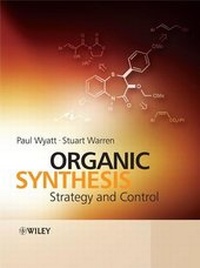
Organic Synthesis
Strategy and Control
Published on 20. April 2007
Book
Paperback/Softback
918 pages
978-0-471-92963-5 (ISBN)
Description
Organic Synthesis: Strategy and Control is the long-awaited sequel to Stuart Warren's bestseller Organic Synthesis: The Disconnection Approach, which looked at the planning behind the synthesis of compounds. This unique book now provides a comprehensive, practical account of the key concepts involved in synthesising compounds and focuses on putting the planning into practice.
The two themes of the book are strategy and control: solving problems either by finding an alternative strategy or by controlling any established strategy to make it work. The book is divided into five sections that deal with selectivity, carbon-carbon single bonds, carbon-carbon double bonds, stereochemistry and functional group strategy.
* A comprehensive, practical account of the key concepts involved in synthesising compounds
* Takes a mechanistic approach, which explains reactions and gives guidelines on how reactions might behave in different situations
* Focuses on reactions that really work rather than those with limited application
* Contains extensive, up-to-date references in each chapter
Students and professional chemists familiar with Organic Synthesis: The Disconnection Approach will enjoy the leap into a book designed for chemists at the coalface of organic synthesis.
Reviews / Votes
This is a book which will change the way you think about making molecules. (Chemistry World, July 2008) The authors can be commended on producing a really useful and enjoyable new book on Organic Synthesis. (Reviews, June 2008) "The authors have spent approximately ten years putting this excellent book together, and their hard work has paid off." (Journal of Chemical Education, May 2008) "Of interest to the experienced practitioner looking to broaden (or reawaken) awareness of the remarkable diversity of available synthetic transformations"(Journal of Medicinal Chemistry, 2008)More details
Other editions
Additional editions
E-Book
05/2013
1st Edition
Wiley
€60.99
Available for download
E-Book
04/2007
Wiley
€60.99
Available for download
Book
04/2007
1st Edition
Wiley
€173.50
Shipment within 10-20 days
Persons
Paul Wyatt, Senior Lecturer and Director of Undergraduate Studies, School of Chemistry, University of Bristol, UK and Stuart Warren, Reader in Organic Chemistry, Department of Chemistry, University of Cambridge, UK.
Content
A: Introduction: Selectivity.
1. Planning Organic Syntheses: Tactics, Strategy, and Control.
2. Chemoselectivity.
3. Regioselectivity: Controlled Aldol Reactions.
4. Stereoselectivity: Stereoselective Aldol Reactions.
5. Alternative Strategies for Enone Synthesis.
6. Choosing a Strategy : The Synthesis of cyclopentenones.
B: Making Carbon-Carbon Bonds.
7. The Ortho Strategy for Aromatic Compounds.
8. ´-Complexes of Metals.
9. Controlling the Michael Reaction.
10. Specific Enol Equivalents.
11. Extended Enolates.
12. Allyl Anions.
13. Homoenolates.
14. Acyl Anion Equivalents.
C: Carbon-Carbon Double Bonds.
15. Synthesis of Double Bonds of Defined Stereochemistry.
16. Stereo-Controlled Vinyl Anion Equivalents.
17. Electrophilic Attack on Alkenes.
18. Vinyl Cations: Palladium-Catalysed C-C Coupling.
19. Allyl Alcohols: Allyl Cation Equivalents (and More).
D: Stereochemistry.
20. Control of Stereochemistry -- Introduction.
21 Controlling Relative Stereochemistry.
22. Resolution.
23. The Chiral Pool.
24. Asymmetric Induction I: Reagent-Based Strategy.
25. Asymmetric Induction II: Asymmetric Catalysis: Formation of C-O and C-N Bonds.
26. Asymmetric Induction III: Asymmetric Catalysis: Formation of C-H and C-C Bonds.
27. Asymmetric Induction IV: Substrate-Based Strategy.
28. Kinetic Resolution.
29. Enzymes: Biological Methods in Asymmetric Synthesis.
30. New Chiral Centres from Old.
31. Strategy of Asymmetric Synthesis.
E: Functional Group Strategy.
32. Functionalisation of Pyridine.
33. Oxidation of Aromatic Compounds, Enols and Enolates.
34. Functionality and Pericyclic Reactions: Nitrogen Heterocycles by Cycloadditions and Sigmatropic Rearrangements.
35. Synthesis and Chemistry of Azoles and other Heterocycles with Two or more Heteroatoms.
36. Tandem Organic Reactions.
General References.
Index.