

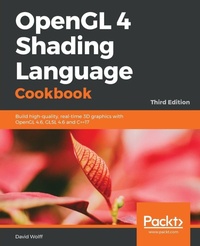
OpenGL 4 Shading Language Cookbook
Build high-quality, real-time 3D graphics with OpenGL 4.6, GLSL 4.6 and C++17
3rd Edition
Published on 28. September 2018
Book
Paperback/Softback
472 pages
978-1-78934-225-3 (ISBN)
Description
Over 70 recipes that cover advanced techniques for 3D programming such as lighting, shading, textures, particle systems, and image processing with OpenGL 4.6
Key Features
Book DescriptionOpenGL 4 Shading Language Cookbook, Third Edition provides easy-to-follow recipes that first walk you through the theory and background behind each technique, and then proceed to showcase and explain the GLSL and OpenGL code needed to implement them.
The book begins by familiarizing you with beginner-level topics such as compiling and linking shader programs, saving and loading shader binaries (including SPIR-V), and using an OpenGL function loader library. We then proceed to cover basic lighting and shading effects. After that, you'll learn to use textures, produce shadows, and use geometry and tessellation shaders. Topics such as particle systems, screen-space ambient occlusion, deferred rendering, depth-based tessellation, and physically based rendering will help you tackle advanced topics.
OpenGL 4 Shading Language Cookbook, Third Edition also covers advanced topics such as shadow techniques (including the two of the most common techniques: shadow maps and shadow volumes). You will learn how to use noise in shaders and how to use compute shaders.
The book provides examples of modern shading techniques that can be used as a starting point for programmers to expand upon to produce modern, interactive, 3D computer-graphics applications.What you will learn
Compile, debug, and communicate with shader programs
Use compute shaders for physics, animation, and general computing
Learn about features such as shader storage buffer objects and image load/store
Utilize noise in shaders and learn how to use shaders in animations
Use textures for various effects including cube maps for reflection or refraction
Understand physically based reflection models and the SPIR-V Shader binary
Learn how to create shadows using shadow maps or shadow volumes
Create particle systems that simulate smoke, fire, and other effects
Who this book is forIf you are a graphics programmer looking to learn the GLSL shading language, this book is for you. A basic understanding of 3D graphics and programming experience with C++ are required.
Key Features
Book DescriptionOpenGL 4 Shading Language Cookbook, Third Edition provides easy-to-follow recipes that first walk you through the theory and background behind each technique, and then proceed to showcase and explain the GLSL and OpenGL code needed to implement them.
The book begins by familiarizing you with beginner-level topics such as compiling and linking shader programs, saving and loading shader binaries (including SPIR-V), and using an OpenGL function loader library. We then proceed to cover basic lighting and shading effects. After that, you'll learn to use textures, produce shadows, and use geometry and tessellation shaders. Topics such as particle systems, screen-space ambient occlusion, deferred rendering, depth-based tessellation, and physically based rendering will help you tackle advanced topics.
OpenGL 4 Shading Language Cookbook, Third Edition also covers advanced topics such as shadow techniques (including the two of the most common techniques: shadow maps and shadow volumes). You will learn how to use noise in shaders and how to use compute shaders.
The book provides examples of modern shading techniques that can be used as a starting point for programmers to expand upon to produce modern, interactive, 3D computer-graphics applications.What you will learn
Compile, debug, and communicate with shader programs
Use compute shaders for physics, animation, and general computing
Learn about features such as shader storage buffer objects and image load/store
Utilize noise in shaders and learn how to use shaders in animations
Use textures for various effects including cube maps for reflection or refraction
Understand physically based reflection models and the SPIR-V Shader binary
Learn how to create shadows using shadow maps or shadow volumes
Create particle systems that simulate smoke, fire, and other effects
Who this book is forIf you are a graphics programmer looking to learn the GLSL shading language, this book is for you. A basic understanding of 3D graphics and programming experience with C++ are required.
More details
Edition
3rd Revised edition
Language
English
Place of publication
Birmingham
United Kingdom
Edition type
Revised edition
Dimensions
Height: 235 mm
Width: 191 mm
Thickness: 26 mm
Weight
806 gr
ISBN-13
978-1-78934-225-3 (9781789342253)
Copyright in bibliographic data and cover images is held by Nielsen Book Services Limited or by the publishers or by their respective licensors: all rights reserved.
Schweitzer Classification
Other editions
Additional editions
David Wolff
OpenGL 4 Shading Language Cookbook
Build high-quality, real-time 3D graphics with OpenGL 4.6, GLSL 4.6 and C++17
E-Book
06/2024
3rd Edition
Packt Publishing Limited
€38.99
Available for download
Person
David Wolff is a professor in the computer science department at Pacific Lutheran University (PLU). He received a PhD in Physics and an MS in computer science from Oregon State University. He has been teaching computer graphics to undergraduates at PLU for over 17 years, using OpenGL.
Content
Table of Contents
Getting Started with GLSL
Working with GLSL programs
The Basics of GLSL Shaders
Lighting and Shading
Using Textures
Image Processing and Screen Space Techniques
Using Geometry and Tessellation Shaders
Shadows
Using Noise in Shaders
Particle Systems and Animation
Using Compute Shaders
Getting Started with GLSL
Working with GLSL programs
The Basics of GLSL Shaders
Lighting and Shading
Using Textures
Image Processing and Screen Space Techniques
Using Geometry and Tessellation Shaders
Shadows
Using Noise in Shaders
Particle Systems and Animation
Using Compute Shaders