

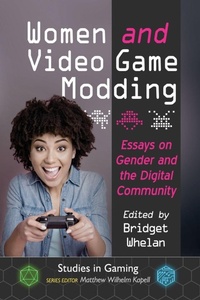
Women and Video Game Modding
Essays on Gender and the Digital Community
Published on 7. February 2020
Book
Paperback/Softback
216 pages
978-1-4766-6743-0 (ISBN)
Description
The world of video games has long revolved around a subset of its player base: straight, white males aged 18-25. Highly gendered marketing in the late 1990s and early 2000s widened the gap between this perceived base and the actual diverse group who buy video games. Despite reports from the Entertainment Software Association that nearly half of gamers identify as female, many developers continue to produce content reflecting this imaginary audience.
Many female gamers are in turn modifying the games. "Modders" alter the appearance of characters, rewrite scenes and epilogues, enhance or add love scenes and create fairy tale happy endings.
This is a collection of new essays on the phenomenon of women and modding, focusing on such titles as Skyrim, Dragon Age, Mass Effect and The Sims. Topics include the relationship between modders and developers, the history of modding, and the relationship between modding and disability, race, sexuality and gender identity.
Many female gamers are in turn modifying the games. "Modders" alter the appearance of characters, rewrite scenes and epilogues, enhance or add love scenes and create fairy tale happy endings.
This is a collection of new essays on the phenomenon of women and modding, focusing on such titles as Skyrim, Dragon Age, Mass Effect and The Sims. Topics include the relationship between modders and developers, the history of modding, and the relationship between modding and disability, race, sexuality and gender identity.
More details
Series
Language
English
Place of publication
Jefferson, NC
United States
Target group
Professional and scholarly
Interest Age: From 18 years
Product notice
Paperback (trade)
Illustrations
20 photos, notes, bibliographies, index
Dimensions
Height: 229 mm
Width: 152 mm
Thickness: 14 mm
Weight
361 gr
ISBN-13
978-1-4766-6743-0 (9781476667430)
Copyright in bibliographic data and cover images is held by Nielsen Book Services Limited or by the publishers or by their respective licensors: all rights reserved.
Schweitzer Classification
Persons
Bridget Whelan is an assistant professor of English at SOWELA Technical Community College in Lake Charles, Louisiana. Her research interests include children's literature, fan studies, game studies, and girl culture. Series editor Matthew Wilhelm Kapell teaches American studies, anthropology, and writing at Pace University in New York.
Content
Table of Contents
Introduction
Bridget Whelan
"And nothing he has wrought shall be lost": Examining Race
and Sexuality in the Mods of Dragon Age: Inquisition (Jennifer Collins)
"Mod" About You: Exploring the Use of Mods as a Storytelling
Technique (Anne Betz)
LGBTQIA Inclusion in Dragon Age: Inquisition: Burning Down
Stereotypes and Modding for Representation (Jessica Hylton)
Simulated Ableism: The Sims and the Lack of Disability
Representation (Shelly Jones)
Regional and Ethnic Diversity in The Sims Mods (Hanna Wirman)
#WeNeedDiverseLooks: Female Body Mods, Immersion
and Curatorial Practices in the Gamer's Construction of the Fantasy Self (Cara Miele)
Game Characters as Tools for Expression: Modding the Body
in Mass Effect (Tanja Sihvonen)
Gender-Considerate Digital Game Design (Leigh Hughes)
About the Contributors
Index
Introduction
Bridget Whelan
"And nothing he has wrought shall be lost": Examining Race
and Sexuality in the Mods of Dragon Age: Inquisition (Jennifer Collins)
"Mod" About You: Exploring the Use of Mods as a Storytelling
Technique (Anne Betz)
LGBTQIA Inclusion in Dragon Age: Inquisition: Burning Down
Stereotypes and Modding for Representation (Jessica Hylton)
Simulated Ableism: The Sims and the Lack of Disability
Representation (Shelly Jones)
Regional and Ethnic Diversity in The Sims Mods (Hanna Wirman)
#WeNeedDiverseLooks: Female Body Mods, Immersion
and Curatorial Practices in the Gamer's Construction of the Fantasy Self (Cara Miele)
Game Characters as Tools for Expression: Modding the Body
in Mass Effect (Tanja Sihvonen)
Gender-Considerate Digital Game Design (Leigh Hughes)
About the Contributors
Index