

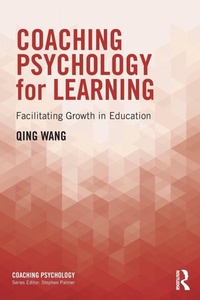
Coaching Psychology for Learning
Facilitating Growth in Education
1st Edition
Published on 20. April 2018
Book
Paperback/Softback
208 pages
978-1-138-04794-5 (ISBN)
Description
The contribution of coaching psychology to educational fields is increasingly recognised. This timely book introduces coaching psychology as a facilitative method to support learning in different educational contexts.
Coaching Psychology for Learning: Facilitating Growth in Education is conveniently organised into three parts:
Part One begins with a detailed account of educational paradigms, learning theories, and coaching psychology theories; it then reviews important studies of coaching applied to the educational field and identifies a number of gaps to which coaching psychology for learning can contribute;
Part Two presents two empirical participatory studies of coaching psychology for learning, which draw from both doctoral research conducted in the UK and educational work in Mainland China; two original and evidence-based coaching models are also illustrated;
Part Three consolidates the empirical evidence and original coaching models by exploring the nature of educational coaching, including the context, purpose, processes, and people and their interrelations.
The review of learning theories and coaching psychology theories in Part One enables the reader to gain a quick understanding of coaching psychology and its role in education, while the empirical studies in Part Two are particularly useful for undergraduate and postgraduate students, providing practical examples of how to conduct coaching psychology research in the field of education, in both the West and the East. The book also offers advice on design and implementation issues, which will benefit educational psychologists and coaching psychologists who wish to focus their professional practice in education.
Coaching Psychology for Learning is essential reading for any teacher, student or practitioner who wishes to become an educational coach to facilitate learning. It will appeal to coaches and coaching psychologists, including those in training and at postgraduate level, as well as professionals in educational settings, such as school leaders, counsellors and coaches, and educational psychologists.
Coaching Psychology for Learning: Facilitating Growth in Education is conveniently organised into three parts:
Part One begins with a detailed account of educational paradigms, learning theories, and coaching psychology theories; it then reviews important studies of coaching applied to the educational field and identifies a number of gaps to which coaching psychology for learning can contribute;
Part Two presents two empirical participatory studies of coaching psychology for learning, which draw from both doctoral research conducted in the UK and educational work in Mainland China; two original and evidence-based coaching models are also illustrated;
Part Three consolidates the empirical evidence and original coaching models by exploring the nature of educational coaching, including the context, purpose, processes, and people and their interrelations.
The review of learning theories and coaching psychology theories in Part One enables the reader to gain a quick understanding of coaching psychology and its role in education, while the empirical studies in Part Two are particularly useful for undergraduate and postgraduate students, providing practical examples of how to conduct coaching psychology research in the field of education, in both the West and the East. The book also offers advice on design and implementation issues, which will benefit educational psychologists and coaching psychologists who wish to focus their professional practice in education.
Coaching Psychology for Learning is essential reading for any teacher, student or practitioner who wishes to become an educational coach to facilitate learning. It will appeal to coaches and coaching psychologists, including those in training and at postgraduate level, as well as professionals in educational settings, such as school leaders, counsellors and coaches, and educational psychologists.
More details
Series
Language
English
Place of publication
London
United Kingdom
Publishing group
Taylor & Francis Ltd
Target group
College/higher education
Professional and scholarly
Postgraduate, Professional, and Professional Practice & Development
Illustrations
2 Farbfotos bzw. farbige Rasterbilder, 13 s/w Zeichnungen, 9 s/w Tabellen, 24 s/w Abbildungen
9 Tables, black and white; 13 Line drawings, black and white; 2 Halftones, color; 24 Illustrations, black and white
Dimensions
Height: 234 mm
Width: 156 mm
Thickness: 12 mm
Weight
354 gr
ISBN-13
978-1-138-04794-5 (9781138047945)
Copyright in bibliographic data and cover images is held by Nielsen Book Services Limited or by the publishers or by their respective licensors: all rights reserved.
Schweitzer Classification
Other editions
Additional editions
E-Book
04/2018
Routledge
€45.99
Available for download
E-Book
04/2018
1st Edition
Routledge
€45.99
Available for download
Book
04/2018
1st Edition
Routledge
€177.00
Shipment within 10-20 days
Person
Qing Wang is an educational psychologist, chartered psychologist, an ISCP accredited coaching psychologist and a passionate lecturer. She is currently Associate Professor in Educational Psychology at the School of Psychology and Cognitive Science of East China Normal University. She has 10 years' experience in coaching psychology in the field of education. With a genuine interest in coaching psychology for learning, she explores, designs, delivers, and evaluates coaching models and approaches with teachers and students in secondary schools, medical schools, vocational schools, universities and in parents' education. She uses ideas from CBT, mindfulness, narratives, motivational interviewing, solution-focused and positive psychology approaches to provide a comprehensive service that encompasses professional and personal issues.
Content
Chapter 1: Introduction; Part 1: An enquiry of educational paradigms, learning and coaching; Chapter 2: Philosophy and educational paradigms examined; Chapter 3: What is learning?; Chapter 4: The place of coaching psychology in learning; Part 2: Empirical case studies of coaching psychology for learning; Chapter 5: Coaching psychology for enquiry-based learning in secondary education; Chapter 6: Towards a systems model of Coaching for Learning; Chapter 7: Coaching psychology for problem-based learning in medical education; Chapter 8: PBL coaching: Towards an integrative model of CPBL; Part 3: Towards a systems approach of educational coaching; Chapter 9: The relational and discursive aspects of educational coaching; Chapter 10: Reflections and concluding remarks