

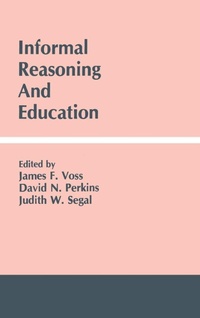
Informal Reasoning and Education
Published on 1. April 1991
Book
Hardback
518 pages
978-0-8058-0208-5 (ISBN)
Description
Based on extensive reasoning acquisition research, this volume provides theoretical and empirical considerations of the reasoning that occurs during the course of everyday personal and professional activities. Of particular interest is the text's focus on the question of how such reasoning takes place during school activities and how students acquire reasoning skills.
Reviews / Votes
"The summary chapters of each section are excellent....there are a number of interesting and well-written chapters..."-Merrill-Palmer Quarterly
More details
Language
English
Place of publication
New York
United States
Publishing group
Taylor & Francis Inc
Target group
College/higher education
Professional and scholarly
Dimensions
Height: 235 mm
Width: 157 mm
Thickness: 32 mm
Weight
896 gr
ISBN-13
978-0-8058-0208-5 (9780805802085)
Copyright in bibliographic data and cover images is held by Nielsen Book Services Limited or by the publishers or by their respective licensors: all rights reserved.
Schweitzer Classification
Other editions
Additional editions
James F. Voss | David N. Perkins | Judith W. Segal
Informal Reasoning and Education
E-Book
11/2012
1st Edition
Routledge
€68.49
Available for download
James F. Voss | David N. Perkins | Judith W. Segal
Informal Reasoning and Education
E-Book
11/2012
1st Edition
Routledge
€68.49
Available for download
James F. Voss | David N. Perkins | Judith W. Segal
Informal Reasoning and Education
Book
03/1991
Routledge
€76.40
Shipment within 10-20 days
Persons
Judith W. Segal, James F. Voss, David N. Perkins
Content
Contents: J. Voss, D. Perkins, J. Segal, Editors' Preface. Part I:Contexts for Informal Reasoning.R.D. Tweney, Informal Reasoning in Science. C. Christensen, A.S. Elstein, Informal Reasoning in the Medical Profession. J.F. Voss, Informal Reasoning in International Relations. J.A. Lawrence, Informal Reasoning in the Judicial System. D.N. Perkins, M. Farady, B. Bushey, Everyday Reasoning and the Roots of Intelligence. D. Miller-Jones, Informal Reasoning in Inner-City Children. R.H. Johnson, J.A. Blair, Contexts of Informal Reasoning: Commentary. Part II:Modes and Models of Informal Reasoning.M.H. Salmon, Informal Reasoning and Informal Logic. J. Baron, Beliefs About Thinking. E.L. Rissland, Example-Based Reasoning. J.W. Leland, Informal Reasoning in Decision Theory. J.M. Williams, Rhetoric and Informal Reasoning: Disentangling Some Confounded Effects in Good Reasoning and Good Writing. F.C. Keil, Intuitive Belief Systems and Informal Reasoning in Cognitive Development. N.L. Stein, C.A. Miller, I Win -- You Lose: The Development of Argumentative Thinking. R.S. Nickerson, Modes and Models of Informal Reasoning: Commentary. Part III:Informal Reasoning and Instruction.A.H. Schoenfeld, On Mathematics as Sense-Making: An Informal Attack on the Unfortunate Divorce of Formal and Informal Mathematics. J. Clement, Nonformal Reasoning in Experts and in Science Students: The Use of Analogies, Extreme Cases, and Physical Intuition. K. O'Reilly, Informal Reasoning in High School History: The Critical Thinking in American History Project. F.M. Newmann, Higher Order Thinking in the Teaching of Social Studies: Connections Between Theory and Practice. A.N. Applebee, Informal Reasoning and Writing Instruction. R.J. Swartz, Structured Teaching for Critical Thinking and Reasoning in Standard Subject Area Instruction. S.P. Norris, Informal Reasoning Assessment: Using Verbal Reports of Thinking to Improve Multiple-Choice Test Validity. L. Cuban, Informal Reasoning and Instruction: Commentary.