


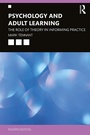
Psychology and Adult Learning
The Role of Theory in Informing Practice
4th Edition
Published on 10. September 2019
Book
Hardback
182 pages
978-0-367-08600-8 (ISBN)
Description
The fourth edition of Psychology and Adult Learning has been thoroughly updated to encompass shifts in the concerns of adult educators as they respond to changing global social and economic issues. It examines the role of psychology in informing adult education practice and explores the seminal traditions of key psychological theories as well as discussing issues and problems in applying them to an understanding of adult learning and development.
Providing a thoughtful and accessible approach to understanding self and personal change in adult education, and with a new emphasis on diversity, this new edition has been revised and updated in light of the impact of globalising processes, the emphasis on diversity among educators, developments in cognitive neuroscience, the impact of social media, and the theoretical move away from 'grand theory'. It examines the formation of identities, and places increased emphasis on how a conception of selfhood lies at the heart of teaching adults. Considering adult learning in a variety of contexts, topics covered include:
* Humanistic psychology
* Selfhood in the adult years
* The relevance of neuroscience
* Adult intelligence and cognition
* Behaviourism
* Group learning
* Transformative learning
Psychology and Adult Learning examines the psychological dimension of adult education work by analysing and critiquing key psychological theories that have informed our understanding. It is essential reading for all those who seek a critical account of how psychology informs contemporary adult education theory and practice.
Providing a thoughtful and accessible approach to understanding self and personal change in adult education, and with a new emphasis on diversity, this new edition has been revised and updated in light of the impact of globalising processes, the emphasis on diversity among educators, developments in cognitive neuroscience, the impact of social media, and the theoretical move away from 'grand theory'. It examines the formation of identities, and places increased emphasis on how a conception of selfhood lies at the heart of teaching adults. Considering adult learning in a variety of contexts, topics covered include:
* Humanistic psychology
* Selfhood in the adult years
* The relevance of neuroscience
* Adult intelligence and cognition
* Behaviourism
* Group learning
* Transformative learning
Psychology and Adult Learning examines the psychological dimension of adult education work by analysing and critiquing key psychological theories that have informed our understanding. It is essential reading for all those who seek a critical account of how psychology informs contemporary adult education theory and practice.
More details
Edition
4th edition
Language
English
Place of publication
London
United Kingdom
Publishing group
Taylor & Francis Ltd
Target group
College/higher education
Illustrations
1 s/w Abbildung, 7 s/w Tabellen
7 Tables, black and white; 1 Illustrations, black and white
Dimensions
Height: 240 mm
Width: 161 mm
Thickness: 15 mm
Weight
461 gr
ISBN-13
978-0-367-08600-8 (9780367086008)
Copyright in bibliographic data and cover images is held by Nielsen Book Services Limited or by the publishers or by their respective licensors: all rights reserved.
Schweitzer Classification
Other editions
Additional editions

Book
09/2019
4th Edition
Routledge
€50.80
Shipment within 15-20 days
E-Book
08/2019
4th Edition
Routledge
€44.99
Available for download
E-Book
08/2019
4th Edition
Routledge
€44.99
Available for download
Previous edition
Mark Tennant
Psychology and Adult Learning
Book
09/2005
3rd Edition
Routledge
€170.84
Article exhausted; check for reprint
Person
Mark Tennant is an Emeritus Professor of Education at the University of Technology, Sydney, Australia.
Content
List of illustrations; Preface; 1. Introduction; 2. The self-directed learner and humanistic psychology; 3. The psychoanalytic approach; 4. The life history of the self; 5. Cognitive neuroscience; 6. Understanding adult intelligence and cognition: the role of experience; 7. Behaviourism; 8. Group learning; 9. Transformative learning; 10. Towards a critical understanding of practice; Index