

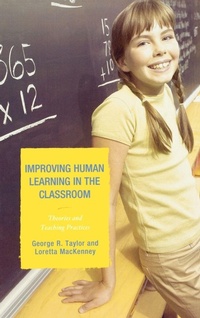
Improving Human Learning in the Classroom
Theories and Teaching Practices
Published on 3. October 2008
Book
Hardback
326 pages
978-1-57886-857-5 (ISBN)
Description
Improving Human Learning in the Classroom provides a functional and realistic approach to facilitate learning through a demonstration of commonalities between the various theories of learning. Designed to assist educators in eliciting students' prior knowledge, providing feedback, transfer of knowledge, and promoting self-assessment, Taylor and MacKenney provide proven strategies for infusing various learning theories into a curriculum, guiding educators to find their own strategies for promoting learning in the classroom.
Both quantitative and qualitative research methods investigate learning theories and reforms in education. Quantitative data sources build the theoretical framework for educating the student, as well as developing strategies for closing the achievement gap. Taylor and MacKenney fuse personal experiences with solid strategies for human learning.
Both quantitative and qualitative research methods investigate learning theories and reforms in education. Quantitative data sources build the theoretical framework for educating the student, as well as developing strategies for closing the achievement gap. Taylor and MacKenney fuse personal experiences with solid strategies for human learning.
Reviews / Votes
Taylor and MacKenney display a detailed knowledge of learning theories and how these theories can be successfully infused into instruction. -- Susan Arisman, Dean, Coppin State University A much needed source for student and teacher learning about strategies and interventions for improving learning that is both intrinsic and extrinsic. -- Theresa L. Harris This book is an excellent and valuable resource for instructors to utilize in their journey to enhance and strengthen their teaching styles as well as improve their students' learning and creativity. -- Sharonda Sharp, Adult Protective Service Investigator for the Howard County Department of Social Services, and adjunct faculty at Howard Communi Improving Human Learning in the Classroom will provide both the undergraduate and graduate student with a theoretical basis of teaching and learning, along with practical suggestions for enhancing learning in the classroom. This bnook is an invaluable tool to improve teaching at any level and should be on every teacher's bookshelf. -- Michael Trumbull, Chair of the Psychology Department at Piles Peak Community College, ColoradoMore details
Language
English
Place of publication
United States
Publishing group
Bloomsbury Publishing Plc
Dimensions
Height: 235 mm
Width: 157 mm
Thickness: 24 mm
Weight
685 gr
ISBN-13
978-1-57886-857-5 (9781578868575)
Copyright in bibliographic data and cover images is held by Nielsen Book Services Limited or by the publishers or by their respective licensors: all rights reserved.
Schweitzer Classification
Other editions
Additional editions
George R. Taylor | Loretta MacKenney
Improving Human Learning in the Classroom
Theories and Teaching Practices
E-Book
10/2008
1st Edition
Rowman & Littlefield Education
€126.09
Available for download
George R. Taylor | Loretta MacKenney
Improving Human Learning in the Classroom
Theories and Teaching Practices
E-Book
10/2008
Bloomsbury eBooks US
€124.99
Available for download
Persons
George R. Taylor is professor and head of the Department of Special Education at Coppin State College and Core Faculty at the Union Institute. Loretta MacKenney retired from teaching at Baltimore County Public Schools after 30 years.
Content
Chapter 1 The Psychology of Human Learning
Chapter 2 Emotions and Human Motivation in Learning
Chapter 3 Bahaviorism and its Impact on Learning Theories
Chapter 4 Ivan Petrovich Pavlov
Chapter 5 Burrhus Frederic Skinner
Chapter 6 Social Learning Theories
Chapter 7 Application of Social Learning Theory
Chapter 8 Cognitive Psychology
Chapter 9 Cognitive Theories of Learning
Chapter 10 Theory of Multiple Intelligences
Chapter 11 Concept Learning
Chapter 12 Critical Thinking and Problem Solving
Chapter 13 Holistic Learning and Education
Chapter 14 Reciprocal Teaching
Chapter 15 Brain-based Learning
Chapter 16 Integrating Learning Styles in the Curriculum
Chapter 17 Strategies for Improving Memory
Chapter 18 Direct Intervention Techniques for Teaching Social Skills
Chapter 19 Integrating Reading into Content Areas
Chapter 20 Summary
Chapter 2 Emotions and Human Motivation in Learning
Chapter 3 Bahaviorism and its Impact on Learning Theories
Chapter 4 Ivan Petrovich Pavlov
Chapter 5 Burrhus Frederic Skinner
Chapter 6 Social Learning Theories
Chapter 7 Application of Social Learning Theory
Chapter 8 Cognitive Psychology
Chapter 9 Cognitive Theories of Learning
Chapter 10 Theory of Multiple Intelligences
Chapter 11 Concept Learning
Chapter 12 Critical Thinking and Problem Solving
Chapter 13 Holistic Learning and Education
Chapter 14 Reciprocal Teaching
Chapter 15 Brain-based Learning
Chapter 16 Integrating Learning Styles in the Curriculum
Chapter 17 Strategies for Improving Memory
Chapter 18 Direct Intervention Techniques for Teaching Social Skills
Chapter 19 Integrating Reading into Content Areas
Chapter 20 Summary