

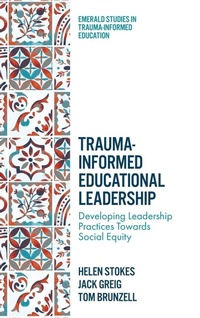
Trauma-Informed Educational Leadership
Developing Leadership Practices Towards Social Equity
Published on 5. November 2025
Book
Hardback
192 pages
978-1-83608-097-8 (ISBN)
Description
Trauma-Informed Educational Leadership, part of the Emerald Studies in Trauma-Informed Education series, is a new development in the field of educational leadership and specifically addresses educational leadership through the lens of trauma- informed educational practice. It is the first research to document work with leaders over time as they undertook the complex work to bring about changing their schools from trauma-impacted to trauma-informed.
The research is drawn from four Australian schools (secondary, primary and special education) in suburban areas that experience high levels of financial and social disadvantage and low levels of educational achievement. The authors research with school leaders has resulted in suggested key leadership practices for implementing trauma-informed strategies, embedded supports for upskilling and supporting staff to sustain trauma-informed education, and incorporating the mindset of a trauma-informed leader working towards student achievement and equity within their communities.
The authors explore how school leaders can support teachers to change their practice in the classroom, how they can move their schools from undertaking professional learning in trauma-informed positive education (TIPE) to then implementing, maintaining and growing a positive trauma-informed culture in their schools and what leadership practices are pivotal to bringing about change.
The research is drawn from four Australian schools (secondary, primary and special education) in suburban areas that experience high levels of financial and social disadvantage and low levels of educational achievement. The authors research with school leaders has resulted in suggested key leadership practices for implementing trauma-informed strategies, embedded supports for upskilling and supporting staff to sustain trauma-informed education, and incorporating the mindset of a trauma-informed leader working towards student achievement and equity within their communities.
The authors explore how school leaders can support teachers to change their practice in the classroom, how they can move their schools from undertaking professional learning in trauma-informed positive education (TIPE) to then implementing, maintaining and growing a positive trauma-informed culture in their schools and what leadership practices are pivotal to bringing about change.
More details
Series
Language
English
Place of publication
Bingley
United Kingdom
Target group
Professional and scholarly
Dimensions
Height: 236 mm
Width: 159 mm
Thickness: 17 mm
Weight
400 gr
ISBN-13
978-1-83608-097-8 (9781836080978)
Copyright in bibliographic data and cover images is held by Nielsen Book Services Limited or by the publishers or by their respective licensors: all rights reserved.
Schweitzer Classification
Persons
Helen Stokes is a Professor of Education at the University of Melbourne, Faculty of Education. Her research explores trauma-informed instructional practices and relational pedagogies with a focus on how schools lead their implementation in low socio-economic communities.
Jack Greig is a Senior Consultant at Berry Street Education Model and a DEd candidate at the University of Melbourne, Faculty of Education. His research explores pathways to social equity and school engagement through trauma-informed pedagogies, culturally responsive practice, and systems-aware school leadership.
Tom Brunzell is Director of Berry Street Education Model (BSEM) and an Honorary Fellow at the University of Melbourne, Faculty of Education. His research explores transforming school culture through pedagogies that integrate evidence of learning, student engagement, and trauma-informed practice.
Jack Greig is a Senior Consultant at Berry Street Education Model and a DEd candidate at the University of Melbourne, Faculty of Education. His research explores pathways to social equity and school engagement through trauma-informed pedagogies, culturally responsive practice, and systems-aware school leadership.
Tom Brunzell is Director of Berry Street Education Model (BSEM) and an Honorary Fellow at the University of Melbourne, Faculty of Education. His research explores transforming school culture through pedagogies that integrate evidence of learning, student engagement, and trauma-informed practice.
Content
Chapter 1. Introduction to Trauma-Informed Educational Leadership
Chapter 2. The Need for Trauma-Informed Educational Leadership
Chapter 3. Key Leadership Practices
Chapter 4. Leading Trauma-Informed Learning and Teaching
Chapter 5. Leading Trauma-Informed Self and Others
Chapter 6. Leading Trauma-Informed Management of the School
Chapter 7. Leading Trauma-Informed Community Engagement
Chapter 8. Leading Trauma-Informed Improvement, Innovation, and Change
Chapter 9. Developing a Model of Trauma-Informed Educational Leadership (TIEL)
Chapter 2. The Need for Trauma-Informed Educational Leadership
Chapter 3. Key Leadership Practices
Chapter 4. Leading Trauma-Informed Learning and Teaching
Chapter 5. Leading Trauma-Informed Self and Others
Chapter 6. Leading Trauma-Informed Management of the School
Chapter 7. Leading Trauma-Informed Community Engagement
Chapter 8. Leading Trauma-Informed Improvement, Innovation, and Change
Chapter 9. Developing a Model of Trauma-Informed Educational Leadership (TIEL)