

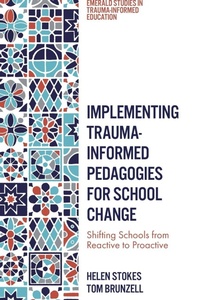
Implementing Trauma-Informed Pedagogies for School Change
Shifting Schools from Reactive to Proactive
Published on 18. May 2026
Book
Paperback/Softback
112 pages
978-1-83797-003-2 (ISBN)
Description
The area of trauma-informed positive education (TIPE) is a recently emerging field in educational studies. Schools serving communities contending with educational inequity have many students identified as trauma-affected, with significant unmet learning and social emotional needs.
This groundbreaking study and first book in the Emerald Studies in Trauma-Informed Education series is the first longitudinal research in trauma informed positive education, and the first research to link the professional learning and ongoing implementation of TIPE pedagogical practices to changed student perceptions of school and collective teacher efficacy over a four-year period.
Providing examples of how schools implement TIPE and using case studies from two schools that were experiencing difficulty with their delivery of learning and wellbeing outcomes for students, the authors explore how implementing TIPE pedagogical practices can bring about school change. There is a focus on student wellbeing, collective teacher efficacy and assisting students to be ready to learn. The case studies that are explored will be of interest to school practitioners and system leaders working with students who are are not yet ready to learn and disengaged from school.
This groundbreaking study and first book in the Emerald Studies in Trauma-Informed Education series is the first longitudinal research in trauma informed positive education, and the first research to link the professional learning and ongoing implementation of TIPE pedagogical practices to changed student perceptions of school and collective teacher efficacy over a four-year period.
Providing examples of how schools implement TIPE and using case studies from two schools that were experiencing difficulty with their delivery of learning and wellbeing outcomes for students, the authors explore how implementing TIPE pedagogical practices can bring about school change. There is a focus on student wellbeing, collective teacher efficacy and assisting students to be ready to learn. The case studies that are explored will be of interest to school practitioners and system leaders working with students who are are not yet ready to learn and disengaged from school.
More details
Series
Language
English
Place of publication
Bingley
United Kingdom
Target group
Professional and scholarly
Dimensions
Height: 228 mm
Width: 150 mm
Thickness: 11 mm
Weight
176 gr
ISBN-13
978-1-83797-003-2 (9781837970032)
Copyright in bibliographic data and cover images is held by Nielsen Book Services Limited or by the publishers or by their respective licensors: all rights reserved.
Schweitzer Classification
Persons
Helen Stokes is a Professor of Education at the University of Melbourne, Faculty of Education, Australia. Her research interests include trauma-informed instructional practices and relational pedagogies with a focus on how schools lead their implementation in low socio-economic communities.
Tom Brunzell is the Director of Education at Berry Street Victoria and an Honorary Fellow at the University of Melbourne, Faculty of Education, Australia. In his research he investigates trauma-informed and wellbeing pedagogies as schools work towards educational equity in their communities.
Tom Brunzell is the Director of Education at Berry Street Victoria and an Honorary Fellow at the University of Melbourne, Faculty of Education, Australia. In his research he investigates trauma-informed and wellbeing pedagogies as schools work towards educational equity in their communities.
Content
Chapter 1. Introduction to Trauma-Informed Education
Chapter 2. Intervention with Trauma-Informed Positive Education (TIPE)
Chapter 3. Case Study 1: Garron Secondary College
Chapter 4. Case Study 2: Wiyal Primary School
Chapter 5. Two Schools Working Together in a Community-Wide Approach
Conclusion
Chapter 2. Intervention with Trauma-Informed Positive Education (TIPE)
Chapter 3. Case Study 1: Garron Secondary College
Chapter 4. Case Study 2: Wiyal Primary School
Chapter 5. Two Schools Working Together in a Community-Wide Approach
Conclusion