

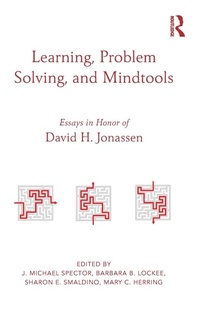
Learning, Problem Solving, and Mindtools
Essays in Honor of David H. Jonassen
1st Edition
Published on 27. March 2013
Book
Hardback
336 pages
978-0-415-52435-3 (ISBN)
Description
Learning, Problem Solving, and Mindtools is inspired by the substantial body of learning research by David H. Jonassen in the areas of mind tools and problem solving. The focus of the volume is on educational technology, especially with regard to how new technologies have facilitated and supported problem solving and critical thinking. Each chapter focuses on a particular aspect of learning with technology and elaborates the implications for the design and implementation of learning environments and activities aimed at improving the conceptualization of problems, reasoning and higher-order thinking, and solving challenging problems.
This collection of scholarly essays provides a highly engaging treatment of using tools and technologies to improve problem solving; multiple perspectives on integrating educational technology to support learning in complex and challenging problem solving domains; guidance for the design of instruction to support problem solving; a systemic account of the relationships between mental models, instructional models, and assessment models; and a look into the future of educational technology research and practice.
This collection of scholarly essays provides a highly engaging treatment of using tools and technologies to improve problem solving; multiple perspectives on integrating educational technology to support learning in complex and challenging problem solving domains; guidance for the design of instruction to support problem solving; a systemic account of the relationships between mental models, instructional models, and assessment models; and a look into the future of educational technology research and practice.
More details
Language
English
Place of publication
London
United Kingdom
Publishing group
Taylor & Francis Ltd
Target group
College/higher education
Illustrations
20 s/w Tabellen
20 Tables, black and white
Dimensions
Height: 235 mm
Width: 157 mm
Thickness: 23 mm
Weight
638 gr
ISBN-13
978-0-415-52435-3 (9780415524353)
Copyright in bibliographic data and cover images is held by Nielsen Book Services Limited or by the publishers or by their respective licensors: all rights reserved.
Schweitzer Classification
Other editions
Additional editions
J. Michael Spector | Barbara B. Lockee | Sharon Smaldino
Learning, Problem Solving, and Mindtools
Essays in Honor of David H. Jonassen
Book
12/2014
1st Edition
Routledge
€83.20
Shipment within 15-20 days
J. Michael Spector | Barbara B. Lockee | Sharon Smaldino
Learning, Problem Solving, and Mindtools
Essays in Honor of David H. Jonassen
E-Book
04/2013
1st Edition
Routledge
€76.49
Available for download
J. Michael Spector | Barbara B. Lockee | Sharon Smaldino
Learning, Problem Solving, and Mindtools
Essays in Honor of David H. Jonassen
E-Book
04/2013
1st Edition
Routledge
€76.49
Available for download
Persons
J. Michael Spector is Professor and Chair of the Department of Learning Technologies at the University of North Texas, USA.
Barbara B. Lockee is Professor of Education and Associate Director of the School of Education at Virginia Polytechnic and State University, USA.
Sharon E. Smaldino is the L.D. and Ruth Morgridge Endowed Chair for Teacher Education at Northern Illinois University, USA.
Mary C. Herring is the Associate Dean of the College of Education at the University of Northern Iowa, USA.
All four co-editors of this volume are Past Presidents of the Association of Educational Communications and Technology (AECT; see http://www.aect.org), which has supported and facilitated this effort.
Barbara B. Lockee is Professor of Education and Associate Director of the School of Education at Virginia Polytechnic and State University, USA.
Sharon E. Smaldino is the L.D. and Ruth Morgridge Endowed Chair for Teacher Education at Northern Illinois University, USA.
Mary C. Herring is the Associate Dean of the College of Education at the University of Northern Iowa, USA.
All four co-editors of this volume are Past Presidents of the Association of Educational Communications and Technology (AECT; see http://www.aect.org), which has supported and facilitated this effort.
Content
Table of Contents
Dedication
Acknowledgements
Preface
Part 1 (J. M. Spector)
Chapter 1: Introducing mindtools and problem solving (J. M. Spector, B. B. Lockee, S. E. Smaldino, & M. C. Herring)
Chapter 2: Mental models and their role in learning by insight and creative problem solving (N. M. Seel, D. Ifenthaler, P. Pirnay-Dummer)
Chapter 3: A practice-centered approach to instructional design (B. Wilson)
Chapter 4: Experiential learning and cognitive tools: The impact of simulations on conceptual change in continuing healthcare education (T. Reeves)
Part 2 (Barbara B. Lockee)
Chapter 5: Simulations, games and virtual worlds as mindtools (S. J. Warren & J. S. Wakefield)
Chapter 6: Mindtools for teachers: Do you know the way to ... Web 2.0? (P. A. Kirschner & I. G. J. H. Wopereis)
Chapter 7: Virtual gaming and leaving environments as "experience"-tools for learning through problem solving (J. M. Laffey, M. Schmidt, & K. Galyen)
Chapter 8: Comprehension using the strategic organization of text aided by a Web-based intelligent tutoring system: A text- and computer-based mindtool (K. Wijekumar & B. J. F. Meyer)
Chapter 9: Alternative pathways for research and instructional design on technology-supported group problem solving (S-C. Tan)
Part 3 (Sharon E. Smaldino)
Chapter 10: Reconsidering epistemology, learning and design (M. J. Hannafin)
Chapter 11: Conceptualizing problems in problem-based learning: Its role and cognitive tools (W. Hung)
Chapter 12: Problem solving for conceptual change (C. B. Lee & K. Murcia)
Chapter 13: Mobile technologies as mindtools for augmenting observations and reflection in everyday environments (S. M. Land, B. K. Smith, & H. T. Zimmerman)
Chapter 14: Mindtools for augmentation and their role in promoting ill-structured problem solving (B. Belland)
Part 4 (Mary C. Herring)
Chapter 15: A compendium of taxonomies (A. Tristan)
Chapter 16: Mindtools in online education: Enabling meaningful learning (R. Marra)
Chapter 17: First principles of learning (D. H. Jonassen)
Glossary
Index
Dedication
Acknowledgements
Preface
Part 1 (J. M. Spector)
Chapter 1: Introducing mindtools and problem solving (J. M. Spector, B. B. Lockee, S. E. Smaldino, & M. C. Herring)
Chapter 2: Mental models and their role in learning by insight and creative problem solving (N. M. Seel, D. Ifenthaler, P. Pirnay-Dummer)
Chapter 3: A practice-centered approach to instructional design (B. Wilson)
Chapter 4: Experiential learning and cognitive tools: The impact of simulations on conceptual change in continuing healthcare education (T. Reeves)
Part 2 (Barbara B. Lockee)
Chapter 5: Simulations, games and virtual worlds as mindtools (S. J. Warren & J. S. Wakefield)
Chapter 6: Mindtools for teachers: Do you know the way to ... Web 2.0? (P. A. Kirschner & I. G. J. H. Wopereis)
Chapter 7: Virtual gaming and leaving environments as "experience"-tools for learning through problem solving (J. M. Laffey, M. Schmidt, & K. Galyen)
Chapter 8: Comprehension using the strategic organization of text aided by a Web-based intelligent tutoring system: A text- and computer-based mindtool (K. Wijekumar & B. J. F. Meyer)
Chapter 9: Alternative pathways for research and instructional design on technology-supported group problem solving (S-C. Tan)
Part 3 (Sharon E. Smaldino)
Chapter 10: Reconsidering epistemology, learning and design (M. J. Hannafin)
Chapter 11: Conceptualizing problems in problem-based learning: Its role and cognitive tools (W. Hung)
Chapter 12: Problem solving for conceptual change (C. B. Lee & K. Murcia)
Chapter 13: Mobile technologies as mindtools for augmenting observations and reflection in everyday environments (S. M. Land, B. K. Smith, & H. T. Zimmerman)
Chapter 14: Mindtools for augmentation and their role in promoting ill-structured problem solving (B. Belland)
Part 4 (Mary C. Herring)
Chapter 15: A compendium of taxonomies (A. Tristan)
Chapter 16: Mindtools in online education: Enabling meaningful learning (R. Marra)
Chapter 17: First principles of learning (D. H. Jonassen)
Glossary
Index