

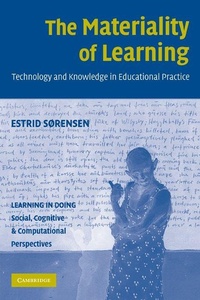
The Materiality of Learning
Technology and Knowledge in Educational Practice
Published on 17. February 2011
Book
Paperback/Softback
226 pages
978-0-521-18271-3 (ISBN)
Description
The field of educational research lacks a methodology for the study of learning that does not begin with humans, their aims, and their interests. The Materiality of Learning seeks to overcome this human-centered mentality by developing a novel spatial approach to the materiality of learning. Drawing on science and technology studies (STS), Estrid Sorensen compares an Internet-based 3D virtual environment project in a fourth-grade class with the class's work with traditional learning materials, including blackboards, textbooks, notebooks, pencils, and rulers. Taking into account pupils' and teachers' physical bodies, Professor Sorensen analyzes the multiple forms of technology, knowledge, and presence that are enacted with the materials. Featuring detailed ethnographic descriptions and useful end-of-chapter summaries, this book is an important reference for professionals and graduate or postgraduate students interested in a variety of fields, including educational studies, educational psychology, social anthropology, and STS.
Reviews / Votes
"Estrid Sorensen offers a deeply fascinating, new look on learning. She shows us how blackboards and notebooks, pencils and rulers, bodies and tables, PCs and virtual environments are profoundly implicated in learning processes in an ordinary classroom and an internet-based 3D virtual environment project in a fourth-grade class. Her introduction of science and technology studies into research on education inspires us to re-imagine and rearrange educational practices at a time when we are struggling with integrating new technologies in our schools."-Ole Dreier, University of Copenhagen "Indeed a pathbreaking book on the conception of learning. For the reflective teacher it is a gold mine of inspiration for what to do to improve teaching and education. And for those who hold views on learning in resonance with the ones outlined in the book - e.g. cultural-historical activity theory, sociocultural perspectives, situated learning approaches - it is thought provoking and a challenge on how to get a grip of what we have only begun to explore: the socio-material activities that make up learning."
-Berthel Sutter, Blekinge Institute of Technology "The Materiality of Learning presents a refreshing and insightful account of technology in schools. Sorensen gives a rich empirical description of how several kinds of technology - from virtual worlds and blogs to more traditional educational tools - helped constitute activity in a fourth grade classroom. She uses her empirical case to push forward an important set of cross-disciplinary issues, illustrating how learning is spread across systems of people and objects and demonstrating the power of objects as equal participants in cognitive activity. The book will be useful to scholars across anthropology, psychology, and educational research, who can use a clear but complex empirical case of technology in the classroom that skillfully uses theoretical innovations from science and technology studies to analyze classroom learning as a material process."
-Stanton Wortham, University of Pennsylvania
More details
Series
Language
English
Place of publication
Cambridge
United Kingdom
Target group
Professional and scholarly
Product notice
Paperback (trade)
Illustrations
Worked examples or Exercises
Dimensions
Height: 229 mm
Width: 152 mm
Thickness: 13 mm
Weight
335 gr
ISBN-13
978-0-521-18271-3 (9780521182713)
Copyright in bibliographic data and cover images is held by Nielsen Book Services Limited or by the publishers or by their respective licensors: all rights reserved.
Schweitzer Classification
Other editions
Additional editions
Book
04/2009
Cambridge University Press
€96.00
Shipment within 15-20 days
E-Book
04/2009
1st Edition
Cambridge University Press
€26.49
Available for download
Person
Content
1. Introduction: a minimal methodology; 2. Components and opponents: designing the Femtedit Network; 3. Forms of technology; 4. Forms of knowledge; 5. Forms of presence; 6. Conclusion: the materiality of learning.