

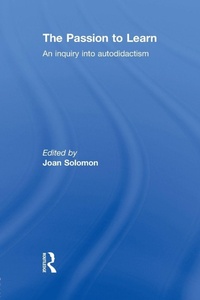
The Passion to Learn
An Inquiry into Autodidactism
1st Edition
Published on 23. December 2014
Book
Paperback/Softback
240 pages
978-1-138-86639-3 (ISBN)
Description
This is the first book to provide a detailed overview and analysis of autodidactism, or self-education. Autodidacts' strong preference for teaching themselves is likely to manifest itself, in childhood, as a pronounced resistance to formal schooling. However, in later life, an autodidact's passion for learning will emerge as they participate in open or distance learning or even take responsibility for devising, structuring and following their own programme of education.
Beginning and ending with comprehensive and stimulating discussions of learning theories, The Passion to Learn includes fourteen case studies of autodidactism in informal learning situations, all written by authors with specialised knowledge. These wide-ranging case studies reflect the inherent diversity of autodidactism, yet four common themes emerge: emotional/cognitive balance; learning environment; life mission; and ownership of learning. The final chapter addresses the implications of autodidactism for educational theory, research, philosophy and psychology.
This inquiry into autodidactism provides fresh insight into the motivation to learn. It shows how closely cognition, emotion and sensory perception act together in learning processes and draws upon memory studies, neurobiology, complexity theory and philosophy to illuminate the findings. At a time when such issues as participation in education, lifelong learning and alternative, non-formal modes of teaching and learning are in the forefront of international educational discourse, this fascinating, inspiring and timely book will be of great interest to anyone involved in the practice or policy of teaching and learning.
Beginning and ending with comprehensive and stimulating discussions of learning theories, The Passion to Learn includes fourteen case studies of autodidactism in informal learning situations, all written by authors with specialised knowledge. These wide-ranging case studies reflect the inherent diversity of autodidactism, yet four common themes emerge: emotional/cognitive balance; learning environment; life mission; and ownership of learning. The final chapter addresses the implications of autodidactism for educational theory, research, philosophy and psychology.
This inquiry into autodidactism provides fresh insight into the motivation to learn. It shows how closely cognition, emotion and sensory perception act together in learning processes and draws upon memory studies, neurobiology, complexity theory and philosophy to illuminate the findings. At a time when such issues as participation in education, lifelong learning and alternative, non-formal modes of teaching and learning are in the forefront of international educational discourse, this fascinating, inspiring and timely book will be of great interest to anyone involved in the practice or policy of teaching and learning.
Reviews / Votes
'Solomon has performed a valuable service.' - John Vorhaus, University of LondonMore details
Language
English
Place of publication
London
United Kingdom
Publishing group
Taylor & Francis Ltd
Target group
College/higher education
Illustrations
9 s/w Tabellen
9 Tables, black and white
Dimensions
Height: 234 mm
Width: 156 mm
Thickness: 13 mm
Weight
365 gr
ISBN-13
978-1-138-86639-3 (9781138866393)
Copyright in bibliographic data and cover images is held by Nielsen Book Services Limited or by the publishers or by their respective licensors: all rights reserved.
Schweitzer Classification
Other editions
Additional editions
E-Book
09/2003
Routledge
€76.49
Available for download
E-Book
09/2003
Routledge
€76.49
Available for download
Book
08/2003
Routledge
€231.60
Shipment within 15-20 days
Person
Joan Solomon is Senior Research Fellow and Visting Professor at the Open University, Kings College London and the University of Plymouth.
Content
Introduction J. Solomon 1. Theories of Learning and the Range of Autodidactism J. Solomon 2. Are Autodidacts Creative? M. Boden 3. Children in an Interactive Science Centre H. Brooke & J. Solomon 4. Do Autodidacts Have EBD? P. Howard 5. Hom Ludens R. Hodgkin 6. Learning to be a Genetic Counsellor: Patterns of Life-world Knowledge V. Leyser da Rosa & J. Solomon 7. Autodidactism in the Workplace R. Edwards 8. Teachers' Professional Knowledge S. Lunn 9. The Scientist as Autodidact J. Ziman 10. The Autodidactic Museum in France and Other Countries P. Caro 11. The Useful Arts T. Hunkin 12. Indian Market Women and their Mathematics A. Rampal 13. How Does Resource-based Learning Help the Self Directed Learner? E. Scanlon 14. Learning Through Project Work at the University A. Paulsen 15. A Long Life of Learning J. Diamond 16. Common Features J. Solomon 17. Useful Theories, Great and Small J. Solomon Epilogue: Implications for Education J. Solomon