

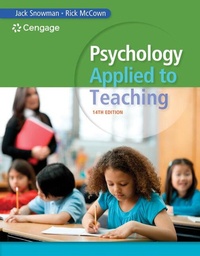
Psychology Applied to Teaching
14th Edition
Published on 24. February 2014
Book
Paperback/Softback
688 pages
978-1-285-73455-2 (ISBN)
Description
This book has received wide acclaim for its practical and reader-friendly approach to educational psychology, which demonstrates how complex psychological theories apply to the everyday experiences of in-service teachers. Coverage of educational psychology is framed so that aspiring or developing teachers can see themselves as professionals who continuously seek, find, and test better ways to help their students succeed. PSYCHOLOGY APPLIED TO TEACHING, 14th Edition, combines fresh concepts and contemporary research with long-standing theory and applications to create a book that addresses the needs of today's teachers and students. This edition also features integration of InTASC Standards, new Learning Objectives correlated with chapter headings and summaries, new Guides to Reading and Studying, new first-person accounts (Improving Practice through Inquiry: One Teacher's Story), and more.
More details
Edition
14th edition
Language
English
Place of publication
Belmont, CA
United States
Publishing group
Cengage Learning, Inc
Target group
College/higher education
Product notice
Paperback (trade)
Unsewn / adhesive bound
Dimensions
Height: 275 mm
Width: 220 mm
Thickness: 43 mm
Weight
1471 gr
ISBN-13
978-1-285-73455-2 (9781285734552)
Copyright in bibliographic data and cover images is held by Nielsen Book Services Limited or by the publishers or by their respective licensors: all rights reserved.
Schweitzer Classification
Other editions
New editions
Jack Snowman | Rick McCown | Amy Olson
Psychology Applied to Teaching
Book
approx. 05/2026
15th Edition
Wadsworth Publishing Co Inc
€157.22
Not yet published
Persons
Jack Snowman is professor emeritus in the School of Education at Southern Illinois University. He has a master's degree in school psychology from Miami University (Ohio) and a Ph.D. from Indiana University in educational psychology. He taught courses in human learning, memory and theories of intelligence. He began his professional career as a school psychologist in Ohio and New Jersey. Since 1982, he has either been a co-author or sole author of "Psychology Applied to Teaching." He was included in the 1989-1990 edition of "Who's Who in American Education." Over the book's many editions, he has striven to have it reflect current research findings and to maintain the book's unique feature -- providing useful suggestions for how research findings could be used to improve classroom instruction. Rick McCown is professor emeritus in the School of Education at Duquesne University, PA. He has won a number of teaching awards, including election to the Pennsylvania Society for Scholar-Teachers, his University's highest teaching awards, the Presidential Award for Excellence in Teaching and citation from the American Educational Research Association. He is a former Senior Improvement Fellow with the Carnegie Project on the Education Doctorate and has conducted improvement inquiry with numerous schools and community-based educational organizations ranging from government agencies to foundations to collective action networks collaborating with formerly incarcerated citizens and their families in pursuit of restorative justice.
Content
1. Applying Psychology to Teaching.
Part I: DEVELOPMENTAL CHARACTERISTICS AND THEORIES.
2. Theories of Psychosocial and Cognitive Development.
3. Age-Level Characteristics.
Part II: STUDENT DIFFERENCES AND DIVERSITY.
4. Understanding Student Differences.
5. Addressing Cultural and Socioeconomic Diversity.
6. Accommodating Student Variability.
Part III: LEARNING AND THINKING.
7. Behavioral Learning Theory: Operant Conditioning.
8. Information-Processing Theory.
9. Social Cognitive Theory.
10. Constructivist Learning Theory, Problem Solving, and Transfer.
Part IV: CREATING A POSITIVE ENVIRONMENT FOR LEARNING AND TEACHING.
11. Motivation and Perceptions of Self.
12. Classroom Management.
13. Approaches to Instruction.
Part V: ASSESSING STUDENTS' CAPABILITIES.
14. Assessment of Classroom Learning.
15. Understanding Standardized Assessment.
16. Becoming a Better Teacher by Becoming a Reflective Teacher.
Part I: DEVELOPMENTAL CHARACTERISTICS AND THEORIES.
2. Theories of Psychosocial and Cognitive Development.
3. Age-Level Characteristics.
Part II: STUDENT DIFFERENCES AND DIVERSITY.
4. Understanding Student Differences.
5. Addressing Cultural and Socioeconomic Diversity.
6. Accommodating Student Variability.
Part III: LEARNING AND THINKING.
7. Behavioral Learning Theory: Operant Conditioning.
8. Information-Processing Theory.
9. Social Cognitive Theory.
10. Constructivist Learning Theory, Problem Solving, and Transfer.
Part IV: CREATING A POSITIVE ENVIRONMENT FOR LEARNING AND TEACHING.
11. Motivation and Perceptions of Self.
12. Classroom Management.
13. Approaches to Instruction.
Part V: ASSESSING STUDENTS' CAPABILITIES.
14. Assessment of Classroom Learning.
15. Understanding Standardized Assessment.
16. Becoming a Better Teacher by Becoming a Reflective Teacher.