

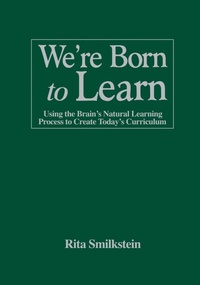
We're Born to Learn
Using the Brain's Natural Learning Process to Create Today's Curriculum
2nd Edition
Published on 4. May 2011
Book
Paperback/Softback
272 pages
978-1-4129-7938-2 (ISBN)
Description
"Applying the natural human learning process described in the book transformed my students' ability to learn. No teacher, new or experienced, should enter any classroom without a copy of this book."
-Patricia Jamie Lee, Educational Consultant
Many Kites Press, St. Paul, MN
Teach students to take responsibility for their own success!
This updated edition of the bestselling book on the brain's natural learning process brings new research results and applications in a power-packed teacher tool kit. Rita Smilkstein shows teachers how to create and deliver curricula that help students become the motivated, successful, and natural learners they were born to be. Updated features include:
Guidelines for using the six-step Natural Human Learning Process (NHLP) for lesson planning and test preparation
New information on how technology and Internet research affect student learning
Practical methods for giving all students the tools they need to achieve
The author translates her unique research on students' critical and creative thinking into classroom strategies and sample lesson plans that will help to create a successful learning environment. Building on the content that earned the author an Educator's Award of the Year from the Delta Kappa Gamma International Society, We're Born to Learn provides teachers with practical methods for giving all students the metacognitive, motivational, and technological tools they need to take responsibility for their own achievement.
-Patricia Jamie Lee, Educational Consultant
Many Kites Press, St. Paul, MN
Teach students to take responsibility for their own success!
This updated edition of the bestselling book on the brain's natural learning process brings new research results and applications in a power-packed teacher tool kit. Rita Smilkstein shows teachers how to create and deliver curricula that help students become the motivated, successful, and natural learners they were born to be. Updated features include:
Guidelines for using the six-step Natural Human Learning Process (NHLP) for lesson planning and test preparation
New information on how technology and Internet research affect student learning
Practical methods for giving all students the tools they need to achieve
The author translates her unique research on students' critical and creative thinking into classroom strategies and sample lesson plans that will help to create a successful learning environment. Building on the content that earned the author an Educator's Award of the Year from the Delta Kappa Gamma International Society, We're Born to Learn provides teachers with practical methods for giving all students the metacognitive, motivational, and technological tools they need to take responsibility for their own achievement.
Reviews / Votes
"I encountered Rita Smilkstein's work as I struggled with teaching entry level students on an Indian Reservation. The natural human learning process described in the book transformed my experience. My students were engaged, attending classes, and reprogramming their past from the frame of 'failure' to the frame of 'born to learn.' No teacher, new or experienced, should enter any class without a copy of this book." -- Patricia Jamie Lee, Educational Consultant "Dr. Rita Smilkstein has inspired thousands of students and educators with her practical application of the Natural Human Learning Process. This new edition brings us up-to-date, and maintains the clarity and generosity of spirit that is Smilkstein's trademark. Her enthusiasm rekindles the joy of learning that is hard-wired in all of us. If you read one book this year, make it We're Born to Learn, then put it into action." -- Laura Symons, Assistant Professor "We're Born to Learn is one of the most valuable instructional tools teachers will ever use. Knowing 'how' students learn should be absolutely mandatory, yet is rarely taught in college prep. All teachers believe that they are teaching, but few know how students actually learn, and don't consider how the brain processes new information while developing their lesson plans. Dr. Smilkstein likens the learning brain to twigs on a tree; the twigs grow from a branch that is already there (prior knowledge). After reading this book, the most treasured seven words in every classroom will be, 'See if you can figure this out.'" -- Dr. Deborah Daiek, Associate Dean "Dr. Rita Smilkstein offers a prescription for what ails our developmental students: lack of critical thinking, lack of understanding of the learning process, etc. While the previous edition is a must read, this latest edition is teaching and learning's pharmacology textbook...a collector's item for developmental education." -- Reneau Waggoner, Associate Professor "This book is a must read for anyone with ADHD or ADD students who are drowning in the public education system. The author presents recent research that opens the door for teachers to immediately create an environment conducive to helping these students learn." -- Karen J. Sides, Dean of Interdisciplinary Programs "Packs in in practical methods for achievement and is a top pick for any education collection." -- James A. Cox, Editor-in-ChiefMore details
Edition
2nd Revised edition
Language
English
Place of publication
Thousand Oaks
United States
Publishing group
SAGE Publications Inc
Target group
Professional and scholarly
Edition type
Revised edition
Dimensions
Height: 254 mm
Width: 178 mm
Thickness: 15 mm
Weight
518 gr
ISBN-13
978-1-4129-7938-2 (9781412979382)
Copyright in bibliographic data and cover images is held by Nielsen Book Services Limited or by the publishers or by their respective licensors: all rights reserved.
Schweitzer Classification
Other editions
Previous edition
Rita Smilkstein
We're Born to Learn
Using the Brain's Natural Learning Process to Create Today's Curriculum
Book
02/2003
1st Edition
Corwin Press Inc
€52.18
Article exhausted; check for reprint
Person
Dr. Smilkstein speaks nationally and internationally on brain-compatible education. She has taught in middle school through graduate school including 28 years at North Seattle Community College. Currently Professor Emerita North Seattle Community College and invited faculty in Educational Psychology at Western Washington University's Woodring College of Education, Everett Campus. Publications include articles and books on brain-based curriculum and pedagogy. Author of We're Born to Learn: Using the Brain's Natural Learning Process to Create Curriculum (Corwin Press, 2003), which won the Delta Kappa Gamma International Society's Educator's Award of the Year, 2004; the second edition will be published in 2011. She is a co-author of Igniting Student Potential Using the Natural Human Learning Process (Corwin Press, 2007). M.A. (English, Michigan State University), Ph.D. (Educational Psychology, University of Washington). She has received many teaching awards, including the National Institute for Staff and Organizational Development's Excellence Award, 1991, 1995; the College Reading and Learning Association's highest honor, the Robert Griffin Award, 2005; Induction as a Fellow of the American Council of Developmental Education Associations, 2006, the highest honor in the field of Developmental Education.
Content
Foreword by James H. Berry
Preface
Acknowledgments
About the Author
Introduction
What This Book Is About
Why Study the Brain?
Experienced Educators and the Research
The Learning Paradigm
Assumptions
Where We Have Been
Where We Are Today
This Book
PART I: Research in the Classroom and in the Brain Lab
1. Learning and Teaching
Eye-Opening Experiences in the Classroom
The Natural Human Learning Process and Brain Research
The Breakthrough Classroom
The Research-Based Stages, Curriculum, and Lesson Plans
2. How People Learn: The Natural Human Learning Process (NHLP)
Critical and Creative Thinking by Infants and Children
An Example of Children's Critical and Creative Thinking
Critical and Creative Thinking in School
The Natural Human Learning Process and School
The Natural Human Learning Process (NHLP) Research
After the Research Is Over
Research Reports
The Importance of Making Mistakes
Where We Go From Here
3. How the Brain Learns: The Brain's Natural Learning Process
Introducing the Brain
Getting to Know the Brain
How the Brain Learns
Convergence of Ceiling Levels and Neural Networks
Pruning
Experience and Brain Growth
Constructivism
How the Brain Thinks and Remembers
The Brain's Innate Resources and Rules
Children's Brains and Adults' Brains
The Brain Grows Holistically with Plasticity
Implications for Curriculum Development
What About Piaget?
The Breakthrough Theory of Learning
4. Personal Experience, Individual Differences, and Learning
Emotions and the Brain
Negative and Positive Self-Image Networks
Learning from Experience
Learning Styles, Preferences, and Multiple Intelligences
Gifted Students
Aptitudes
Special Needs, Learning Differences, Autism, ADD, and ADHD
The Seven Magic Words: See If You Can Figure It Out
Tests
Beyond Individual Differences
A Handout for Students
5. The Student's Experience: Metacognition, Motivation, Self-Evaluation, Achievement, and Technology Self Taught
Metacognition and Motivation
Intrinsic Rewards
Removing the Barriers
Self-Evaluation and Metacognition
Another Metacognitive Experience
Achievement
Writing Samples
Age and Achievement
Technology Self Taught
PART II: Theory and Application
6. Sequencing of the Curriculum
Challenges
The Missing Link
Two Problems
Neuroscience and Education
Converging Research
The Theory and Guide
Putting the Theory into Practice
Thinking at Higher Levels
Constructing New Knowledge
Planning the Sequence of the Units or Topics in a Curriculum
Using a Causal Sequence
Learning Activities for Units and Topics
The First Activity
Two Classroom Examples
Students and the NHLP
Developing a Curriculum
Young Students Thinking at a High Level
The NHLP in the Classroom
7. The Pedagogical Model and Guidelines
Transfer
Four Effective Instructional Practices
NHLP Pedagogical Guidelines
Assessment
Education Courses or Faculty Development Programs
Good News
PART III: Using the Brain's Natural Learning Process to Create Curriculum
8. Brain-Based, Natural Learning Across the Curriculum
The Seven Magic Words in Action
Safety
Respect
The Opportunity to Learn Naturally
The Critical First Stages
The Introduction-to-Poetry Unit
Front Loading
A Science Learning Activity about the Concept of Buoyancy
A Unit for Library Orientation
A Unit for Introduction to Safety Procedures
A Science Learning Activity about Water
A Unit for Learning How to Take Lecture Notes
The NHLP Planning Guidelines and Pedagogy
9. Curriculum Development for Units, Courses, and Programs
Where to Start
Curriculum Development Guidelines
A Unit on Literal and Inferential Meaning
A Unit on an Introduction to Egypt
A Unit on an Introduction to Fractions
A Basic Grammar Curriculum: A Sequence of Units for a Whole Course
A Developmental English Curriculum: Courses in a Program
References
General Bibliography
Index
Preface
Acknowledgments
About the Author
Introduction
What This Book Is About
Why Study the Brain?
Experienced Educators and the Research
The Learning Paradigm
Assumptions
Where We Have Been
Where We Are Today
This Book
PART I: Research in the Classroom and in the Brain Lab
1. Learning and Teaching
Eye-Opening Experiences in the Classroom
The Natural Human Learning Process and Brain Research
The Breakthrough Classroom
The Research-Based Stages, Curriculum, and Lesson Plans
2. How People Learn: The Natural Human Learning Process (NHLP)
Critical and Creative Thinking by Infants and Children
An Example of Children's Critical and Creative Thinking
Critical and Creative Thinking in School
The Natural Human Learning Process and School
The Natural Human Learning Process (NHLP) Research
After the Research Is Over
Research Reports
The Importance of Making Mistakes
Where We Go From Here
3. How the Brain Learns: The Brain's Natural Learning Process
Introducing the Brain
Getting to Know the Brain
How the Brain Learns
Convergence of Ceiling Levels and Neural Networks
Pruning
Experience and Brain Growth
Constructivism
How the Brain Thinks and Remembers
The Brain's Innate Resources and Rules
Children's Brains and Adults' Brains
The Brain Grows Holistically with Plasticity
Implications for Curriculum Development
What About Piaget?
The Breakthrough Theory of Learning
4. Personal Experience, Individual Differences, and Learning
Emotions and the Brain
Negative and Positive Self-Image Networks
Learning from Experience
Learning Styles, Preferences, and Multiple Intelligences
Gifted Students
Aptitudes
Special Needs, Learning Differences, Autism, ADD, and ADHD
The Seven Magic Words: See If You Can Figure It Out
Tests
Beyond Individual Differences
A Handout for Students
5. The Student's Experience: Metacognition, Motivation, Self-Evaluation, Achievement, and Technology Self Taught
Metacognition and Motivation
Intrinsic Rewards
Removing the Barriers
Self-Evaluation and Metacognition
Another Metacognitive Experience
Achievement
Writing Samples
Age and Achievement
Technology Self Taught
PART II: Theory and Application
6. Sequencing of the Curriculum
Challenges
The Missing Link
Two Problems
Neuroscience and Education
Converging Research
The Theory and Guide
Putting the Theory into Practice
Thinking at Higher Levels
Constructing New Knowledge
Planning the Sequence of the Units or Topics in a Curriculum
Using a Causal Sequence
Learning Activities for Units and Topics
The First Activity
Two Classroom Examples
Students and the NHLP
Developing a Curriculum
Young Students Thinking at a High Level
The NHLP in the Classroom
7. The Pedagogical Model and Guidelines
Transfer
Four Effective Instructional Practices
NHLP Pedagogical Guidelines
Assessment
Education Courses or Faculty Development Programs
Good News
PART III: Using the Brain's Natural Learning Process to Create Curriculum
8. Brain-Based, Natural Learning Across the Curriculum
The Seven Magic Words in Action
Safety
Respect
The Opportunity to Learn Naturally
The Critical First Stages
The Introduction-to-Poetry Unit
Front Loading
A Science Learning Activity about the Concept of Buoyancy
A Unit for Library Orientation
A Unit for Introduction to Safety Procedures
A Science Learning Activity about Water
A Unit for Learning How to Take Lecture Notes
The NHLP Planning Guidelines and Pedagogy
9. Curriculum Development for Units, Courses, and Programs
Where to Start
Curriculum Development Guidelines
A Unit on Literal and Inferential Meaning
A Unit on an Introduction to Egypt
A Unit on an Introduction to Fractions
A Basic Grammar Curriculum: A Sequence of Units for a Whole Course
A Developmental English Curriculum: Courses in a Program
References
General Bibliography
Index