

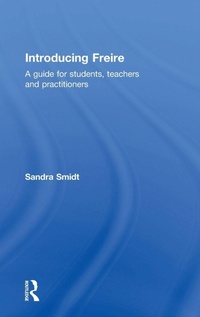
Introducing Freire
A guide for students, teachers and practitioners
1st Edition
Published on 24. April 2014
Book
Hardback
146 pages
978-0-415-71727-4 (ISBN)
Description
The famous Brazilian educator Paulo Freire has influenced educators, teachers and students in a broad tapestry of contexts and countries, as he challenged conventional thinking on how teachers ought to teach and learners ought to learn. By making his ideas accessible and relevant, this insightful and thought-provoking text draws out the relevance and topicality of Freire's work and applies this to a wide range of educational settings, from adult education, through schools, to early years settings.
Themes covered include:
the lasting impact of illiteracy;
the benefits and potential in becoming literate;
literacy, language and power;
the differences between banking and dialogic education;
the social and political nature of learning.
what kind of teaching and learning do we want?
Using a variety of practical examples and case studies, Introducing Freire is an essential guide to the work of one of the most significant figures in education in the last century. Fascinating and accessible, this book is for anyone interested in teaching and learning, poverty and affluence, power and powerlessness, and society and change.
Themes covered include:
the lasting impact of illiteracy;
the benefits and potential in becoming literate;
literacy, language and power;
the differences between banking and dialogic education;
the social and political nature of learning.
what kind of teaching and learning do we want?
Using a variety of practical examples and case studies, Introducing Freire is an essential guide to the work of one of the most significant figures in education in the last century. Fascinating and accessible, this book is for anyone interested in teaching and learning, poverty and affluence, power and powerlessness, and society and change.
Reviews / Votes
'Looking at the work of one of the most influential educators in the last century, someone who challenged conventional thinking on how teachers ought to teach and how learners ought to learn, this is a fascinatingly riveting and accessible read.'- Early Years Educator Magazine "Looking at the work of one of the most influential educators in the last century, someone who challenged conventional thinking on how teachers ought to teach and how learners ought to learn, this is a fascinatingly riveting and accessible read." -Early Years Educator Magazine"It will appeal to students, educators, and researchers who are interested in a brief overview of approaches to critical education theory and practice. ... Smidt's book offers a challenge to teachers to consider the implications of Freire's pedagogical theory for their development as teachers with a conscious concern for fostering social justice and equity in their classrooms, communities, and the world." -PsycCRITIQUES
More details
Series
Language
English
Place of publication
London
United Kingdom
Publishing group
Taylor & Francis Ltd
Target group
College/higher education
Professional and scholarly
Adult education
Illustrations
1 s/w Tabelle
1 Tables, black and white
Dimensions
Height: 240 mm
Width: 161 mm
Thickness: 13 mm
Weight
391 gr
ISBN-13
978-0-415-71727-4 (9780415717274)
Copyright in bibliographic data and cover images is held by Nielsen Book Services Limited or by the publishers or by their respective licensors: all rights reserved.
Schweitzer Classification
Other editions
Additional editions
E-Book
05/2014
1st Edition
Routledge
€65.99
Available for download
E-Book
05/2014
1st Edition
Routledge
€65.99
Available for download
Book
04/2014
1st Edition
Routledge
€71.70
Shipment within 15-20 days
Person
Sandra Smidt is a writer and consultant in early years education. She has previously written The Developing Child in the 21st Century (2013), Introducing Malaguzzi (2012), Introducing Bruner (2011), Playing to Learn (2010) and Introducing Vygotsky (2008), all published by Routledge.
Content
1. The life and times of Paulo Freire 2. Literacy and Beyond 3. Dialogue, illiteracy and more 4. Naming, reading and writing the world 5. The definition, philosophy and politics of literacy 6. Part 1:What kind of teaching and learning do we want? 7. Part 2: What kind of teaching and learning do we want? Links to informal education 8. A Pedagogy for Liberation 9. Theater of the Oppressed: an elaboration of the work of Paulo Freire 10. No more silence: learning in informal settings