

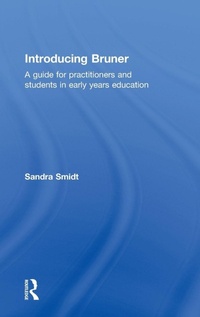
Introducing Bruner
A Guide for Practitioners and Students in Early Years Education
1st Edition
Published on 1. April 2011
Book
Hardback
134 pages
978-0-415-57420-4 (ISBN)
Description
Sandra Smidt takes the reader on a journey through the key concepts of Jerome Bruner, a significant figure in the field of early education whose work has spanned almost a century. His wide-ranging and innovative principles of early learning and teaching are unpicked here using everyday language and the links between his ideas and those of other key thinkers of the twentieth and twenty-first centuries are revealed.
Introducing Bruner is the companion volume to Introducing Vygotsky and is an invaluable work for anyone involved with children in the early years. The introduction of Bruner's key concepts is followed by discussion of the implications of these for teaching and learning. This accessible text is illustrated throughout with examples drawn from real-life early years settings and the concepts discussed include:
how children acquire language
how children come to make sense of their world through narrative
the significance of play to learning
the importance of culture and context
the role of memory
what should children be taught: the spiral curriculum
how should children be taught: scaffolding and interaction.
The book also looks, crucially, at what those working or involved with young children can learn from Bruner, and includes a helpful glossary of terminology. This fascinating insight in to the life and work of a key figure in early years education is essential reading for anyone concerned with the learning and development of young children.
Introducing Bruner is the companion volume to Introducing Vygotsky and is an invaluable work for anyone involved with children in the early years. The introduction of Bruner's key concepts is followed by discussion of the implications of these for teaching and learning. This accessible text is illustrated throughout with examples drawn from real-life early years settings and the concepts discussed include:
how children acquire language
how children come to make sense of their world through narrative
the significance of play to learning
the importance of culture and context
the role of memory
what should children be taught: the spiral curriculum
how should children be taught: scaffolding and interaction.
The book also looks, crucially, at what those working or involved with young children can learn from Bruner, and includes a helpful glossary of terminology. This fascinating insight in to the life and work of a key figure in early years education is essential reading for anyone concerned with the learning and development of young children.
More details
Series
Language
English
Place of publication
London
United Kingdom
Publishing group
Taylor & Francis Ltd
Target group
College/higher education
Illustrations
1 s/w Tabelle
1 Tables, black and white
Dimensions
Height: 240 mm
Width: 161 mm
Thickness: 13 mm
Weight
388 gr
ISBN-13
978-0-415-57420-4 (9780415574204)
Copyright in bibliographic data and cover images is held by Nielsen Book Services Limited or by the publishers or by their respective licensors: all rights reserved.
Schweitzer Classification
Other editions
Additional editions
E-Book
10/2013
1st Edition
Routledge
€45.99
Available for download
E-Book
10/2013
1st Edition
Routledge
€45.99
Available for download
Book
04/2011
1st Edition
Routledge
€52.50
Shipment within 15-20 days
Person
Sandra Smidt is a writer and consultant in early years education. Her most recent books include: Playing to Learn (2010); Planning for the Early Years Foundation Stage (2009); Key Issues in Early Years Education, 2nd edn (as editor) (2009); Introducing Vygotsky (2008); Supporting Multilingual Learners in the Early Years (2007) and A Guide to Early Years Practice, 3rd edn (2007) - all published by Routledge.
Content
Introduction Glossary 1. The early life and times of Jerome Bruner 2. The life of the mind of Jerome Bruner 3. Mind and meaning 4. Brilliant babies 5. From communicating to talking 6. Learning to name and reference 7. Learning to ask and to question 8. Pedagogy: Teaching and Learning 9. Narrative: the making of stories A final word