

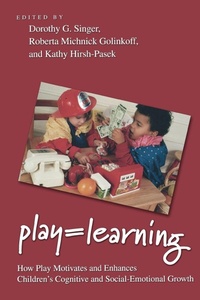
Play = Learning
How Play Motivates and Enhances Children's Cognitive and Social-Emotional Growth
Published on 29. October 2009
Book
Paperback/Softback
288 pages
978-0-19-973382-8 (ISBN)
Description
Why is it that the best and brightest of our children are arriving at college too burned out to profit from the smorgasbord of intellectual delights that they are offered? Why is it that some preschools and kindergartens have a majority of children struggling to master cognitive tasks that are inappropriate for their age? Why is playtime often considered to be time unproductively spent?
In Play=Learning, top experts in child development and learning contend that the answers to these questions stem from a single source: in the rush to create a generation of Einsteins, our culture has forgotten about the importance of play for children's development. Presenting a powerful argument about the pervasive and long-term effects of play, Singer, Golinkoff, and Hirsh-Pasek urge researchers and practitioners to reconsider the ways play facilitates development across domains. Over forty years of developmental research indicates that play has enormous benefits to offer children, not the least of which is physical activity in this era of obesity and hypertension. Play provides children with the opportunity to maximize their attention spans, learn to get along with peers, cultivate their creativity, work through their emotions, and gain the academic skills that are the foundation for later learning. Using a variety of methods and studying a wide range of populations, the contributors to this volume demonstrate the powerful effects of play in the intellectual, social, and emotional spheres.
Play=Learning will be an important resource for students and researchers in developmental psychology. Its research-based policy recommendations will be valuable to teachers, counselors, and school psychologists in their quest to reintroduce play and joyful learning into our school rooms and living rooms.
In Play=Learning, top experts in child development and learning contend that the answers to these questions stem from a single source: in the rush to create a generation of Einsteins, our culture has forgotten about the importance of play for children's development. Presenting a powerful argument about the pervasive and long-term effects of play, Singer, Golinkoff, and Hirsh-Pasek urge researchers and practitioners to reconsider the ways play facilitates development across domains. Over forty years of developmental research indicates that play has enormous benefits to offer children, not the least of which is physical activity in this era of obesity and hypertension. Play provides children with the opportunity to maximize their attention spans, learn to get along with peers, cultivate their creativity, work through their emotions, and gain the academic skills that are the foundation for later learning. Using a variety of methods and studying a wide range of populations, the contributors to this volume demonstrate the powerful effects of play in the intellectual, social, and emotional spheres.
Play=Learning will be an important resource for students and researchers in developmental psychology. Its research-based policy recommendations will be valuable to teachers, counselors, and school psychologists in their quest to reintroduce play and joyful learning into our school rooms and living rooms.
Reviews / Votes
"...a realistic appraisal of what play can contribute to early learning such as the links between play and early literacy and language competence and the importance of recess in the primary grades."--Young Children (November 2006)"Early childhood educators are well aware of the importance of play in children's lives. This volume is a wonderful collection of chapters by eminent authors, who have thought deeply about play and young children's learning. Readers will find it challenging, provocative, reassuring, and enormously satisfying."--Barbara Bowman, Erikson Institute
"In the current era of scientifically-based education and accountability, this book fills a critical gap in the knowledge base--providing an extensive research review of all the ways play enhances learning and development for all children, including those with special needs. This book should help teachers, administrators, teacher educators, and policy makers go beyond the either/or debates of the past. The evidence is clear--children need both hands-on,
educationally enriching play experiences and teacher instruction."--Sue Bredekamp, Ph.D., Director of Research, Council for Professional Recognition, Washington, DC, and Former Director of Professional
Development, National Association for the Education of Young Children (NAEYC)
"This is a stunning and important book. The authors do more for play than anyone since Vygotsky. In the earliest years, play lays the groundwork for imitative learning, simulation, and contributes to socio-emotional growth. By the third and fourth years, play becomes a critical avenue by which the child experiments with virtual realities and explores future possibilities. Play is sometimes undervalued in the increasingly high-pressured world of child-rearing.
This volume transforms how we think about play and is essential reading for developmental psychologists, practitioners, policymakers, and all those who wish to enhance the lives of children."--Andrew N.
Meltzoff, co-author, The Scientist in the Crib: What Early Learning Tells Us About the Mind
"In this wonderful book on play, a variety of leading researchers and scholars in the play and child development area review how play helps children develop and learn. There is a special focus on play and the learning process which involves the whole child. This book provides a fresh and up-to-date look at play and areas of adaptive functioning such as literacy, mathematics, and self-regulation. This is a much needed and timely book, as our culture is
de-emphasizing the importance of play. Many authors discuss implications of play research for public policy. This book tells us why we, as a society, need to provide time, space, and guidance for children to
play."--Sandra W. Russ, Ph.D., Professor of Psychology, Case Western Reserve University
More details
Language
English
Place of publication
New York
United States
Target group
College/higher education
Professional and scholarly
Illustrations
small amount of figures
Dimensions
Height: 229 mm
Width: 152 mm
Thickness: 17 mm
Weight
474 gr
ISBN-13
978-0-19-973382-8 (9780199733828)
Copyright in bibliographic data and cover images is held by Nielsen Book Services Limited or by the publishers or by their respective licensors: all rights reserved.
Schweitzer Classification
Other editions
Additional editions
Dorothy G. Singer | Roberta Michnick Golinkoff | Kathy Hirsh-Pasek
Play = Learning
How Play Motivates and Enhances Children's Cognitive and Social-Emotional Growth
Book
09/2006
Oxford University Press Inc
€140.10
Shipment within 15-20 days
Dorothy Singer | Roberta Michnick Golinkoff | Kathy Hirsh-Pasek
Play = Learning
How Play Motivates and Enhances Children's Cognitive and Social-Emotional Growth
E-Book
08/2006
1st Edition
OUP eBook
€35.49
Available for download
Dorothy Singer | Roberta Michnick Golinkoff | Kathy Hirsh-Pasek
Play = Learning
How Play Motivates and Enhances Children's Cognitive and Social-Emotional Growth
E-Book
08/2006
1st Edition
OUP eBook
€35.49
Available for download
Persons
Dorothy G. Singer received her doctorate in School Psychology from Teachers College, Columbia University. She is Senior Research Scientist, Department of Psychology, Yale University. She is also Co-Director, with Jerome L. Singer, of the Yale University Family Television Research and Consultation Center. An expert on early childhood development, television effects on youth, and parent training in imaginative play, she has written 20 books and over 150 articles. Her latest books with Jerome L. Singer are Handbook of Children and the Media, Make-Believe: Games and Activities for Imaginative Play, and Imagination and Play in the Electronic Age. She co-edited, with Edward F. Zigler and Sandra J.Bishop-Josef, Children's Play: Roots of Reading, which was selected for CHOICE's Outstanding Academic Title list. She co-authored, with Kathy Kirsh-Pasek, Roberta Michnick Golinkoff, and Laura E. Berk, A Mandate for Playful Learning in Preschool: Presenting the Evidence (OUP 2009).
Editor
Senior Research Scientist, Department of Psychology and Child Study CenterSenior Research Scientist, Department of Psychology and Child Study Center, Yale University, USA
Professor, Departments of Educational Studies, Psychology, and LinguisticsProfessor, Departments of Educational Studies, Psychology, and Linguistics, University of Delaware, USA
Professor of PsychologyProfessor of Psychology, Temple University, USA
Content
PROLOGUE
1. Why Play=Learning: A Call for Change
Roberta M. Golinkoff, Kathryn A. Hirsh-Pasek, and Dorothy G. Singer
CHALLENGES TO PLAY
2. The Cognitive Child vs. the Whole Child: Lessons from 40 Years of Head Start
Edward F. Zigler and Sandra J. Bishop-Josef
3. The Role of Recess in Primary School
Anthony D. Pellegrini and Robyn M. Holmes
SHOOL READINESS - SCHOOL STANDARDS
4. Standards, Science, and the Role of Play in Early Literacy Education
James F. Christie and Kathleen A. Roskos
5. Make-Believe Play: Wellspring for Development of Self-Regulation
Laura E. Berk, Trisha D. Mann, and Amy T. Ogan
6. 'My Magic Story Car': Video-Based Play Intervention to Strengthen Emergent Literary of At-Risk Preschoolers
Harvey F. Bellin and Dorothy G. Singer
7. Narrative Play and Emergent Literacy: Storytelling and Story-acting Meets Journal Writing
Angelika Nicolopoulou, Judith McDowell, and Carolyn Brockmeyer
8. Mathematical Play and Playful Mathematics: A Guide for Early Education
Herbert P. Ginsburg
MEDIA AND COMPUTERS
9. Media Use by Infants and Toddlers: A Potential for Play
Deborah S. Weber
10. Computer as Paint Brush: Technology, Play, and the Creative Society
Mitchel Resnick
PLAY WITH DYSFUNCTIONAL CHILDREN
11. Pretend Play and Emotion Learning in Traumatized Mothers and Children
Wendy Haight, James Black, Teresa Jacobsen, and Kathryn Sheridan
12. Play and Autism: Facilitating Symbolic Understanding
Melissa Allen Preissler
EPILOGUE
13. Learning to Play and Learning Through Play
Jerome L. Singer
Index/Contributors
1. Why Play=Learning: A Call for Change
Roberta M. Golinkoff, Kathryn A. Hirsh-Pasek, and Dorothy G. Singer
CHALLENGES TO PLAY
2. The Cognitive Child vs. the Whole Child: Lessons from 40 Years of Head Start
Edward F. Zigler and Sandra J. Bishop-Josef
3. The Role of Recess in Primary School
Anthony D. Pellegrini and Robyn M. Holmes
SHOOL READINESS - SCHOOL STANDARDS
4. Standards, Science, and the Role of Play in Early Literacy Education
James F. Christie and Kathleen A. Roskos
5. Make-Believe Play: Wellspring for Development of Self-Regulation
Laura E. Berk, Trisha D. Mann, and Amy T. Ogan
6. 'My Magic Story Car': Video-Based Play Intervention to Strengthen Emergent Literary of At-Risk Preschoolers
Harvey F. Bellin and Dorothy G. Singer
7. Narrative Play and Emergent Literacy: Storytelling and Story-acting Meets Journal Writing
Angelika Nicolopoulou, Judith McDowell, and Carolyn Brockmeyer
8. Mathematical Play and Playful Mathematics: A Guide for Early Education
Herbert P. Ginsburg
MEDIA AND COMPUTERS
9. Media Use by Infants and Toddlers: A Potential for Play
Deborah S. Weber
10. Computer as Paint Brush: Technology, Play, and the Creative Society
Mitchel Resnick
PLAY WITH DYSFUNCTIONAL CHILDREN
11. Pretend Play and Emotion Learning in Traumatized Mothers and Children
Wendy Haight, James Black, Teresa Jacobsen, and Kathryn Sheridan
12. Play and Autism: Facilitating Symbolic Understanding
Melissa Allen Preissler
EPILOGUE
13. Learning to Play and Learning Through Play
Jerome L. Singer
Index/Contributors