

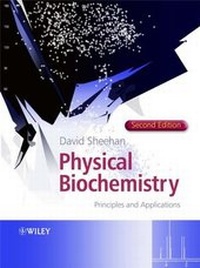
Physical Biochemistry
Principles and Applications
2nd Edition
Published on 27. March 2009
Book
Hardback
422 pages
978-0-470-85602-4 (ISBN)
Description
"As will be seen, there is not much missing here. I thought that the sections were well balanced, with rarely too much or too little on a given topic.This is a text to be welcomed by both teachers and students." BIOCHEMISTRY & MOLECULAR BIOLOGY EDUCATION (on the first edition)
The second edition of this successful textbook explains the basic principles behind the key techniques currently used in the modern biochemical laboratory and describes the pros and cons of each technique and compares one to another. It is non-mathematical, comprehensive and approachable for students who are not physical chemists.
* A major update of this comprehensive, accessible introduction to physical biochemistry.
* Includes two new chapters on proteomics and bioinformatics.
* Introduces experimental approaches with a minimum of mathematics and numerous practical examples.
* Provides a bibliography at the end of each chapter.
Written by an author with many years teaching and research experience, this text is a must-have for students of biochemistry, biophysics, molecular and life sciences and food science.
More details
Other editions
Additional editions
E-Book
04/2013
2nd Edition
Wiley
€64.99
Available for download
Book
03/2009
2nd Edition
Wiley
€108.50
Shipment within 10-20 days
E-Book
01/2009
2nd Edition
Wiley
€64.99
Available for download
Previous edition

Book
04/2000
1st Edition
Wiley
€169.00
Article exhausted; check for reprint
Person
Content
Preface.
Introduction.
Chromatography.
Spectroscopic Techniques.
Mass spectrometry.
Electrophoresis.
Three-dimensional structure determination of macromolecules.
Hydrodynamic methods.
Biocalorimetry.
Appendix 1.
Appendix 2.
Index.