

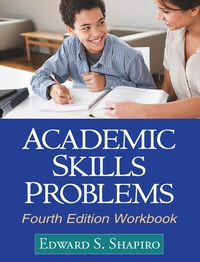
Academic Skills Problems Fourth Edition Workbook
4th Edition
Published on 17. December 2010
Book
Paperback/Softback
190 pages
978-1-60918-021-8 (ISBN)
Description
*A practical companion to Academic Skills Problems, 4e (9781606239605), featuring 30 new figures, forms, and exercises, and a new section on RTI.
*Detailed how-to explanations, forms, and practice exercises help readers quickly develop proficiency in assessment and intervention.
*Includes ready-to-use, full-sized reproducibles.
*Detailed how-to explanations, forms, and practice exercises help readers quickly develop proficiency in assessment and intervention.
*Includes ready-to-use, full-sized reproducibles.
Reviews / Votes
. -More details
Edition
4th edition
Language
English
Place of publication
New York
United States
Target group
College/higher education
School psychologists, K-12 school administrators, special educators, and classroom teachers; graduate students and researchers in these fields. Together with Academic Skills Problems, Fourth Edition, will serve as a text in graduate-level courses dealing with academic assessment and intervention.
Dimensions
Height: 267 mm
Width: 203 mm
Weight
524 gr
ISBN-13
978-1-60918-021-8 (9781609180218)
Copyright in bibliographic data and cover images is held by Nielsen Book Services Limited or by the publishers or by their respective licensors: all rights reserved.
Schweitzer Classification
Other editions
New editions
Edward S. Shapiro | Nathan H. Clemens
Academic Skills Problems Fifth Edition Workbook
Book
08/2023
5th Edition
Guilford Press
€43.00
Shipment within 15-20 days
Person
Edward S. Shapiro, PhD, until his death in 2016, was Director of the Center for Promoting Research to Practice and Professor in the School Psychology Program at Lehigh University. Best known for his work in curriculum-based assessment and nonstandardized methods of assessing academic skills problems, Dr. Shapiro was author or coauthor of numerous books. He also developed the widely used BOSS (Behavioral Observation of Students in Schools) software system and presented papers, chaired symposia, and delivered invited addresses at conferences around the world. Dr. Shapiro's contributions to the field of school psychology have been recognized with the Outstanding Contributions to Training Award from Trainers of School Psychologists, the Distinguished Contribution to School Psychology Award from the Pennsylvania Psychological Association, the Eleanor and Joseph Lipsch Research Award from Lehigh University, and the Senior Scientist Award from the Division of School Psychology of the American Psychological Association, among other honors.
Content
Introduction
STEP 1. ASSESSING THE ACADEMIC ENVIRONMENT
- Teacher Interview
- Academic Performance Rating Scale
- Student Interview
- Direct Observation: Manual for the Behavioral Observation of Students in Schools (BOSS)
Rationale
Identifying the Behaviors for Observation
Use of Technology in Conducting Systemic Observation
Guidelines for Paper-and-Pencil Direct Observation
Making a Coding Interval Recording
Completing Identifying Information
Observing Peer Comparison Students
Coding Academic Engagement
Coding Nonengagement
Coding Teacher-Directed Instruction
Review: Procedure for Conducting the Observation
Scoring the BOSS
Interpretation of BOSS Data
STEP 2. ASSESSING INSTRUCTIONAL PLACEMENT
- Reading
Oral Retell Techniques
Retell Techniques: Examples and Exercises
- Math
Using Digits Correct in Scoring Math Probes
Scoring Digits Correct in Addition and Subtraction Problems
Scoring Digits Correct in Multiplication Problems
Scoring Digits Correct in Division Problems
Math Concepts-Applications
-Spelling
Using Correct Letter Sequences in Scoring Spelling
Scoring Correct Letter Sequences
- Written Language
Scoring for Words Written
Scoring for Writing Mechanics
Assessing Quality of Longer Writing Samples
Scoring Brief Written Language Samples: Examples and Exercises
- Summary Form for Academic Assessment
STEP 3. INSTRUCTIONAL MODIFICATION
- The Folding-In Technique
Example: Folding-In Technique for Word Acquisition and Reading Fluency
Example: Folding-In Technique for Multiplication Facts
- Cover-Copy-Compare
Example: Cover-Copy-Compare for Addition Facts, Sums to 18
Example: Cover-Copy-Compare for Spelling
STEP 4.
STEP 1. ASSESSING THE ACADEMIC ENVIRONMENT
- Teacher Interview
- Academic Performance Rating Scale
- Student Interview
- Direct Observation: Manual for the Behavioral Observation of Students in Schools (BOSS)
Rationale
Identifying the Behaviors for Observation
Use of Technology in Conducting Systemic Observation
Guidelines for Paper-and-Pencil Direct Observation
Making a Coding Interval Recording
Completing Identifying Information
Observing Peer Comparison Students
Coding Academic Engagement
Coding Nonengagement
Coding Teacher-Directed Instruction
Review: Procedure for Conducting the Observation
Scoring the BOSS
Interpretation of BOSS Data
STEP 2. ASSESSING INSTRUCTIONAL PLACEMENT
- Reading
Oral Retell Techniques
Retell Techniques: Examples and Exercises
- Math
Using Digits Correct in Scoring Math Probes
Scoring Digits Correct in Addition and Subtraction Problems
Scoring Digits Correct in Multiplication Problems
Scoring Digits Correct in Division Problems
Math Concepts-Applications
-Spelling
Using Correct Letter Sequences in Scoring Spelling
Scoring Correct Letter Sequences
- Written Language
Scoring for Words Written
Scoring for Writing Mechanics
Assessing Quality of Longer Writing Samples
Scoring Brief Written Language Samples: Examples and Exercises
- Summary Form for Academic Assessment
STEP 3. INSTRUCTIONAL MODIFICATION
- The Folding-In Technique
Example: Folding-In Technique for Word Acquisition and Reading Fluency
Example: Folding-In Technique for Multiplication Facts
- Cover-Copy-Compare
Example: Cover-Copy-Compare for Addition Facts, Sums to 18
Example: Cover-Copy-Compare for Spelling
STEP 4.