

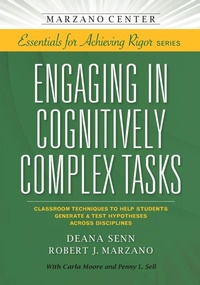
Engaging in Cognitively Complex Tasks
Classroom Techniques to Help Students Generate & Test Hypotheses Across Disciplines
Published on 15. April 2015
Book
Paperback/Softback
128 pages
978-1-941112-09-0 (ISBN)
Description
Academic standards call for increased rigor, but simply raising complexity is not enough. Students must also know how to investigate, experiment, solve problems, and deepen their understanding of the content. They need to be able to apply their learning to authentic, reality-based situations. Engaging in Cognitively Complex Tasks: Classroom Techniques to Help Students Generate & Test Hypotheses Across Disciplines explores explicit techniques for mastering a crucial strategy of instructional practice: teaching students to generate and test hypotheses. It includes: Explicit steps for implementation Recommendations for monitoring if students are able to generate and test hypotheses Adaptations for students who struggle, have special needs, or excel in learning Examples and nonexamples from classroom practice Common mistakes and ways to avoid them The Essentials for Achieving Rigor series of instructional guides helps educators become highly skilled at implementing, monitoring, and adapting instruction. Put it to practical use immediately, adopting day-to-day examples as models for application in your own classroom.
More details
Series
Language
English
Place of publication
West Palm Beach
United States
Target group
Professional and scholarly
Product notice
Paperback (trade)
Unsewn / adhesive bound
Dimensions
Height: 254 mm
Width: 174 mm
Thickness: 10 mm
Weight
277 gr
ISBN-13
978-1-941112-09-0 (9781941112090)
Copyright in bibliographic data and cover images is held by Nielsen Book Services Limited or by the publishers or by their respective licensors: all rights reserved.
Schweitzer Classification
Persons
With more than 15 years of education experience, Deana Senn, MS, is an expert in instructional strategies and classroom assessments. Her curriculum and instruction experience span the United States and Canada, in both rural and urban districts, from the school level to regional level. She actively develops content with the Marzano Center team and trains nationwide. She is a graduate of Texas A&M University and received her master's degree from Montana State University.
Robert J. Marzano, PhD, is a nationally recognized education researcher, speaker, trainer, and author of more than 30 books and 150 articles on topics such as instruction, assessment, writing and implementing standards, cognition, effective leadership, and school intervention. His practical translations of the most current research and theory into classroom strategies are widely practiced internationally by both teachers and administrators.
Robert J. Marzano, PhD, is a nationally recognized education researcher, speaker, trainer, and author of more than 30 books and 150 articles on topics such as instruction, assessment, writing and implementing standards, cognition, effective leadership, and school intervention. His practical translations of the most current research and theory into classroom strategies are widely practiced internationally by both teachers and administrators.