

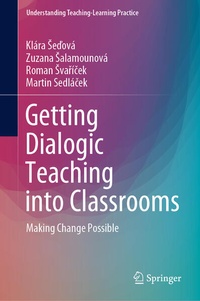
Getting Dialogic Teaching into Classrooms
Making Change Possible
Published on 20. October 2020
Book
Hardback
VIII, 184 pages
978-981-15-9242-3 (ISBN)
Description
This book contributes to our understanding how teachers can improve classroom dialogue and thereby boost student learning.
The book reports the results of intervention research based on professional development program for teacher. Participating teachers strived, with the help of the researchers, to instigate a rich and authentic dialogue in their classrooms. The data shows that teachers were able to change their talk and interaction patterns, and this was followed by a desirable change in their students who started to talk more and expressed more complex thoughts.
The book not only reports on a successful intervention, but most importantly investigates in depth the teacher experiences and ways of learning during the intervention project.
The book reports the results of intervention research based on professional development program for teacher. Participating teachers strived, with the help of the researchers, to instigate a rich and authentic dialogue in their classrooms. The data shows that teachers were able to change their talk and interaction patterns, and this was followed by a desirable change in their students who started to talk more and expressed more complex thoughts.
The book not only reports on a successful intervention, but most importantly investigates in depth the teacher experiences and ways of learning during the intervention project.
More details
Series
Edition
2020 ed.
Language
English
Place of publication
Singapore
Singapore
Target group
Professional and scholarly
Illustrations
1 s/w Abbildung
VIII, 184 p. 1 illus.
Dimensions
Height: 241 mm
Width: 160 mm
Thickness: 17 mm
Weight
459 gr
ISBN-13
978-981-15-9242-3 (9789811592423)
DOI
10.1007/978-981-15-9243-0
Schweitzer Classification
Other editions
Additional editions
Klára Sedová | Zuzana Salamounová | Roman Svarícek
Getting Dialogic Teaching into Classrooms
Making Change Possible
Book
10/2021
Springer
€106.99
Shipment within 3-4 weeks
Klára Sedová | Zuzana Salamounová | Roman Svarícek
Getting Dialogic Teaching into Classrooms
Making Change Possible
E-Book
10/2020
1st Edition
Springer
€96.29
Available for download
Persons
Dr. Klára Sedová is an Associate Professor of Education at Masaryk University, Czech Republic. Her research interest focuses on classroom discourse, the relationship between speech, teaching, teacher professional development and a change towards dialogic teaching. Her papers were published in a range of professional journals, such as Teaching and Teacher Education; Learning, Culture and Social Interaction; International Journal of Educational Research; Teacher Development. She lectures on classroom discourse and communication, methodology and academic writing in masters and Ph.D. programmes. She published a textbook on qualitative methods in Czech co-authored with Roman Svarícek which is very popular among early career researchers.
Dr. Roman Svarícek is a Senior Lecturer in the Department of Educational Sciences, Faculty of Arts, Masaryk University, Czech Republic. His research interests are around classroom discourse, dialogic teaching, teacher identity and teacher professional development. He has co-published several academic books in Czech and also articles in international journals. He lectures on Philosophy of Education, Educational Theories and Qualitative Research. He is a member of the university's Ethics Committee focused on the quality of research, and a member of the Experimental Humanities Laboratory's Board focused on improving innovation and understanding of human interaction. He is further involved in the university's Centre for the Development of Pedagogical Competencies.
Dr. Zuzana Salamounová is a Senior Lecturer in the Department of Educational Sciences, Faculty of Arts, Masaryk University, Czech Republic. Her research interest focuses on classroom discourse, social networks in educational processes and teacher professional development. She is responsible for the direction of didactics in Secondary School Teacher Training Programmes.
Dr. Martin Sedlácek is a Senior Lecturer in the Department of Educational Sciences, Faculty of Arts, Masaryk University, Czech Republic. His research interests are around dialogic teaching, student engagement, and educational leadership and management. He lectures on Statistical Analysis, Quantitative Research and Management of Education Processes. He is an expert in academic statistics in Education.
Dr. Roman Svarícek is a Senior Lecturer in the Department of Educational Sciences, Faculty of Arts, Masaryk University, Czech Republic. His research interests are around classroom discourse, dialogic teaching, teacher identity and teacher professional development. He has co-published several academic books in Czech and also articles in international journals. He lectures on Philosophy of Education, Educational Theories and Qualitative Research. He is a member of the university's Ethics Committee focused on the quality of research, and a member of the Experimental Humanities Laboratory's Board focused on improving innovation and understanding of human interaction. He is further involved in the university's Centre for the Development of Pedagogical Competencies.
Dr. Zuzana Salamounová is a Senior Lecturer in the Department of Educational Sciences, Faculty of Arts, Masaryk University, Czech Republic. Her research interest focuses on classroom discourse, social networks in educational processes and teacher professional development. She is responsible for the direction of didactics in Secondary School Teacher Training Programmes.
Dr. Martin Sedlácek is a Senior Lecturer in the Department of Educational Sciences, Faculty of Arts, Masaryk University, Czech Republic. His research interests are around dialogic teaching, student engagement, and educational leadership and management. He lectures on Statistical Analysis, Quantitative Research and Management of Education Processes. He is an expert in academic statistics in Education.
Content
1 Classroom talk: Introduction and theoretical background.- 2 How to change classroom talk: The methodology of the project.- 3 How to measure the change: Analysis of the impact of the professional development project.- 4 How the change takes place: Two case studies.- 5 How to understand the change: Teachers' self-understanding and emotions as a key to change.- 6 Discussion and conclusion.