

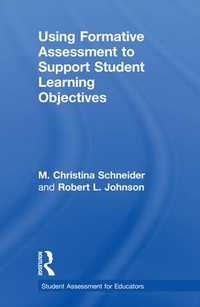
Using Formative Assessment to Support Student Learning Objectives
1st Edition
Published on 26. July 2018
Book
Hardback
184 pages
978-1-138-64950-7 (ISBN)
Description
As student learning objectives become an increasingly prominent approach to setting goals and growth measures in schools, teachers' competence in formative assessment is essential. Using Formative Assessment to Support Student Learning Objectives introduces current and future educators to SLOs as tools for shaping career- and college-ready students. Written in concise and straightforward language, and replete with step-by-step exercises, real-life examples, and illustrative charts, this useful guide provides pre- and in-service educators with the theoretical background and practical tools needed to implement the latest SLO research in their classrooms.
Reviews / Votes
"Finally! A pragmatic approach for linking formative assessment practices to instructional next steps. For educators seeking to sharpen their professional practice and focus more deeply on teaching and learning, this book offers commonsense, easy-to-follow guidance that is meaningful for all engaged in the educational process: administrators, teachers, students, and even policy-makers. If you believe in the power of formative assessment and its impact on teaching and learning, this book is for you!"-Melissa Fincher, Former Deputy Superintendent for Assessment & Accountability at the Georgia Department of Education, USA
"Using Formative Assessment to Support Student Learning Objectives provides teachers and other educational leaders a structured approach for unlocking the potential of standards-based frameworks with a consistent orientation of service to students and their development."
-Chad Gotch, Clinical Assistant Professor of Educational Psychology at Washington State University, USA
"What a great resource for teachers and administrators! Schneider and Johnson have created a guide that provides concrete information and tools for developing and measuring high quality trajectory-based SLOs. This book provides guidance for teachers to maximize the period between pre- and post-assessment to monitor students' progression toward the learning goals."
-Missy Wall-Mitchell, Director of Accountability for School District Five of Lexington and Richland Counties, USA
More details
Series
Language
English
Place of publication
London
United Kingdom
Publishing group
Taylor & Francis Ltd
Target group
College/higher education
Professional and scholarly
Illustrations
22 s/w Abbildungen, 13 s/w Photographien bzw. Rasterbilder, 9 s/w Zeichnungen, 37 s/w Tabellen
37 Tables, black and white; 9 Line drawings, black and white; 13 Halftones, black and white; 22 Illustrations, black and white
Dimensions
Height: 198 mm
Width: 129 mm
Weight
294 gr
ISBN-13
978-1-138-64950-7 (9781138649507)
Copyright in bibliographic data and cover images is held by Nielsen Book Services Limited or by the publishers or by their respective licensors: all rights reserved.
Schweitzer Classification
Other editions
Additional editions
M. Christina Schneider | Robert L. Johnson
Using Formative Assessment to Support Student Learning Objectives
Book
08/2018
1st Edition
Routledge
€43.30
Shipment within 10-20 days
M. Christina Schneider | Robert L. Johnson
Using Formative Assessment to Support Student Learning Objectives
E-Book
08/2018
1st Edition
Routledge
€31.49
Available for download
M. Christina Schneider | Robert L. Johnson
Using Formative Assessment to Support Student Learning Objectives
E-Book
08/2018
Routledge
€31.49
Available for download
Persons
M. Christina Schneider is Senior Director of Psychometric Solutions at NWEA and is involved in various federally-funded research projects.
Robert L. Johnson is Professor of Educational Research and Measurement at the University of South Carolina, USA.
Robert L. Johnson is Professor of Educational Research and Measurement at the University of South Carolina, USA.
Content
1. Introduction to Student Learning Objectives 2. Developing the SLO Learning Goal 3. Creating the SLO Learning Trajectory 4. A Principled Approach to Performance Task Design 5. Triangulating Evidence of Student Learning 6. Policy Decisions on the Use and Evaluation of Trajectory-based SLOs