

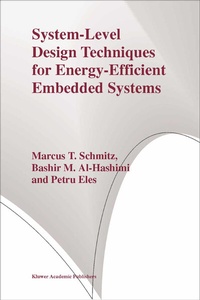
System-Level Design Techniques for Energy-Efficient Embedded Systems
Published on 5. November 2010
Book
Paperback/Softback
XVII, 194 pages
978-1-4419-5429-9 (ISBN)
Description
System-Level Design Techniques for Energy-Efficient Embedded Systems addresses the development and validation of co-synthesis techniques that allow an effective design of embedded systems with low energy dissipation. The book provides an overview of a system-level co-design flow, illustrating through examples how system performance is influenced at various steps of the flow including allocation, mapping, and scheduling. The book places special emphasis upon system-level co-synthesis techniques for architectures that contain voltage scalable processors, which can dynamically trade off between computational performance and power consumption. Throughout the book, the introduced co-synthesis techniques, which target both single-mode systems and emerging multi-mode applications, are applied to numerous benchmarks and real-life examples including a realistic smart phone.
More details
Edition
1st ed. Softcover of orig. ed. 2004
Language
English
Place of publication
New York
United States
Target group
Professional and scholarly
Research
Illustrations
XVII, 194 p.
Dimensions
Height: 240 mm
Width: 160 mm
Thickness: 12 mm
Weight
347 gr
ISBN-13
978-1-4419-5429-9 (9781441954299)
DOI
10.1007/b106642
Schweitzer Classification
Other editions
Additional editions
Marcus T. Schmitz | Bashir M. Al-Hashimi | Petru Eles
System-Level Design Techniques for Energy-Efficient Embedded Systems
E-Book
01/2006
Springer
€96.29
Available for download
Marcus T. Schmitz | Bashir M. Al-Hashimi | Petru Eles
System-Level Design Techniques for Energy-Efficient Embedded Systems
Book
12/2003
Kluwer Academic Publishers
€106.99
Shipment within 15-20 days
Content
Background.- Power Variation-Driven Dynamic Voltage Scaling.- Optimisation of Mapping and Scheduling for Dynamic Voltage Scaling.- Energy-Efficient Multi-mode Embedded Systems.- Dynamic Voltage Scaling for Control Flow-Intensive Applications.- LOPOCOS: A Prototype Low Power Co-Synthesis Tool.- Conclusion.