

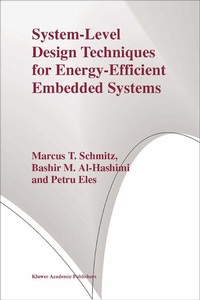
System-Level Design Techniques for Energy-Efficient Embedded Systems
Published on 31. December 2003
Book
Hardback
XVII, 194 pages
978-1-4020-7750-0 (ISBN)
Description
System-Level Design Techniques for Energy-Efficient Embedded Systems addresses the development and validation of co-synthesis techniques that allow an effective design of embedded systems with low energy dissipation. The book provides an overview of a system-level co-design flow, illustrating through examples how system performance is influenced at various steps of the flow including allocation, mapping, and scheduling. The book places special emphasis upon system-level co-synthesis techniques for architectures that contain voltage scalable processors, which can dynamically trade off between computational performance and power consumption. Throughout the book, the introduced co-synthesis techniques, which target both single-mode systems and emerging multi-mode applications, are applied to numerous benchmarks and real-life examples including a realistic smart phone.
More details
Edition
2004 ed.
Language
English
Place of publication
New York
United States
Target group
Professional and scholarly
Research
Product notice
sewn/stitched
Cloth over boards
Illustrations
XVII, 194 p.
Dimensions
Height: 252 mm
Width: 160 mm
Thickness: 14 mm
Weight
517 gr
ISBN-13
978-1-4020-7750-0 (9781402077500)
DOI
10.1007/b106642
Schweitzer Classification
Other editions
Additional editions
Marcus T. Schmitz | Bashir M. Al-Hashimi | Petru Eles
System-Level Design Techniques for Energy-Efficient Embedded Systems
Book
11/2010
Springer
€106.99
Shipment within 15-20 days
Marcus T. Schmitz | Bashir M. Al-Hashimi | Petru Eles
System-Level Design Techniques for Energy-Efficient Embedded Systems
E-Book
01/2006
Springer
€96.29
Available for download
Content
Background.- Power Variation-Driven Dynamic Voltage Scaling.- Optimisation of Mapping and Scheduling for Dynamic Voltage Scaling.- Energy-Efficient Multi-mode Embedded Systems.- Dynamic Voltage Scaling for Control Flow-Intensive Applications.- LOPOCOS: A Prototype Low Power Co-Synthesis Tool.- Conclusion.