

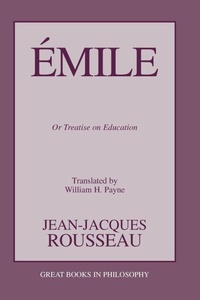
Emile
Or Treatise on Education
Published on 1. August 2003
Book
Paperback/Softback
315 pages
978-1-59102-111-7 (ISBN)
Description
In his pioneering treatise on education the great French philosopher presented concepts that had a significant influence on the development of pedagogy, and yet many of his ideas still sound radical today. Written in reaction to the stultifying system of rote learning and memorization prevalent throughout Europe in Rousseau's time, Emile is a utopian vision of child-centered education, full of the sentiments of Romanticism, which Rousseau himself inspired.
Imagining a typical boy named Emile, Rousseau creates an ideal model of one-on-one tutelage from infancy to manhood with himself as the child's mentor. "Everything is good as it comes from the hands of the Author of Nature; but everything degenerates in the hands of man." This is the first of many provocative statements that characterize this work and are a hallmark of Rousseau's arresting rhetoric. As in so many of his other famous works, here too Rousseau asserts his main thesis that human beings by nature are good; it is only the distorting influences of civilization that have corrupted them.
If this is true, then in educating children one must do nothing to interfere with human nature in its natural course. Far from being the chief means by which society inculcates its rules and principles, education should be the method of helping youths discover the inherent truths of their own human nature. From infancy to young adulthood learning should come purely from personal experience. Rather than imparting facts, teachers should foster self-discovery, so that knowledge is acquired through following innate curiosity, not vicariously through the statements of others.
Educators as well as students of philosophy will find much to admire in Rousseau's original and still radical ideas.
Imagining a typical boy named Emile, Rousseau creates an ideal model of one-on-one tutelage from infancy to manhood with himself as the child's mentor. "Everything is good as it comes from the hands of the Author of Nature; but everything degenerates in the hands of man." This is the first of many provocative statements that characterize this work and are a hallmark of Rousseau's arresting rhetoric. As in so many of his other famous works, here too Rousseau asserts his main thesis that human beings by nature are good; it is only the distorting influences of civilization that have corrupted them.
If this is true, then in educating children one must do nothing to interfere with human nature in its natural course. Far from being the chief means by which society inculcates its rules and principles, education should be the method of helping youths discover the inherent truths of their own human nature. From infancy to young adulthood learning should come purely from personal experience. Rather than imparting facts, teachers should foster self-discovery, so that knowledge is acquired through following innate curiosity, not vicariously through the statements of others.
Educators as well as students of philosophy will find much to admire in Rousseau's original and still radical ideas.
More details
Language
English
Place of publication
Amherst
United States
Target group
Professional and scholarly
College/higher education
Product notice
Paperback (trade)
Dimensions
Height: 213 mm
Width: 162 mm
Thickness: 19 mm
Weight
408 gr
ISBN-13
978-1-59102-111-7 (9781591021117)
Copyright in bibliographic data and cover images is held by Nielsen Book Services Limited or by the publishers or by their respective licensors: all rights reserved.
Schweitzer Classification