

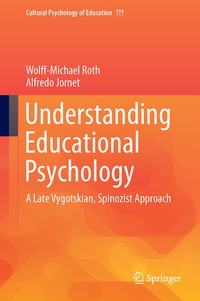
Understanding Educational Psychology
A Late Vygotskian, Spinozist Approach
Published on 29. August 2016
Book
Hardback
XIV, 328 pages
978-3-319-39867-9 (ISBN)
Description
This book takes up the agenda of the late (but unknown) L. S. Vygotsky, who had turned to the philosopher Spinoza to develop a holistic approach to psychology, an approach that no longer dichotomized the body and mind, intellect and affect, or the individual and the social. In this approach, there is only one substance, which manifests itself in different ways in the thinking body, including as biology and culture. The manifestation as culture is premised on the existence of the social.
In much of current educational psychology, there are unresolved contradictions that have their origin in the opposition between body and mind, individual and collective, and structure and process-including the different nature of intellect and affect or the difference between knowledge and its application. Many of the same contradictions are repeated in constructivist approaches, which do not overcome dichotomies but rather acerbate them by individualizing and intellectualizing our knowledgeable participation in recognizably exhibiting and producing the everyday cultural world. Interestingly enough, L. S. Vygotsky, who is often used as a referent for making arguments about inter- and intrasubjective "mental" "constructions," developed, towards the end of his life, a Spinozist approach according to which there is only one substance. This one substance manifests itself in two radically different ways: body (material, biology) and mind (society, culture). But there are not two substances that are combined into a unit; there is only one substance. Once such an approach is adopted, the classical question of cognitive scientists about how symbols are grounded in the world comes to be recognized as an artefact of the theory. Drawing on empirical materials from different learning settings-including parent-child, school, and workplace settings-this book explores the opportunities and implications that this non-dualist approach has for educational research and practice.More details
Series
Edition
1st ed. 2017
Language
English
Place of publication
Cham
Switzerland
Publishing group
Springer International Publishing
Target group
Professional and scholarly
Illustrations
83 s/w Abbildungen
XIV, 328 p. 83 illus.
Dimensions
Height: 241 mm
Width: 160 mm
Thickness: 25 mm
Weight
682 gr
ISBN-13
978-3-319-39867-9 (9783319398679)
DOI
10.1007/978-3-319-39868-6
Schweitzer Classification
Other editions
Additional editions
Wolff-Michael Roth | Alfredo Jornet
Understanding Educational Psychology
A Late Vygotskian, Spinozist Approach
Book
04/2018
Springer
€128.39
Shipment within 10-15 days
Wolff-Michael Roth | Alfredo Jornet
Understanding Educational Psychology
A Late Vygotskian, Spinozist Approach
E-Book
08/2016
Springer
€117.69
Available for download
Persons
Wolff-Michael Roth is Lansdowne Professor of Applied Cognitive Science at theUniversity of Victoria. His transdisciplinary research is concerned with knowing andlearning (cognition) across the lifespan, in formal and informal educational environments,workplace, and leisure settings. His body of work includes, among others, 60+co/authored and edited books, over 470 articles in peer-reviewed journals, and more than200 book chapters.
Content
Foreword.- 1. Vygotsky, Spinoza, and Cultural Psychology of Education.- PART I: FOUNDATIONS.- Introduction.- Biology | Culture .- Communicating | Thinking.- Intrasubjectivity | Intersubjectivity.- Primacy of the Social and Sociogenetic Method.- Learning | Development .- PART II: CASE STUDIES.- Introduction.- The Social Nature of Reading.- Intention-A Product of Joint Social Work.- Culturing Conceptions.- Natural History of the Sign.- Genesis of the Zone of Proximal Development.- PART III: IMPLICATIONS.- Introduction.- The Thinking Body.- "The Way to Freedom" in/for Education.- Appendix.- Index.