

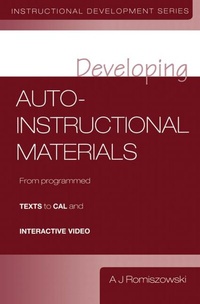
Developing Auto-instructional Materials
1st Edition
Will be published approx. on 1. March 1987
Book
Paperback/Softback
461 pages
978-1-85091-281-1 (ISBN)
Description
This two-volume work on the development of instruction is planned as a companion to an earlier book - Designing Instructional Systems. The present work continues the micro-design stages of lesson and instructional materials development. Taken together, these two volumes give extensive coverage of practical techniques for the development of instruction. This title draws a distinction between instructional design and instructional development, although some authors seem to use the two terms synonymously. The structure of the content will enable the two volumes to be used conveniently as both initial reading or later reference material.
More details
Language
English
Place of publication
London
United Kingdom
Publishing group
Taylor & Francis Ltd
Target group
College/higher education
Professional and scholarly
Dimensions
Height: 234 mm
Width: 156 mm
Weight
498 gr
ISBN-13
978-1-85091-281-1 (9781850912811)
Copyright in bibliographic data and cover images is held by Nielsen Book Services Limited or by the publishers or by their respective licensors: all rights reserved.
Schweitzer Classification
Other editions
Additional editions
A.J. Romiszowski
Developing Auto-instructional Materials
E-Book
12/2013
1st Edition
Routledge
€59.49
Available for download
A.J. Romiszowski
Developing Auto-instructional Materials
E-Book
12/2013
1st Edition
Routledge
€59.49
Available for download
Person
Romiszowski, A.J.,
Content
Preface to the Instructional Development Series, Introduction to Developing Auto-Instructional Materials, Part 1. The Context for Materials Development, 1. Individualized Instruction: The Philosophical Context, 2. A Model of Learning: The Theoretical Context, 3. Four Levels of Instructional Design: The Practical Context, Part 2. Instructional Programming and its Evolution, 4. The Fourth Level of Analysis: Task-Centred and Topic-Centred Approaches, 5. A Study of Change in Programmed Instruction: Analysis of the Topic-Centred and Task-Centred Programming Techniques, 6. Tactics for Producing Expositive Self-Instructional Materials, 7. Structural Communication: A Cognitive Approach to Self-Instruction, 8. Structured Writing or 'Mapping*: An Information Processing Approach, 9. 'Experience Programming': Writing Structured Case Studies and Role-Plays, Part 3. The Impact of the Computer, 10. 'CAL \ 'CAP and 'CMI': Definitions, Scope and Potential, 11. Initial Design and Development: The Educator's Role, 12. The Range of CAI Designs: Some Examples of Courseware, 13. Coding the Courseware for the Computer: Use of Standard Languages and Authoring Systems, Part 4. Techniques for Audiovisual Materials Development, 14. Audiovisual Media: Informational, Motivational or Instructional?, 15. Audiovisual Instructional Packages: A Review, 16. Developing Audiovisual Instructional Materials, 17. Interactive Video and the New Media: An Evaluation, Part 5. The Evaluation of Instructional Materials, 18. The Validation and Evaluation of Instructional Materials, 19. Developmental and Field-Testing: Organization, Execution and Interpretation, 20. Evaluation: Final Words, Bibliography, Subject Index, Author Index