

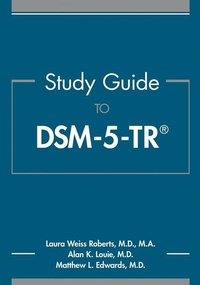
Study Guide to DSM-5-TR (R)
Published on 10. February 2025
Book
Paperback/Softback
600 pages
978-1-61537-555-4 (ISBN)
Description
The ultimate companion volume to DSM-5-TR, the Study
Guide is designed to help clinical learners, teachers, and
practitioners in psychiatry, psychology, and social work understand and
apply diagnostic criteria. Medical students, residents, and fellows and
trainees throughout the clinical neurosciences will find this text to be
invaluable in developing their diagnostic abilities. Readers learn key
clinical content through concise chapters and can assess their knowledge
with more than 100 multiple choice questions.
The book is organized
into three sections:
* Part I delves into foundational concepts of psychiatric diagnoses and
explores how diagnostic assessment fits into the process of working
therapeutically with patients. In this new edition, Part I includes a new
chapter examining structural and cultural considerations in arriving at a
diagnosis.
* Part II focuses on the diagnostic classes within DSM-5-TR
and features clinical case vignettes with real-life complexity relevant to
psychiatric diagnoses, diagnostic pearls that can be applied to daily
clinical practice, and a self-assessment section with key concepts,
questions for further discussion, patient cases, and Q&As.
* Part
III includes more than 100 multiple choice questions with an answer key.
These questions cover a range of diagnoses and patient presentations from
across DSM-5-TR, helping readers review their learning and assess their
skills.
Taking a patient-centered approach that complements the more
disorder-centered organization of DSM-5-TR, this Study Guide provides
context for DSM-5-TR's diagnoses while offering an array of interesting and
memorable cases. Rich in thought-provoking detail and designed for repeated
use, this is an indispensable guide for learners, educators, and
clinicians.
Guide is designed to help clinical learners, teachers, and
practitioners in psychiatry, psychology, and social work understand and
apply diagnostic criteria. Medical students, residents, and fellows and
trainees throughout the clinical neurosciences will find this text to be
invaluable in developing their diagnostic abilities. Readers learn key
clinical content through concise chapters and can assess their knowledge
with more than 100 multiple choice questions.
The book is organized
into three sections:
* Part I delves into foundational concepts of psychiatric diagnoses and
explores how diagnostic assessment fits into the process of working
therapeutically with patients. In this new edition, Part I includes a new
chapter examining structural and cultural considerations in arriving at a
diagnosis.
* Part II focuses on the diagnostic classes within DSM-5-TR
and features clinical case vignettes with real-life complexity relevant to
psychiatric diagnoses, diagnostic pearls that can be applied to daily
clinical practice, and a self-assessment section with key concepts,
questions for further discussion, patient cases, and Q&As.
* Part
III includes more than 100 multiple choice questions with an answer key.
These questions cover a range of diagnoses and patient presentations from
across DSM-5-TR, helping readers review their learning and assess their
skills.
Taking a patient-centered approach that complements the more
disorder-centered organization of DSM-5-TR, this Study Guide provides
context for DSM-5-TR's diagnoses while offering an array of interesting and
memorable cases. Rich in thought-provoking detail and designed for repeated
use, this is an indispensable guide for learners, educators, and
clinicians.
More details
Language
English
Place of publication
VA
United States
Target group
Professional and scholarly
US School Grade: College Graduate Student and over
Product notice
Paperback (trade)
Illustrations
1 Line drawings, black and white; 30 Tables, unspecified
Dimensions
Height: 254 mm
Width: 178 mm
Thickness: 23 mm
Weight
898 gr
ISBN-13
978-1-61537-555-4 (9781615375554)
Copyright in bibliographic data and cover images is held by Nielsen Book Services Limited or by the publishers or by their respective licensors: all rights reserved.
Schweitzer Classification
Other editions
Additional editions
Laura Weiss Roberts | Alan K. Louie | Matthew L. Edwards
Study Guide to DSM-5-TR®
E-Book
12/2024
American Psychiatric Association Publishing
€69.49
Available for download
Previous edition
Laura Weiss Roberts | Alan K. Louie
Study Guide to DSM-5 (R)
Book
02/2015
American Psychiatric Association Publishing
€66.00
Article exhausted; check for reprint
Persons
Laura Weiss Roberts, M.D., M.A., is Chairman and
Katharine Dexter McCormick and Stanley McCormick Memorial Professor in the
Department of Psychiatry and Behavioral Sciences at Stanford University
School of Medicine in Stanford, California.
Alan K. Louie,
M.D., is Professor, Associate Chair, and Director of Education in
the Department of Psychiatry and Behavioral Sciences at Stanford University
School of Medicine in Stanford, California.
Matthew L. Edwards,
M.D., is an Assistant Professor and the Assistant Director of
General Psychiatry Residency Training in the Department of Psychiatry and
Behavioral Sciences at Stanford University School of Medicine in Stanford,
California.
Katharine Dexter McCormick and Stanley McCormick Memorial Professor in the
Department of Psychiatry and Behavioral Sciences at Stanford University
School of Medicine in Stanford, California.
Alan K. Louie,
M.D., is Professor, Associate Chair, and Director of Education in
the Department of Psychiatry and Behavioral Sciences at Stanford University
School of Medicine in Stanford, California.
Matthew L. Edwards,
M.D., is an Assistant Professor and the Assistant Director of
General Psychiatry Residency Training in the Department of Psychiatry and
Behavioral Sciences at Stanford University School of Medicine in Stanford,
California.
Content
Dedications
Introduction
Part One:
Foundations
Chapter 1: The role of diagnosis and the
DSM-5-TR
Chapter 2: Arriving at a diagnosis: the role of the clinical
interview
Chapter 3: Understanding different approaches to diagnostic
classification
Chapter 4: Beyond diagnostic classification: Structural
and cultural considerations and the DSM-5-TR
Part Two: DSM-5 Diagnostic
Categories
Chapter 5. Neurodevelopmental Disorders
Chapter 6.
Schizophrenia Spectrum and Other Psychotic Disorders
Chapter 7. Bipolar
and Related Disorders
Chapter 8. Depressive Disorders
Chapter 9.
Anxiety Disorders
Chapter 10. Obsessive-Compulsive and Related
Disorders
Chapter 11. Trauma- and Stressor-Related Disorders
Chapter
12. Dissociative Disorders
Chapter 13. Somatic Symptom and Related
Disorders
Chapter 14. Feeding and Eating Disorders
Chapter 15.
Elimination Disorders
Chapter 16. Sleep-Wake Disorders
Chapter 17.
Sexual Dysfunctions
Chapter 18. Gender Dysphoria
Chapter 19.
Disruptive, Impulse-Control, and Conduct Disorders
Chapter 20.
Substance-Related and Addictive Disorders
Chapter 21. Neurocognitive
Disorders
Chapter 22. Personality Disorders
Chapter 23. Paraphilic
Disorders
Part Three: Q&A
Chapter 25. Questions &
Answers
Introduction
Part One:
Foundations
Chapter 1: The role of diagnosis and the
DSM-5-TR
Chapter 2: Arriving at a diagnosis: the role of the clinical
interview
Chapter 3: Understanding different approaches to diagnostic
classification
Chapter 4: Beyond diagnostic classification: Structural
and cultural considerations and the DSM-5-TR
Part Two: DSM-5 Diagnostic
Categories
Chapter 5. Neurodevelopmental Disorders
Chapter 6.
Schizophrenia Spectrum and Other Psychotic Disorders
Chapter 7. Bipolar
and Related Disorders
Chapter 8. Depressive Disorders
Chapter 9.
Anxiety Disorders
Chapter 10. Obsessive-Compulsive and Related
Disorders
Chapter 11. Trauma- and Stressor-Related Disorders
Chapter
12. Dissociative Disorders
Chapter 13. Somatic Symptom and Related
Disorders
Chapter 14. Feeding and Eating Disorders
Chapter 15.
Elimination Disorders
Chapter 16. Sleep-Wake Disorders
Chapter 17.
Sexual Dysfunctions
Chapter 18. Gender Dysphoria
Chapter 19.
Disruptive, Impulse-Control, and Conduct Disorders
Chapter 20.
Substance-Related and Addictive Disorders
Chapter 21. Neurocognitive
Disorders
Chapter 22. Personality Disorders
Chapter 23. Paraphilic
Disorders
Part Three: Q&A
Chapter 25. Questions &
Answers