

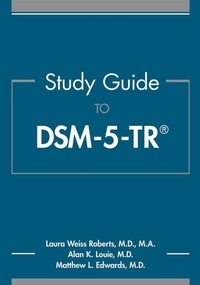
Study Guide to DSM-5-TR®
Description

The ultimate companion volume to DSM-5-TR, the Study Guide is designed to help clinical learners, teachers, and practitioners in psychiatry, psychology, and social work understand and apply diagnostic criteria. Medical students, residents, and fellows and trainees throughout the clinical neurosciences will find this text to be invaluable in developing their diagnostic abilities. An introduction to diagnostic frameworks and how they shape work with patients is followed by chapters focusing on DSM-5-TR's diagnostic categories. Each chapter features clinical vignettes that illustrate patterns of illness; diagnostic pearls that can be applied to daily practice; and a self-assessment section with key concepts, patient cases, and questions for further discussion.
This volume includes more than 100 multiple choice questions with an answer key, replete with brief vignettes covering a range of diagnoses and patient circumstances, bringing the concepts of DSM-5-TR to life and helping readers apply them to their work and training.
Rich in thought-provoking detail and designed for repeated use, the Study Guide to DSM-5-TR is an indispensable guide for learners, educators, and clinicians.
More details
Other editions
Additional editions
Persons
Laura Weiss Roberts, M.D., M.A., is Chairman and Katharine Dexter McCormick and Stanley McCormick Memorial Professor in the Department of Psychiatry and Behavioral Sciences at Stanford University School of Medicine in Stanford, California.
Alan K. Louie, M.D., is Professor, Associate Chair, and Director of Education in the Department of Psychiatry and Behavioral Sciences at Stanford University School of Medicine in Stanford, California.
Matthew L. Edwards, M.D., is an Assistant Professor and the Assistant Director of General Psychiatry Residency Training in the Department of Psychiatry and Behavioral Sciences at Stanford University School of Medicine in Stanford, California.
Content
DedicationsIntroductionPart One: FoundationsChapter 1: The role of diagnosis and the DSM-5-TRChapter 2: Arriving at a diagnosis: the role of the clinical interviewChapter 3: Understanding different approaches to diagnostic classificationChapter 4: Beyond diagnostic classification: Structural and cultural considerations and the DSM-5-TRPart Two: DSM-5 Diagnostic CategoriesChapter 5. Neurodevelopmental DisordersChapter 6. Schizophrenia Spectrum and Other Psychotic DisordersChapter 7. Bipolar and Related DisordersChapter 8. Depressive DisordersChapter 9. Anxiety DisordersChapter 10. Obsessive-Compulsive and Related DisordersChapter 11. Trauma- and Stressor-Related DisordersChapter 12. Dissociative DisordersChapter 13. Somatic Symptom and Related DisordersChapter 14. Feeding and Eating DisordersChapter 15. Elimination DisordersChapter 16. Sleep-Wake DisordersChapter 17. Sexual DysfunctionsChapter 18. Gender DysphoriaChapter 19. Disruptive, Impulse-Control, and Conduct DisordersChapter 20. Substance-Related and Addictive DisordersChapter 21. Neurocognitive DisordersChapter 22. Personality DisordersChapter 23. Paraphilic DisordersPart Three: Q&AChapter 25. Questions & Answers
