

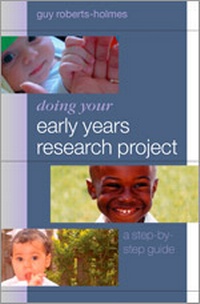
Doing Your Early Years Research Project
A Step by Step Guide
1st Edition
Published on 30. March 2005
Book
Hardback
176 pages
978-1-4129-0111-6 (ISBN)
Description
`This book provides an excellent foundation for anyone about to begin a small-scale research project for a diploma or first degree, not only in early years education, but in any educational phase. As its subtitle suggests, it is a step-by-step guide but it goes beyond this in the issues it tackles in several chapters, as well as being a valuable source of information including a glossary of research terminology, and an annotated list of early years journals. It has several strengths, in particular the 'personal research stories' which show the reader how several of the author's students tackled each stage of the research process. A second strength is the use of numerous thought provoking and pertinent activities throughout each chapter which encourage 'interaction' with the text. Guy Roberts-Holmes' accessible book should be on every reading list for people doing their undergraduate dissertations, or about to begin action research or small-scale research projects with children' - Early Years
'The book is written with a keen sensitivity to the needs of the novice researcher in ECEC, managing to demystify the concept of research without degrading it. Reading the excellent guidance on formulating a research question brought back for me the excitement of discovering that a simple, pared down question can yield big and complex answers. Magic! Case-study material from the work of students lends transparency to the discussion and makes real the research experience' - Early Education
`This book will provide invaluable for all those embarking on research of any kind in the filed of early childhood research. The author, an experienced researcher and lecturer in this field, has produced a clear, thorough and informative book which balances theoretical background with lots of practical examples and case studies' - Foundation Stage
`This new step-by-step guide will prove valuable to anyone completing an early years project. All aspects are covered from designing your research questions to writing your conclusion' - Practical Professional Child Care
`Doing Your Early Years Research Project is an ideal resource to help you through from start to finish. It will help students doing Early Childhood Studies Degree, Teacher Education, Nursing, Social Sciences and a range or CACHE awards' - Nursery Education
'This is an excellent resource for all those undertaking research in the field of Early Childhood Education and Care. It will be particularly valuable for students on Early Childhood Studies Degree Courses! Guy Roberts-Holmes has succeeded in writing a book which, in addition to offering valuable practical advice, is rigorous, supportive and encouraging to all those undertaking research with young children and their families' - Lesley Abbott, Professor of Early Childhood Education, Centre for Multi-Professional Research in the Early Years, Manchester Metropolitan University
This step-by-step guide will talk you through your Early Years research project from start to finish. Drawing on the work of practitioners within the sector to illustrate concepts and methods, it brings the entire research process to life. The heart of the book is concerned with how practitioners and students can listen to young children. Throughout the book the children's many 'voices' are seen as central to the research.
This book is packed with research summaries, key points checklists and discussion topics, making it practical and user-friendly. It features guidance on:
- selecting a topic
- organizing and structuring your project
- the range of research methods available to you (covering case studies, surveys, action research, documentary analysis and ethnography)
- ethical issues.
The text will also show you how to:
" use a whole range of methods of investigation, including observation, interviews and questionnaires
" do a literature review
" interpret your findings
" present and write up your project
" access useful sources of information for your research.
This is essential reading for students on all courses featuring a research project in the early years, such as early childhood studies, teacher education, nursing, social sciences and a wide range of CACHE awards. It is also invaluable for early years practitioners required to carry out small-scale research projects.
'The book is written with a keen sensitivity to the needs of the novice researcher in ECEC, managing to demystify the concept of research without degrading it. Reading the excellent guidance on formulating a research question brought back for me the excitement of discovering that a simple, pared down question can yield big and complex answers. Magic! Case-study material from the work of students lends transparency to the discussion and makes real the research experience' - Early Education
`This book will provide invaluable for all those embarking on research of any kind in the filed of early childhood research. The author, an experienced researcher and lecturer in this field, has produced a clear, thorough and informative book which balances theoretical background with lots of practical examples and case studies' - Foundation Stage
`This new step-by-step guide will prove valuable to anyone completing an early years project. All aspects are covered from designing your research questions to writing your conclusion' - Practical Professional Child Care
`Doing Your Early Years Research Project is an ideal resource to help you through from start to finish. It will help students doing Early Childhood Studies Degree, Teacher Education, Nursing, Social Sciences and a range or CACHE awards' - Nursery Education
'This is an excellent resource for all those undertaking research in the field of Early Childhood Education and Care. It will be particularly valuable for students on Early Childhood Studies Degree Courses! Guy Roberts-Holmes has succeeded in writing a book which, in addition to offering valuable practical advice, is rigorous, supportive and encouraging to all those undertaking research with young children and their families' - Lesley Abbott, Professor of Early Childhood Education, Centre for Multi-Professional Research in the Early Years, Manchester Metropolitan University
This step-by-step guide will talk you through your Early Years research project from start to finish. Drawing on the work of practitioners within the sector to illustrate concepts and methods, it brings the entire research process to life. The heart of the book is concerned with how practitioners and students can listen to young children. Throughout the book the children's many 'voices' are seen as central to the research.
This book is packed with research summaries, key points checklists and discussion topics, making it practical and user-friendly. It features guidance on:
- selecting a topic
- organizing and structuring your project
- the range of research methods available to you (covering case studies, surveys, action research, documentary analysis and ethnography)
- ethical issues.
The text will also show you how to:
" use a whole range of methods of investigation, including observation, interviews and questionnaires
" do a literature review
" interpret your findings
" present and write up your project
" access useful sources of information for your research.
This is essential reading for students on all courses featuring a research project in the early years, such as early childhood studies, teacher education, nursing, social sciences and a wide range of CACHE awards. It is also invaluable for early years practitioners required to carry out small-scale research projects.
Reviews / Votes
`This book provides an excellent foundation for anyone about to begin a small-scale research project for a diploma or first degree, not only in early years education, but in any educational phase. As its subtitle suggests, it is a step-by-step guide but it goes beyond this in the issues it tackles in several chapters, as well as being a valuable source of information including a glossary of research terminology, and an annotated list of early years journals. It has several strengths, in particular the 'personal research stories' which show the reader how several of the author's students tackled each stage of the research process. A second strength is the use of numerous thought provoking and pertinent activities throughout each chapter which encourage 'interaction' with the text. Guy Roberts-Holmes' accessible book should be on every reading list for people doing their undergraduate dissertations, or about to begin action research or small-scale research projects with children' - Early Years'The book is written with a keen sensitivity to the needs of the novice researcher in ECEC, managing to demystify the concept of research without degrading it. Reading the excellent guidance on formulating a research question brought back for me the excitement of discovering that a simple, pared down question can yield big and complex answers. Magic! Case-study material from the work of students lends transparency to the discussion and makes real the research experience' - British Association for Early Childhood Education
`I found the case studies and activities extremely valuable as they acted as prompts and helped me to focus on particular stages of my study. The author understands the complexities that face research students, and highlights the important issues of methodology and ethics surrounding a childhood study. It's definitely a must for anyone undertaking research of the kind' - Nursery World
`Doing Your Early Years Research Project is an ideal resource to help you through from start to finish. It will help students doing Early Childhood Studies Degree, Teacher Education, Nursing, Social Sciences and a range or CACHE awards' - Nursery Education
'This is an excellent resource for all those undertaking research in the field of Early Childhood Education and Care. It will be particularly valuable for students on Early Childhood Studies Degree Courses! Guy Roberts-Holmes has succeeded in writing a book which, in addition to offering valuable practical advice, is rigorous, supportive and encouraging to all those undertaking research with young children and their families' - Lesley Abbott, Professor of Early Childhood Education, Centre for Multi-Professional Research in the Early Years, Manchester Metropolitan University
More details
Language
English
Place of publication
Thousand Oaks
United States
Target group
College/higher education
Product notice
Cloth over boards
Dimensions
Height: 242 mm
Width: 170 mm
Weight
504 gr
ISBN-13
978-1-4129-0111-6 (9781412901116)
Copyright in bibliographic data and cover images is held by Nielsen Book Services Limited or by the publishers or by their respective licensors: all rights reserved.
Schweitzer Classification
Other editions
New editions
Book
03/2011
2nd Edition
SAGE Publications Ltd
€103.08
Article exhausted; check different version
Person
In the 1980s and 1990s, Guy Roberts-Holmes worked as one of a handful of male nursery and reception teachers in inner London primary schools. Guy thoroughly enjoyed this challenging experience and was eager for more insight into the wider context of early years education, and so completed a Master's degree at King's College, London. Guy then worked in The Gambia, West Africa, for Voluntary Services Overseas (VSO) and as a lecturer at The University of The Gambia. Whilst in The Gambia, he carried out an ethnography of a nursery and primary school, leading to a PhD at the University of Nottingham. Guy is the Programme Leader for the internationally renowned MA Early Years Education at the University College London, Institute of Education. His research interests include early years policy sociology, assessment, and the professionalisation of the early years workforce.
Guy Roberts-Holmes will be discussing his ideas in Doing Your Early Years Research Project, a SAGE Masterclass for early years students and practitioners in collaboration with Kathy Brodie. Find out more here.
Guy Roberts-Holmes will be discussing his ideas in Doing Your Early Years Research Project, a SAGE Masterclass for early years students and practitioners in collaboration with Kathy Brodie. Find out more here.
Content
YOU CAN DO RESEARCH
Your Feelings About Doing Research
Myths About Early Childhood Research
An Inclusive Approach Towards Early Childhood Research
Your Research Project within Early Childhood Studies
The Professionalisation of Early Childhood Studies
Principles of High-quality Early Childhood Research
The Research Process within Early Childhood Studies
Everyday Research Skills
The Responsibilities of your Supervisor
The Overall Structure of your Research Report
Your Responsibilities Throughout the Research
The Research Tutorial
Your Research Timetabling
YOUR RESEARCH STORY, METHODOLOGY AND RESEARCH QUESTIONS
Reflecting Upon Your Personal Story
Methodology
Some Research Stories
Your Reflective Diary
High Levels of Motivation
Professional Motivations
Focusing On Your Area of Interest
The Overall Research Questions and the Field Questions
Getting Your Research Questions Right - Breadth and Depth
Doing a Pilot Study
DESIGNING YOUR RESEARCH
Two Research Traditions
Positivist Validity
Interpretivist Validity
Triangulation and Validity
The Positivist and Interpretive Tradition: An Example
Action Research
Case Studies
Surveys
Broad and Deep Research
Justifying Your Methods
The Research Plan
ETHICAL ISSUES IN EARLY CHILDHOOD RESEARCH
Legislation and the Participatory Rights of Children
Sociology and the Participatory Rights of Children
Children's Participation and Protection
A Reflective Impact Assessment of Research on Children
Your Emotional Vulnerability
Informed Consent
Informed Consent, Confidentiality and Child Protection
Informed Consent Leaflet for Children
Socially Inclusive and Respectful Relationships with Children
Informed Consent Is an Ongoing Process
Negotiating Access with the Gatekeepers
'Feedback' and Closure of the Research
Ethical Dilemmas Are Hard To Resolve
Ethical Checklist
DOING YOUR LITERATURE REVIEW
Why Do a Literature Review?
Sources for Your Literature Review
Potential Difficulties
Starting Off Your Literature Review
How to Write Your Literature Review
Writing Bibliographies and References
Appendix 1: List of Early Years Journals
Appendix 2: Annotated List of Early Years Professional and Research-Based Websites
OBSERVATION: LOOKING AND LISTENING
Why Do Observations?
What Is Observation?
Interpretation
Being Open in Your Looking and Listening
Knowing the Context of Your Research Setting
Unstructured Observations
Structured Observations
Tally Counting
Observation Schedules
Event Sampling and Running Records
Video Observations
Observational Diagrams
Participant Observation
INTERVIEWING CHILDREN AND ADULTS
Different Types of Interviews
The Interview Guide
Probing
The Differences between An Interview And A Chat
Focus Group Conversations with Children
Children as Researchers
Using Structured Activities
Reflective Interviewing
A Wide Diversity of Children
Tape-Recording
CREATIVE LISTENING TO YOUNG CHILDREN
Developing Cultures of Meaningful Participation
What Is Creative Listening?
The Mosaic Approach
Cameras and Ethics
Children's Photographs and Walking Tours
Children's Drawings
Children's Interpretations of Their Pictures
WRITING AND USING QUESTIONNAIRES
Using Questionnaires
Using Questionnaires to Identify Issues
Writing Your Questionnaire
Different Types of Questions
THE ANALYSIS OF YOUR DATA AND WRITING THE CONCLUSION
The Process of Organising Your Data
Sorting It All Out
Use a Wide Range of Data
Generating Categories and Themes
Writing Your Conclusion
Further Research Questions
Sharing Your Research
Your Feelings About Doing Research
Myths About Early Childhood Research
An Inclusive Approach Towards Early Childhood Research
Your Research Project within Early Childhood Studies
The Professionalisation of Early Childhood Studies
Principles of High-quality Early Childhood Research
The Research Process within Early Childhood Studies
Everyday Research Skills
The Responsibilities of your Supervisor
The Overall Structure of your Research Report
Your Responsibilities Throughout the Research
The Research Tutorial
Your Research Timetabling
YOUR RESEARCH STORY, METHODOLOGY AND RESEARCH QUESTIONS
Reflecting Upon Your Personal Story
Methodology
Some Research Stories
Your Reflective Diary
High Levels of Motivation
Professional Motivations
Focusing On Your Area of Interest
The Overall Research Questions and the Field Questions
Getting Your Research Questions Right - Breadth and Depth
Doing a Pilot Study
DESIGNING YOUR RESEARCH
Two Research Traditions
Positivist Validity
Interpretivist Validity
Triangulation and Validity
The Positivist and Interpretive Tradition: An Example
Action Research
Case Studies
Surveys
Broad and Deep Research
Justifying Your Methods
The Research Plan
ETHICAL ISSUES IN EARLY CHILDHOOD RESEARCH
Legislation and the Participatory Rights of Children
Sociology and the Participatory Rights of Children
Children's Participation and Protection
A Reflective Impact Assessment of Research on Children
Your Emotional Vulnerability
Informed Consent
Informed Consent, Confidentiality and Child Protection
Informed Consent Leaflet for Children
Socially Inclusive and Respectful Relationships with Children
Informed Consent Is an Ongoing Process
Negotiating Access with the Gatekeepers
'Feedback' and Closure of the Research
Ethical Dilemmas Are Hard To Resolve
Ethical Checklist
DOING YOUR LITERATURE REVIEW
Why Do a Literature Review?
Sources for Your Literature Review
Potential Difficulties
Starting Off Your Literature Review
How to Write Your Literature Review
Writing Bibliographies and References
Appendix 1: List of Early Years Journals
Appendix 2: Annotated List of Early Years Professional and Research-Based Websites
OBSERVATION: LOOKING AND LISTENING
Why Do Observations?
What Is Observation?
Interpretation
Being Open in Your Looking and Listening
Knowing the Context of Your Research Setting
Unstructured Observations
Structured Observations
Tally Counting
Observation Schedules
Event Sampling and Running Records
Video Observations
Observational Diagrams
Participant Observation
INTERVIEWING CHILDREN AND ADULTS
Different Types of Interviews
The Interview Guide
Probing
The Differences between An Interview And A Chat
Focus Group Conversations with Children
Children as Researchers
Using Structured Activities
Reflective Interviewing
A Wide Diversity of Children
Tape-Recording
CREATIVE LISTENING TO YOUNG CHILDREN
Developing Cultures of Meaningful Participation
What Is Creative Listening?
The Mosaic Approach
Cameras and Ethics
Children's Photographs and Walking Tours
Children's Drawings
Children's Interpretations of Their Pictures
WRITING AND USING QUESTIONNAIRES
Using Questionnaires
Using Questionnaires to Identify Issues
Writing Your Questionnaire
Different Types of Questions
THE ANALYSIS OF YOUR DATA AND WRITING THE CONCLUSION
The Process of Organising Your Data
Sorting It All Out
Use a Wide Range of Data
Generating Categories and Themes
Writing Your Conclusion
Further Research Questions
Sharing Your Research