

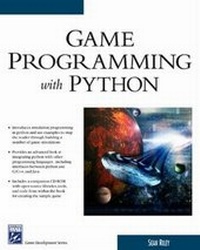
Game Programming With Python
Published on 24. October 2003
Book
Mixed media product
470 pages
978-1-58450-258-6 (ISBN)
Description
If C and C++ are the languages of choice for game programmers, why should you consider using Python? Game Programming with Python explores this question in depth and teaches you why and how Python can reduce your development time, improve your technical designs, and make the entire development process more efficient. Game Programming with Python is about building games using Python. It deals with general concepts of game development and specifics that apply when using Python for game development. Some of the general topics include simulations, game architectures, graphics, networking, and user interfaces. The Python-specific topics covered include Python development strategies, using Python for data-driven systems, performance tuning, modules and packages, and interfaces between Python and other programming languages. Additionally, a series of increasingly complex examples are developed throughout the book using Python. Python is already being used by professional game developers in a number of popular commercial games, including the award winning Star Trek (R) Bridge Commander (Totally Games), Freedom Force (Irrational Games), and Earth & Beyond (Electronic Arts).
Games such as these use Python in three major ways: as a full-fledged programming language to develop real software systems; as a scripting language to control and interface between systems written in other languages; and as a data language to describe game rules and game objects. Throughout the book, each of these major uses of Python is discussed along with the differences between them. Written for Python programmers interested in learning game development, as well as game developers interested in using Python, the book assumes you have some programming background and a basic grasp of software engineering principles. Some knowledge of the game development process is also assumed, although a concise overview is provided.
If C and C++ are the languages of choice for game programmers, why should you consider using Python? Game Programming with Python explores this question in depth and teaches you why and how Python can reduce your development time, improve your technical designs, and make the entire development process more efficient. Game Programming with Python is about building games using Python. It deals with general concepts of game development and specifics that apply when using Python for game development. Some of the general topics include simulations, game architectures, graphics, networking, and user interfaces. The Python-specific topics covered include Python development strategies, using Python for data-driven systems, performance tuning, modules and packages, and interfaces between Python and other programming languages. Additionally, a series of increasingly complex examples are developed throughout the book using Python. Python is already being used by professional game developers in a number of popular commercial games, including the award winning Star Trek (R) Bridge Commander (Totally Games), Freedom Force (Irrational Games), and Earth & Beyond (Electronic Arts).
Games such as these use Python in three major ways: as a full-fledged programming language to develop real software systems; as a scripting language to control and interface between systems written in other languages; and as a data language to describe game rules and game objects. Throughout the book, each of these major uses of Python is discussed along with the differences between them. Written for Python programmers interested in learning game development, as well as game developers interested in using Python, the book assumes you have some programming background and a basic grasp of software engineering principles. Some knowledge of the game development process is also assumed, although a concise overview is provided.
Games such as these use Python in three major ways: as a full-fledged programming language to develop real software systems; as a scripting language to control and interface between systems written in other languages; and as a data language to describe game rules and game objects. Throughout the book, each of these major uses of Python is discussed along with the differences between them. Written for Python programmers interested in learning game development, as well as game developers interested in using Python, the book assumes you have some programming background and a basic grasp of software engineering principles. Some knowledge of the game development process is also assumed, although a concise overview is provided.
If C and C++ are the languages of choice for game programmers, why should you consider using Python? Game Programming with Python explores this question in depth and teaches you why and how Python can reduce your development time, improve your technical designs, and make the entire development process more efficient. Game Programming with Python is about building games using Python. It deals with general concepts of game development and specifics that apply when using Python for game development. Some of the general topics include simulations, game architectures, graphics, networking, and user interfaces. The Python-specific topics covered include Python development strategies, using Python for data-driven systems, performance tuning, modules and packages, and interfaces between Python and other programming languages. Additionally, a series of increasingly complex examples are developed throughout the book using Python. Python is already being used by professional game developers in a number of popular commercial games, including the award winning Star Trek (R) Bridge Commander (Totally Games), Freedom Force (Irrational Games), and Earth & Beyond (Electronic Arts).
Games such as these use Python in three major ways: as a full-fledged programming language to develop real software systems; as a scripting language to control and interface between systems written in other languages; and as a data language to describe game rules and game objects. Throughout the book, each of these major uses of Python is discussed along with the differences between them. Written for Python programmers interested in learning game development, as well as game developers interested in using Python, the book assumes you have some programming background and a basic grasp of software engineering principles. Some knowledge of the game development process is also assumed, although a concise overview is provided.
Reviews / Votes
1 Overview SECTION I Introduction 5 2 Game Architecture 3 Python Game Architectures SECTION II Game Infrastructure 25 4 Python Game Framework 5 Simulation Concepts 6 Data-Driven Simulations 7 Collision Detection SECTION III Game Technologies 97 8 Graphics 9 Audio 10 Input 11 Unit Testing SECTION IV Game Programming 161 12 Game Simulations 13 Game Levels 14 User Interfaces 15 Artificial Intelligence 16 Procedurally Generated Game Content SECTION V Multiplayer Games 295 17 Network Concepts 18 Network Layers 19 Clients and Servers 20 Multiplayer Game Example SECTION VI Advanced Topics 389 21 Using the Python C API 22 Extending Python 23 Embedding Python1 Overview SECTION I Introduction 5 2 Game Architecture 3 Python Game Architectures SECTION II Game Infrastructure 25 4 Python Game Framework 5 Simulation Concepts 6 Data-Driven Simulations 7 Collision Detection SECTION III Game Technologies 97 8 Graphics 9 Audio 10 Input 11 Unit Testing SECTION IV Game Programming 161 12 Game Simulations 13 Game Levels 14 User Interfaces 15 Artificial Intelligence 16 Procedurally Generated Game Content SECTION V Multiplayer Games 295 17 Network Concepts 18 Network Layers 19 Clients and Servers 20 Multiplayer Game Example SECTION VI Advanced Topics 389 21 Using the Python C API 22 Extending Python 23 Embedding Python
More details
Edition
New edition
Language
English
Place of publication
Hingham
United States
Publishing group
Cengage Learning, Inc
Target group
Professional and scholarly
College/higher education
Edition type
New edition
Illustrations
Illustrations
Dimensions
Height: 235 mm
Width: 188 mm
Thickness: 33 mm
Weight
1089 gr
ISBN-13
978-1-58450-258-6 (9781584502586)
Copyright in bibliographic data and cover images is held by Nielsen Book Services Limited or by the publishers or by their respective licensors: all rights reserved.
Schweitzer Classification
Person
Sean Riley (Austin, TX) has worked as a programmer in the computer industry for eleven years and as a programmer and designer in the game industry for over five years. He has been using Python for over three years and has been involved in open source Python development and two large-scale commercial game development projects using Python. He contributed to Massively Multiplayer Game Development and currently works as a senior software engineer in the core technology group of Ncsoft ' the largest publisher of online games in the world, in Austin, Texas.
Sean Riley (Austin, TX) has worked as a programmer in the computer industry for eleven years and as a programmer and designer in the game industry for over five years. He has been using Python for over three years and has been involved in open source Python development and two large-scale commercial game development projects using Python. He contributed to Massively Multiplayer Game Development and currently works as a senior software engineer in the core technology group of Ncsoft ' the largest publisher of online games in the world, in Austin, Texas.
Sean Riley (Austin, TX) has worked as a programmer in the computer industry for eleven years and as a programmer and designer in the game industry for over five years. He has been using Python for over three years and has been involved in open source Python development and two large-scale commercial game development projects using Python. He contributed to Massively Multiplayer Game Development and currently works as a senior software engineer in the core technology group of Ncsoft ' the largest publisher of online games in the world, in Austin, Texas.
Content
1 Overview SECTION I Introduction 5 2 Game Architecture 3 Python Game Architectures SECTION II Game Infrastructure 25 4 Python Game Framework 5 Simulation Concepts 6 Data-Driven Simulations 7 Collision Detection SECTION III Game Technologies 97 8 Graphics 9 Audio 10 Input 11 Unit Testing SECTION IV Game Programming 161 12 Game Simulations 13 Game Levels 14 User Interfaces 15 Artificial Intelligence 16 Procedurally Generated Game Content SECTION V Multiplayer Games 295 17 Network Concepts 18 Network Layers 19 Clients and Servers 20 Multiplayer Game Example SECTION VI Advanced Topics 389 21 Using the Python C API 22 Extending Python 23 Embedding Python