

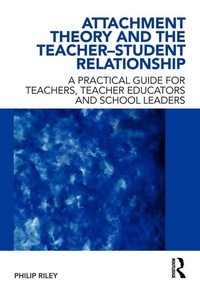
Attachment Theory and the Teacher-Student Relationship
A Practical Guide for Teachers, Teacher Educators and School Leaders
1st Edition
Published on 13. August 2010
Book
Paperback/Softback
200 pages
978-0-415-56262-1 (ISBN)
Description
How teachers form and maintain classroom and staffroom relationships is crucial to the success of their work. A teacher who is able to accurately interpret the underlying relationship processes can learn to proactively, rather than reactively, influence the dynamics of any class. These are skills that can be taught. This invaluable text explains how adult attachment theory offers new ways to examine professional teaching relationships, classroom management and collegial harmony: equally important information for school leaders, teacher mentors and proteges.
Attachment Theory and the Teacher-Student Relationship addresses three significant gaps in the current literature on classroom management:
the effects of teachers' attachment style on the formation and maintenance of classroom and staffroom relationships
the importance of attachment processes in scaffolding teachers' and students emotional responses to daily educational tasks
the degree of influence these factors have on teachers' classroom behaviour, particularly management of student behaviour.
Based on recent developments in adult attachment theory, this book highlights the key aspects of teacher-student relationships that teachers and teacher educators should know. As such, it will be of great interest to educational researchers, teacher educators, students and training teachers.
Attachment Theory and the Teacher-Student Relationship addresses three significant gaps in the current literature on classroom management:
the effects of teachers' attachment style on the formation and maintenance of classroom and staffroom relationships
the importance of attachment processes in scaffolding teachers' and students emotional responses to daily educational tasks
the degree of influence these factors have on teachers' classroom behaviour, particularly management of student behaviour.
Based on recent developments in adult attachment theory, this book highlights the key aspects of teacher-student relationships that teachers and teacher educators should know. As such, it will be of great interest to educational researchers, teacher educators, students and training teachers.
More details
Language
English
Place of publication
London
United Kingdom
Publishing group
Taylor & Francis Ltd
Target group
College/higher education
Professional and scholarly
Illustrations
5 s/w Zeichnungen, 3 s/w Tabellen
3 Tables, black and white; 5 Line drawings, black and white
Dimensions
Height: 234 mm
Width: 156 mm
Thickness: 11 mm
Weight
313 gr
ISBN-13
978-0-415-56262-1 (9780415562621)
Copyright in bibliographic data and cover images is held by Nielsen Book Services Limited or by the publishers or by their respective licensors: all rights reserved.
Schweitzer Classification
Other editions
Additional editions
Philip Riley
Attachment Theory and the Teacher-Student Relationship
A Practical Guide for Teachers, Teacher Educators and School Leaders
E-Book
09/2010
Routledge
€63.49
Available for download
Philip Riley
Attachment Theory and the Teacher-Student Relationship
A Practical Guide for Teachers, Teacher Educators and School Leaders
E-Book
09/2010
Routledge
€63.49
Available for download
Philip Riley
Attachment Theory and the Teacher-Student Relationship
A Practical Guide for Teachers, Teacher Educators and School Leaders
Book
08/2010
1st Edition
Routledge
€251.70
Shipment within 15-20 days
Person
Philip Riley is Senior Lecturer in the Faculty of Education, Monash University, Australia. He is also a registered psychologist and an experienced teacher at both primary and secondary level.
Content
@contents: Foreword Section I: Attachment Theory 1. Attachment Theory and the Classroom 2. Adult Attachment Theory & the Teacher-Student Relationship 3. The Emotionality of Teaching Section II: Researching Teachers' Attachments 4. Does Time in the Classroom Effect Attachment Style? 5. Contextual Insight-Navigated Discussion 6. CIND Mentoring: Supporting Transitions & Early Career Retentions 7. The Implications of New Knowledge: Old Wine in New Bottles? 8 Further into Attachment Theory References and Selected Bibliography Index