

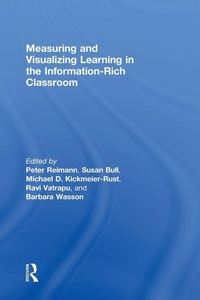
Measuring and Visualizing Learning in the Information-Rich Classroom
1st Edition
Published on 8. December 2015
Book
Hardback
262 pages
978-1-138-02112-9 (ISBN)
Description
Integrated information systems are increasingly used in schools, and the advent of the technology-rich classroom requires a new degree of ongoing classroom assessment. Able to track web searches, resources used, task completion time, and a variety of other classroom behaviors, technology-rich classrooms offer a wealth of potential information about teaching and learning. This information can be used to track student progress in languages, STEM, and in 21st Century skills, for instance. However, despite these changes, there has been little change in the kind of data made available to teachers, administrators, students, and parents.
Measuring and Visualizing Learning in the Information-Rich Classroom collects research on the implementation of classroom assessment techniques in technology-enhanced learning environments. Building on research conducted by a multinational and multidisciplinary team of learning technology experts, and specialists from around the globe, this book addresses these discrepancies. With contributions from major researchers in education technology, testing and assessment, and education psychology, this book contributes to a holistic approach for building the information infrastructure of the 21st Century school.
Measuring and Visualizing Learning in the Information-Rich Classroom collects research on the implementation of classroom assessment techniques in technology-enhanced learning environments. Building on research conducted by a multinational and multidisciplinary team of learning technology experts, and specialists from around the globe, this book addresses these discrepancies. With contributions from major researchers in education technology, testing and assessment, and education psychology, this book contributes to a holistic approach for building the information infrastructure of the 21st Century school.
More details
Language
English
Place of publication
London
United Kingdom
Publishing group
Taylor & Francis Ltd
Target group
College/higher education
Illustrations
87 s/w Abbildungen, 26 s/w Tabellen
26 Tables, black and white; 87 Illustrations, black and white
Dimensions
Height: 260 mm
Width: 183 mm
Thickness: 19 mm
Weight
698 gr
ISBN-13
978-1-138-02112-9 (9781138021129)
Copyright in bibliographic data and cover images is held by Nielsen Book Services Limited or by the publishers or by their respective licensors: all rights reserved.
Schweitzer Classification
Other editions
Additional editions
Peter Reimann | Susan Bull | Michael Kickmeier-Rust
Measuring and Visualizing Learning in the Information-Rich Classroom
Book
12/2015
1st Edition
Routledge
€81.20
Shipment within 10-20 days
Peter Reimann | Susan Bull | Michael Kickmeier-Rust
Measuring and Visualizing Learning in the Information-Rich Classroom
E-Book
11/2015
Routledge
€76.49
Available for download
Peter Reimann | Susan Bull | Michael Kickmeier-Rust
Measuring and Visualizing Learning in the Information-Rich Classroom
E-Book
11/2015
Routledge
€76.49
Available for download
Persons
Peter Reimann is a Professor for Education at the University of Sydney, Australia, and Senior Researcher in that university's Research Centre for Computer-supported Learning and Cognition (CoCo).
Susan Bull is Senior Lecturer of Electronic, Electrical, and Computer Engineering at University of Birmingham, UK.
Michael D. Kickmeier-Rust is a Senior Researcher and Project Director at the Cognitive Science Section of the Knowledge Technologies Institute at Graz University of Technology and University Lecturer at the Department of Psychology at Karl-Franzens-University of Graz, Austria.
Ravi Vatrapu is a Professor of Human Computer Interaction at the Department of IT Management, Copenhagen Business School; Professor of applied computing, Westerdals Oslo School of Arts, Communication and Technology; and Director of the Computational Social Science Laboratory (CSSL).
Barbara Wasson is Professor in the Department of Information Science & Media Studies and Director of the Centre for the Science of Learning and Technology (SLATE) at University of Bergen, and Research Leader at Uni Research Health AS.
Susan Bull is Senior Lecturer of Electronic, Electrical, and Computer Engineering at University of Birmingham, UK.
Michael D. Kickmeier-Rust is a Senior Researcher and Project Director at the Cognitive Science Section of the Knowledge Technologies Institute at Graz University of Technology and University Lecturer at the Department of Psychology at Karl-Franzens-University of Graz, Austria.
Ravi Vatrapu is a Professor of Human Computer Interaction at the Department of IT Management, Copenhagen Business School; Professor of applied computing, Westerdals Oslo School of Arts, Communication and Technology; and Director of the Computational Social Science Laboratory (CSSL).
Barbara Wasson is Professor in the Department of Information Science & Media Studies and Director of the Centre for the Science of Learning and Technology (SLATE) at University of Bergen, and Research Leader at Uni Research Health AS.
Content
Contents
Preface
Introduction
Section 1: Concepts and Research
1. Infrastructures for Improving Learning in Information-Rich Classrooms
Jeremy Roschelle and Andrew Krumm
2. Influencing Cognitive Density and Enhancing Classroom Orchestration
Carmen Biel, Gabriele Ciernak, Matthew D. Johnson, Susan Bull, and Friedrich W. Hesse
3. The Promise and Potential of e-assessment for Learning
Eric Ras, Denise Whitelock, and Marco Kalz
4. Learning Analytics. How can Data be Used to Improve Learning Practice?
Abelardo Pardo and Shane Dawson
5. Data Literacy and Use for Teaching
Barbara Wasson and Cecilie Hansen
6. Teacher Inquiry into Students' Learning: Researching Pedagogical Innovations
Rosemary Luckin, Cecile Hansen, Barbara Wasson, Wilma Clark, Katerina Avramides, Jade Hunter, and Martin Oliver
7. Designing Authentic Assessments in Higher Education
Peter Reimann and Maryam Khosronejad
Section 2: Methods for Measuring Learning
8. Competence-based Knowledge Space Theory: Options for the 21st Century Classroom
Michael D. Kickmeier-Rust and Dietrich Albert
9. Repertory Grids for Formative Assessment: Concept, Method, Tool and Findings
Ravi Vatrapu
10. Tracking and Assessing Students' Learning Strategies in Model-based Learning Environments
Lina Markauskaite and Michael Jacobson
11. Formative Assessment of Computer-supported Collaborative Learning and Knowledge Building
Jan van Aalst, Jin Mu, and Yuqin Yang
12. Integrating and Visualising Diagnostic Information for the Benefit of Learning
Susan Bull, Matthew D. Johnson, Drew Masci, and Carmen Biel
Section 3: Technology
13. Planning for Integration: A Meta-Modelling Approach using ADOxx
Wilfrid Utz, Robert Woitsch, and Zbigniew Misiak
14. Competence diagnostics, activity tracking, and evidence-based visual feedback: Visions vs. school realities
Michael Kickmeier-Rust, Klaus Hammermuller, Kolja Debus, Gerhilde Meissl-Egghart, and Carmen Biel
15. Storing and sharing student learning data with e-portfolios
Fabrizio Giorgini and Roland Unterberger
16. Designing for Visualisation of Formative Information on Learning
Matthew D. Johnson and Susan Bull
Preface
Introduction
Section 1: Concepts and Research
1. Infrastructures for Improving Learning in Information-Rich Classrooms
Jeremy Roschelle and Andrew Krumm
2. Influencing Cognitive Density and Enhancing Classroom Orchestration
Carmen Biel, Gabriele Ciernak, Matthew D. Johnson, Susan Bull, and Friedrich W. Hesse
3. The Promise and Potential of e-assessment for Learning
Eric Ras, Denise Whitelock, and Marco Kalz
4. Learning Analytics. How can Data be Used to Improve Learning Practice?
Abelardo Pardo and Shane Dawson
5. Data Literacy and Use for Teaching
Barbara Wasson and Cecilie Hansen
6. Teacher Inquiry into Students' Learning: Researching Pedagogical Innovations
Rosemary Luckin, Cecile Hansen, Barbara Wasson, Wilma Clark, Katerina Avramides, Jade Hunter, and Martin Oliver
7. Designing Authentic Assessments in Higher Education
Peter Reimann and Maryam Khosronejad
Section 2: Methods for Measuring Learning
8. Competence-based Knowledge Space Theory: Options for the 21st Century Classroom
Michael D. Kickmeier-Rust and Dietrich Albert
9. Repertory Grids for Formative Assessment: Concept, Method, Tool and Findings
Ravi Vatrapu
10. Tracking and Assessing Students' Learning Strategies in Model-based Learning Environments
Lina Markauskaite and Michael Jacobson
11. Formative Assessment of Computer-supported Collaborative Learning and Knowledge Building
Jan van Aalst, Jin Mu, and Yuqin Yang
12. Integrating and Visualising Diagnostic Information for the Benefit of Learning
Susan Bull, Matthew D. Johnson, Drew Masci, and Carmen Biel
Section 3: Technology
13. Planning for Integration: A Meta-Modelling Approach using ADOxx
Wilfrid Utz, Robert Woitsch, and Zbigniew Misiak
14. Competence diagnostics, activity tracking, and evidence-based visual feedback: Visions vs. school realities
Michael Kickmeier-Rust, Klaus Hammermuller, Kolja Debus, Gerhilde Meissl-Egghart, and Carmen Biel
15. Storing and sharing student learning data with e-portfolios
Fabrizio Giorgini and Roland Unterberger
16. Designing for Visualisation of Formative Information on Learning
Matthew D. Johnson and Susan Bull