

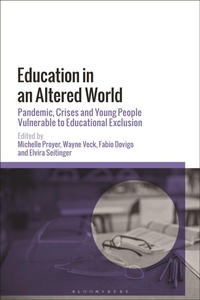
Education in an Altered World
Pandemic, Crises and Young People Vulnerable to Educational Exclusion
Published on 21. August 2025
Book
Paperback/Softback
304 pages
978-1-350-28273-5 (ISBN)
Description
This book brings together world-leading researchers and scholars in the fields of inclusive education, disability studies, refugee education and special education to examine critical and original perspectives of the meaning and consequences of educational and social exclusion. Drawing together, the contributors consider how children already vulnerable to exclusion might be supported and educated in and through times of global pandemic and crisis. They also identify broad prospects for education and inclusion in, through and beyond times of global pandemic and crisis.
Reviews / Votes
This impressive volume exposes the many substantial injustices within an educational world radically altered by the pandemic. The contributors examine the ethics of the vulnerability of children to exclusion and provoke both discomfort and a determination to find new and better ways to educate our children. * Julie Allan, Professor of Equity and Inclusion, University of Birmingham, UK * This book is a "must-read" for anyone committed to educational justice and equity in our complex, uncertain, and altered world. The chapter authors show the pandemic as a moment of inflection and reflection, and offer ways to disrupt entrenched exclusionary practices of those deemed "at risk" or "vulnerable". Highly recommended! * Elizabeth Walton, Professor of Education, University of Nottingham, UK * This book is critical reading for anyone with an interest in educational access and equity. It highlights the uneven educational impacts of the COVID-19 pandemic for children and young people - generally and in specific contexts. It is also relevant beyond the pandemic, given ongoing climate change and geopolitical instability. * Vivienne Anderson, Associate Professor and Dean, College of Education, University of Otago, New Zealand *More details
Language
English
Place of publication
London
United Kingdom
Publishing group
Bloomsbury Publishing PLC
Target group
Professional and scholarly
Illustrations
10 bw illus
Dimensions
Height: 234 mm
Width: 156 mm
Thickness: 16 mm
Weight
465 gr
ISBN-13
978-1-350-28273-5 (9781350282735)
Copyright in bibliographic data and cover images is held by Nielsen Book Services Limited or by the publishers or by their respective licensors: all rights reserved.
Schweitzer Classification
Other editions
Additional editions
Michelle Proyer | Wayne Veck | Fabio Dovigo
Education in an Altered World
Pandemic, Crises and Young People Vulnerable to Educational Exclusion
E-Book
01/2023
1st Edition
Bloomsbury Academic
€31.99
Available for download
Michelle Proyer | Wayne Veck | Fabio Dovigo
Education in an Altered World
Pandemic, Crises and Young People Vulnerable to Educational Exclusion
E-Book
01/2023
1st Edition
Bloomsbury Academic
€31.99
Available for download
Persons
Michelle Proyer is Assistant Professor in Inclusive Education at the University of Vienna, Austria.
Wayne Veck is Reader in Education at Winchester University, UK.
Fabio Dovigo is Professor of Psychology of Education in the Danish School of Education at Aarhus University, Denmark.
Elvira Seitinger is Project Assistant at the University of Vienna, Austria, and teacher at Schule am Himmel, an inclusive school.
Wayne Veck is Reader in Education at Winchester University, UK.
Fabio Dovigo is Professor of Psychology of Education in the Danish School of Education at Aarhus University, Denmark.
Elvira Seitinger is Project Assistant at the University of Vienna, Austria, and teacher at Schule am Himmel, an inclusive school.
Content
Introduction, Michelle Proyer (University of Vienna, Austria), Wayne Veck (Winchester University, UK), Fabio Dovigo (Aarhus University, Denmark) and Elvira Seitinger (University of Vienna, Austria)
Part I: Critical Understandings of Educational Exclusion and Crisis
1. The Meaning of Collective Capabilities for the Education of Refugee Children During a Pandemic, Margarita Bilgeri (University of Vienna, Austria)
2. COVID-19 Exposing the Fault-Lines of Inclusion: The 'Risk' and 'Vulnerability' of Disabled Children in the UK, Sharon Smith (University of Birmingham, UK)
Part II: Teaching and Learning under the Shadow of a Global Pandemic: Exclusions and Possibilities
3. The Effect of the COVID-19 Pandemic on Students in a Vulnerable Situation in Iceland, Hermina Gunn?orsdottir (University of Akureyri, Iceland and the University of Iceland, Iceland) and Ylfa G. Sigur?ardottir (Nor?lingaskoli, Iceland)
4. Increased Educational Disadvantages of Refugee Students in German Language Support Classes During COVID-19 School Closures in Austria: Perceptions and Pedagogical Reactions of Austrian Teachers, Katharina-Theresa Lindner (University of Vienna, Austria), Marie Gitschthaler (KPH Vienna/Lower Austria), Alexandra Gutschik (University of Vienna, Austria), Julia Kast (University of Vienna, Austria), Julia Honcik , Rupert Corazza (Board of Education for Vienna, Austria) and Susanne Schwab (University of Vienna, Austria)
5. Distance Learning and Inclusive School: an Impossible Challenge?, Ines Guerini (Roma Tre University, Italy), Giorgia Ruzzante (University of Bozen, Italy), Alessia Travaglini (La Sapienza University, Italy)
Part III: Addressing Social Exclusion: Illuminating Possibilities for Inclusion in and through Crisis
6. A Widening Inequality Gap: Reducing Educational Inequalities in Europe by Reaching Out to Students and Families at Risk During a Time of Crisis and Beyond, Pamela Spiteri (Lancaster University, UK)
7. Establishing the Medium to Long-Term Impact of Covid-19 Constraints on the Socio-Emotional Wellbeing of Impoverished Children and Young People (and Those Who are Otherwise Disadvantaged) During, and in the Aftermath of, Covid-19, Joan Mowat (University of Strathclyde, UK)
8. Possible Contributions of the School in Preventing the Maintenance of Poverty in the Case of Some Romanian Disadvantaged Children and the Context of the Pandemic, Ruxandra Folostina (University of Bucharest, Romania) and Loredana Adriana Patrascoiu (University of Bucharest, Romania)
Part IV: Including Excluded Individuals and Communities in Times of Crisis
9. COVID-19 and Disadvantaged Roma Communities in Romania, Rosa Drown (Independent Researcher, Romania)
10. Teachers Supporting Refugee Students in Canada during COVID-19: Strengthening a Sense of Belonging, Susan Barber (Simon Fraser University, Canada)
11. Making a Place for Refugee Education: Routes Towards Meaningful Inclusion for Refugee Teenagers in 'New-Normal' England, Joanna McIntyre (University of Nottingham, UK)
12. Thinking About the Emotional Wellbeing of Black Children in a Post-Pandemic World, Siya Mngaza (University of Birmingham, UK)
Part V: Disability and Crisis
13. Teach in the Mornings, Cry in the Evenings: The Impact of COVID-19 Remote Schooling on the Mothers of Emergent Bilinguals with Disabilities, Maria Cioe-Pena (University of Pennsylvania's Graduate School of Education, USA)
14. 'We're in the Same Storm But NOT in the Same Boat': Searching for the Voices of Parents of Students With SEN in Coronavirus Times, Elisabeth De Schauwer (Ghent University, Belgium), Inge Van de Putte (Ghent University, Belgium) and Geert Van Hove (Ghent University, Belgium)
Conclusion
15. Out of Crisis the New Future: Concluding Thoughts on Inclusive and Equitable Education For All With a View From Scotland, David Watt (University of Glasgow, UK)
Index
Part I: Critical Understandings of Educational Exclusion and Crisis
1. The Meaning of Collective Capabilities for the Education of Refugee Children During a Pandemic, Margarita Bilgeri (University of Vienna, Austria)
2. COVID-19 Exposing the Fault-Lines of Inclusion: The 'Risk' and 'Vulnerability' of Disabled Children in the UK, Sharon Smith (University of Birmingham, UK)
Part II: Teaching and Learning under the Shadow of a Global Pandemic: Exclusions and Possibilities
3. The Effect of the COVID-19 Pandemic on Students in a Vulnerable Situation in Iceland, Hermina Gunn?orsdottir (University of Akureyri, Iceland and the University of Iceland, Iceland) and Ylfa G. Sigur?ardottir (Nor?lingaskoli, Iceland)
4. Increased Educational Disadvantages of Refugee Students in German Language Support Classes During COVID-19 School Closures in Austria: Perceptions and Pedagogical Reactions of Austrian Teachers, Katharina-Theresa Lindner (University of Vienna, Austria), Marie Gitschthaler (KPH Vienna/Lower Austria), Alexandra Gutschik (University of Vienna, Austria), Julia Kast (University of Vienna, Austria), Julia Honcik , Rupert Corazza (Board of Education for Vienna, Austria) and Susanne Schwab (University of Vienna, Austria)
5. Distance Learning and Inclusive School: an Impossible Challenge?, Ines Guerini (Roma Tre University, Italy), Giorgia Ruzzante (University of Bozen, Italy), Alessia Travaglini (La Sapienza University, Italy)
Part III: Addressing Social Exclusion: Illuminating Possibilities for Inclusion in and through Crisis
6. A Widening Inequality Gap: Reducing Educational Inequalities in Europe by Reaching Out to Students and Families at Risk During a Time of Crisis and Beyond, Pamela Spiteri (Lancaster University, UK)
7. Establishing the Medium to Long-Term Impact of Covid-19 Constraints on the Socio-Emotional Wellbeing of Impoverished Children and Young People (and Those Who are Otherwise Disadvantaged) During, and in the Aftermath of, Covid-19, Joan Mowat (University of Strathclyde, UK)
8. Possible Contributions of the School in Preventing the Maintenance of Poverty in the Case of Some Romanian Disadvantaged Children and the Context of the Pandemic, Ruxandra Folostina (University of Bucharest, Romania) and Loredana Adriana Patrascoiu (University of Bucharest, Romania)
Part IV: Including Excluded Individuals and Communities in Times of Crisis
9. COVID-19 and Disadvantaged Roma Communities in Romania, Rosa Drown (Independent Researcher, Romania)
10. Teachers Supporting Refugee Students in Canada during COVID-19: Strengthening a Sense of Belonging, Susan Barber (Simon Fraser University, Canada)
11. Making a Place for Refugee Education: Routes Towards Meaningful Inclusion for Refugee Teenagers in 'New-Normal' England, Joanna McIntyre (University of Nottingham, UK)
12. Thinking About the Emotional Wellbeing of Black Children in a Post-Pandemic World, Siya Mngaza (University of Birmingham, UK)
Part V: Disability and Crisis
13. Teach in the Mornings, Cry in the Evenings: The Impact of COVID-19 Remote Schooling on the Mothers of Emergent Bilinguals with Disabilities, Maria Cioe-Pena (University of Pennsylvania's Graduate School of Education, USA)
14. 'We're in the Same Storm But NOT in the Same Boat': Searching for the Voices of Parents of Students With SEN in Coronavirus Times, Elisabeth De Schauwer (Ghent University, Belgium), Inge Van de Putte (Ghent University, Belgium) and Geert Van Hove (Ghent University, Belgium)
Conclusion
15. Out of Crisis the New Future: Concluding Thoughts on Inclusive and Equitable Education For All With a View From Scotland, David Watt (University of Glasgow, UK)
Index