

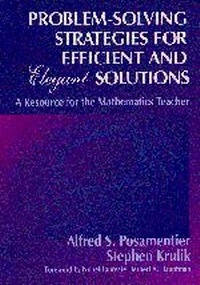
Problem-Solving Strategies for Efficient and Elegant Solutions
A Resource for the Mathematics Teacher
1st Edition
Published on 20. August 1998
Book
Hardback
272 pages
978-0-8039-6697-0 (ISBN)
Description
In this book, the authors examine 10 strategies which are widely used in problem-solving, both in mathematics and real-life situations. They have selected about 200 problems to illustrate these strategies, enabling teachers to apply them to their regular instructional programme. The methods presented make the solution of a problem much easier, much `neater', much more understandable - and thereby more enjoyable.
Reviews / Votes
"It could be used as a supplementary text in secondary mathematics methods course to promote discussion of problem solving or as a text in a formal course on problem solving." -- Horizon Research, Inc. "This book is unique in that it provides alternatives to traditional problem-solving methods used by teachers. It is an attempt to break the mold of looking at only one way to solve a problem. The authors investigate ten strategies that can be used to solve mathematics problems as well as real life situations, using approximately 200 problems to demonstrate the ten strategies." -- C. M. Bradley, Northeastern Illinois University * CHOICE, 1999 *More details
Language
English
Place of publication
Thousand Oaks
United States
Publishing group
SAGE Publications Inc
Target group
Professional and scholarly
Dimensions
Height: 279 mm
Width: 216 mm
Weight
734 gr
ISBN-13
978-0-8039-6697-0 (9780803966970)
Copyright in bibliographic data and cover images is held by Nielsen Book Services Limited or by the publishers or by their respective licensors: all rights reserved.
Schweitzer Classification
Other editions
New editions
Alfred S. Posamentier | Stephen Krulik
Problem-Solving Strategies for Efficient and Elegant Solutions, Grades 6-12
A Resource for the Mathematics Teacher
Book
06/2008
2nd Edition
Corwin Press Inc
€90.20
Shipment within 10-20 days
Persons
Alfred S. Posamentier is professor of mathematics education and dean of the School of Education at the City College of the City University of New York. He has authored and co-authored several resource books in mathematics education for Corwin Press. Stephen Krulik is professor of mathematics education at Temple University in Philadelphia, where he is responsible for the undergraduate and graduate preparation of mathematics teachers for Grades K-12, as well as in the inservice training of mathematics teachers at the graduate level. He teaches a wide variety of courses, among them the History of Mathematics, Methods of Teaching Mathematics, and the Teaching of Problem Solving. Before coming to Temple University, he taught mathematics in the New York City public schools for 15 years, where he created and implemented several courses designed to prepare students for the SAT examination. Nationally, Krulik has served as a member of the committee responsible for preparing the Professional Standards for Teaching Mathematics of the National Council of Teacher of Mathematics (NCTM). He was also the editor of the NCTM's 1980 yearbook Problem Solving in School Mathematics. He is the author or co-author of more than 20 books for teachers of mathematics, including Assessing Reasoning and Problem Solving: A Sourcebook for Elementary School Teachers. He has served as a consultant to and has conducted many workshops for school district throughout the United States and Canada, as well as delivering major presentations in Austria, Hungary, Australia, and international professional meetings, where his major focus is on preparing all students to reason and problem-solve in their mathematics classroom, as well as in their lives. Krulik received his BA degree in mathematics from Brooklyn College of the City University of New York, and his MA and EdD in mathematics education from Columbia University's Teachers College.
Content
Foreword - Herbert A Hauptman
Introduction to Problem-Solving Strategies
Working Backwards
Finding a Pattern
Adopting a Different Point of View
Solving a Simpler Analogous Problem
Considering Extreme Cases
Making a Drawing (Visual Representation)
Intelligent Guessing and Testing (Including Approximation)
Accounting for All Possibilities
Organizing Data
Logical Reasoning
Introduction to Problem-Solving Strategies
Working Backwards
Finding a Pattern
Adopting a Different Point of View
Solving a Simpler Analogous Problem
Considering Extreme Cases
Making a Drawing (Visual Representation)
Intelligent Guessing and Testing (Including Approximation)
Accounting for All Possibilities
Organizing Data
Logical Reasoning