


Fifty Key Video Games
1st Edition
Published on 26. July 2022
Book
Hardback
326 pages
978-1-032-05798-9 (ISBN)
Description
This volume examines fifty of the most important video games that have contributed significantly to the history, development, or culture of the medium, providing an overview of video games from their beginning to the present day.
This volume covers a variety of historical periods and platforms, genres, commercial impact, artistic choices, contexts of play, typical and atypical representations, uses of games for specific purposes, uses of materials or techniques, specific subcultures, repurposing, transgressive aesthetics, interfaces, moral or ethical impact, and more. Key video games featured include Animal Crossing, Call of Duty, Grand Theft Auto, The Legend of Zelda, Minecraft, PONG, Super Mario Bros., Tetris, and World of Warcraft. Each game is closely analyzed in order to properly contextualize it, to emphasize its prominent features, to show how it creates a unique experience of gameplay, and to outline the ways it might speak about society and culture. The book also acts as a highly accessible showcase to a range of disciplinary perspectives that are found and practiced in the field of game studies.
With each entry supplemented by references and suggestions for further reading, Fifty Key Video Games is an indispensable reference for anyone interested in video games.
This volume covers a variety of historical periods and platforms, genres, commercial impact, artistic choices, contexts of play, typical and atypical representations, uses of games for specific purposes, uses of materials or techniques, specific subcultures, repurposing, transgressive aesthetics, interfaces, moral or ethical impact, and more. Key video games featured include Animal Crossing, Call of Duty, Grand Theft Auto, The Legend of Zelda, Minecraft, PONG, Super Mario Bros., Tetris, and World of Warcraft. Each game is closely analyzed in order to properly contextualize it, to emphasize its prominent features, to show how it creates a unique experience of gameplay, and to outline the ways it might speak about society and culture. The book also acts as a highly accessible showcase to a range of disciplinary perspectives that are found and practiced in the field of game studies.
With each entry supplemented by references and suggestions for further reading, Fifty Key Video Games is an indispensable reference for anyone interested in video games.
More details
Series
Language
English
Place of publication
London
United Kingdom
Publishing group
Taylor & Francis Ltd
Target group
College/higher education
Postgraduate, Undergraduate Advanced, and Undergraduate Core
Dimensions
Height: 222 mm
Width: 145 mm
Thickness: 22 mm
Weight
574 gr
ISBN-13
978-1-032-05798-9 (9781032057989)
Copyright in bibliographic data and cover images is held by Nielsen Book Services Limited or by the publishers or by their respective licensors: all rights reserved.
Schweitzer Classification
Other editions
Additional editions
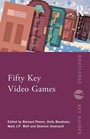
Bernard Perron | Kelly Boudreau | Mark J.P. Wolf
Fifty Key Video Games
Book
07/2022
1st Edition
Routledge
€42.20
Shipment within 10-20 days
Bernard Perron | Kelly Boudreau | Mark J.P. Wolf
Fifty Key Video Games
E-Book
07/2022
1st Edition
Routledge
€36.99
Available for download
Bernard Perron | Kelly Boudreau | Mark J.P. Wolf
Fifty Key Video Games
E-Book
07/2022
1st Edition
Routledge
€36.99
Available for download
Persons
Bernard Perron is a Full Professor of Film and Game Studies at Universite de Montreal. He co-edited, among others, The Video Game Theory Reader 1 and 2 (2003; 2009), The Routledge Companion to Video Game Studies (2014), and Video Games and the Mind: Essays on Cognition, Affect and Emotion (2016) and edited Horror Video Games: Essays on the Fusion of Fear and Play (2009). He is the author of Silent Hill: The Terror Engine (2012) and The World of Scary Video Games: A Study in Videoludic Horror (2018). His research concentrates on video games, interactive cinema, the horror genre, and on narration, cognition, and the ludic dimension of narrative cinema.
Kelly Boudreau is an Associate Professor of Interactive Media Theory and Design at Harrisburg University of Science and Technology. With a background in sociology, film studies, and games studies, she has published on topics ranging from player/avatar relationships in the networked process of video game play, different forms of sociality in and mediated by digital games, to toxic and problematic player behavior in different player communities.
Mark J.P. Wolf is a Professor in the Communication Department at Concordia University Wisconsin whose books include The Video Game Theory Reader 1 and 2 (2003; 2009), The Routledge Companion to Video Game Studies (2014), Building Imaginary Worlds (2012), The Routledge Companion to Imaginary Worlds (2017), The Routledge Companion to Media Technology and Obsolescence (2018), and Encyclopedia of Video Games (2nd Edition, 2021).
Dominic Arsenault is an Associate Professor of Film and Game Studies at the Universite de Montreal. His main publications revolve around narrative and narration in games, genre, and video game history, notably with his recent Super Power, Spoony Bards, and Silverware: The Super Nintendo Entertainment System in the MIT Press platform studies series. He teaches on narratology for film, games and literature, video game screenwriting, and animation film history and theory. He also explores the links between video games and heavy metal music through research and creation with his solo chipmetal project Multi-Memory Controller.
Kelly Boudreau is an Associate Professor of Interactive Media Theory and Design at Harrisburg University of Science and Technology. With a background in sociology, film studies, and games studies, she has published on topics ranging from player/avatar relationships in the networked process of video game play, different forms of sociality in and mediated by digital games, to toxic and problematic player behavior in different player communities.
Mark J.P. Wolf is a Professor in the Communication Department at Concordia University Wisconsin whose books include The Video Game Theory Reader 1 and 2 (2003; 2009), The Routledge Companion to Video Game Studies (2014), Building Imaginary Worlds (2012), The Routledge Companion to Imaginary Worlds (2017), The Routledge Companion to Media Technology and Obsolescence (2018), and Encyclopedia of Video Games (2nd Edition, 2021).
Dominic Arsenault is an Associate Professor of Film and Game Studies at the Universite de Montreal. His main publications revolve around narrative and narration in games, genre, and video game history, notably with his recent Super Power, Spoony Bards, and Silverware: The Super Nintendo Entertainment System in the MIT Press platform studies series. He teaches on narratology for film, games and literature, video game screenwriting, and animation film history and theory. He also explores the links between video games and heavy metal music through research and creation with his solo chipmetal project Multi-Memory Controller.
Content
1. Adventure (1979), 2. Angry Birds (2009), 3. Animal Crossing (2001), 4. Assassin's Creed Origins (2017), 5. Bejeweled (2001), 6. BRAID (2008), 7. Call of Duty: Modern Warfare 2 (2009), 8. Dance Dance Revolution (1998), 9. Diablo (1996), 10. Donkey Kong (1981), 11. DOOM (1993), 12. Dragon's Lair (1983), 13. The Elder Scrolls II: Daggerfall (1996), 14. Elite (1984), 15. EVE Online (2003), 16. FarmVille (2009), 17. FIFA 14 (2013), 18. Final Fantasy VII (1997), 19. Fortnite Battle Royale (2017), 20. Grand Theft Auto III (2001), 21. Guitar Hero (2005), 22. Half-Life (1998), 23. Journey (2012), 24. King's Quest (1984), 25. The Legend of Zelda (1986), 26. Minecraft (2009), 27. Mortal Kombat (1992), 28. Need for Speed III: Hot Pursuit (1998), 29. No Man's Sky (2016), 30. The Oregon Trail (1971), 31. Pac-Man (1980), 32. Pokemon Go (2016), 33. PONG (1972), 34. Portal (2007), 35. Resident Evil (1996), 36. Riven (1997), 37. Sid Meier's Civilization (1991), 38. SimCity (1989), 39. The Sims 4 (2014), 40. Space Invaders (1978), 41. StarCraft (1998), 42. Super Mario 64 (1996), 43. Super Mario Bros. (1985), 44. Tetris (1984), 45. This War of Mine (2014), 46. Ultima IV: The Quest of the Avatar (1985), 47. Wii Sports (2006), 48. Wing Commander III: Heart of the Tiger (1994), 49. World of Warcraft (2004), 50. Zork (1980)