

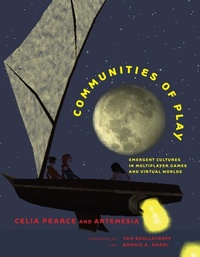
Communities of Play
Emergent Cultures in Multiplayer Games and Virtual Worlds
Published on 30. September 2011
Book
Paperback/Softback
344 pages
978-0-262-51673-0 (ISBN)
Description
The odyssey of a group of “refugees” from a closed-down online game and an exploration of emergent fan cultures in virtual worlds.
Play communities existed long before massively multiplayer online games; they have ranged from bridge clubs to sports leagues, from tabletop role-playing games to Civil War reenactments. With the emergence of digital networks, however, new varieties of adult play communities have appeared, most notably within online games and virtual worlds. Players in these networked worlds sometimes develop a sense of community that transcends the game itself.
In Communities of Play, game researcher and designer Celia Pearce explores emergent fan cultures in networked digital worlds—actions by players that do not coincide with the intentions of the game’s designers. Pearce looks in particular at the Uru Diaspora—a group of players whose game, Uru: Ages Beyond Myst, closed. These players (primarily baby boomers) immigrated into other worlds, self-identifying as “refugees”; relocated in There.com, they created a hybrid culture integrating aspects of their old world. Ostracized at first, they became community leaders. Pearce analyzes the properties of virtual worlds and looks at the ways design affects emergent behavior. She discusses the methodologies for studying online games, including a personal account of the sometimes messy process of ethnography. Pearce considers the “play turn” in culture and the advent of a participatory global playground enabled by networked digital games every bit as communal as the global village Marshall McLuhan saw united by television. Countering the ludological definition of play as unproductive and pointing to the long history of pre-digital play practices, Pearce argues that play can be a prelude to creativity.
Play communities existed long before massively multiplayer online games; they have ranged from bridge clubs to sports leagues, from tabletop role-playing games to Civil War reenactments. With the emergence of digital networks, however, new varieties of adult play communities have appeared, most notably within online games and virtual worlds. Players in these networked worlds sometimes develop a sense of community that transcends the game itself.
In Communities of Play, game researcher and designer Celia Pearce explores emergent fan cultures in networked digital worlds—actions by players that do not coincide with the intentions of the game’s designers. Pearce looks in particular at the Uru Diaspora—a group of players whose game, Uru: Ages Beyond Myst, closed. These players (primarily baby boomers) immigrated into other worlds, self-identifying as “refugees”; relocated in There.com, they created a hybrid culture integrating aspects of their old world. Ostracized at first, they became community leaders. Pearce analyzes the properties of virtual worlds and looks at the ways design affects emergent behavior. She discusses the methodologies for studying online games, including a personal account of the sometimes messy process of ethnography. Pearce considers the “play turn” in culture and the advent of a participatory global playground enabled by networked digital games every bit as communal as the global village Marshall McLuhan saw united by television. Countering the ludological definition of play as unproductive and pointing to the long history of pre-digital play practices, Pearce argues that play can be a prelude to creativity.
More details
Series
Language
English
Place of publication
Cambridge, Mass.
United States
Publishing group
MIT Press Ltd
Target group
Professional and scholarly
Interest Age: From 18 years
Product notice
Paperback (trade)
Illustrations
67 figures
Dimensions
Height: 229 mm
Width: 178 mm
Thickness: 19 mm
Weight
581 gr
ISBN-13
978-0-262-51673-0 (9780262516730)
Copyright in bibliographic data and cover images is held by Nielsen Book Services Limited or by the publishers or by their respective licensors: all rights reserved.
Schweitzer Classification
Other editions
Additional editions
E-Book
09/2011
MIT Press
€29.49
Available for download
Book
09/2009
MIT Press
€9.91
Article exhausted; check different version
Persons
Celia Pearce is Associate Professor of Game Design and Head of the Game Design Program at Northeastern University. She is the author of The Interactive Book: A Guide to the Interactive Revolution. Artemesia is her coauthor and avatar.
Bonnie A. Nardi is Professor of Informatics in the Donald Bren School of Information and Computer Sciences at the University of California, Irvine, and Cofounder of Center for Research in Sustainability, Collapse-preparedness, and Information Technology there. She is the coauthor of Acting with Technology (MIT Press).
Bonnie A. Nardi is Professor of Informatics in the Donald Bren School of Information and Computer Sciences at the University of California, Irvine, and Cofounder of Center for Research in Sustainability, Collapse-preparedness, and Information Technology there. She is the coauthor of Acting with Technology (MIT Press).