

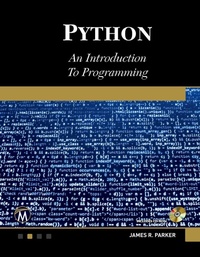
Python. An Introduction to Programming
1st Edition
Will be published approx. on 12. December 2016
Book
Paperback/Softback
600 pages
978-1-944534-65-3 (ISBN)
Description
No detailed description available for "Python. An Introduction to Programming".
More details
Edition
1. Auflage
Language
English
Place of publication
Herndon, VA
United States
Target group
College/higher education
US School Grade: College Graduate Student
Product notice
Klappenbroschur
Dimensions
Height: 229 mm
Width: 178 mm
Thickness: 30 mm
Weight
918 gr
ISBN-13
978-1-944534-65-3 (9781944534653)
Copyright in bibliographic data and cover images is held by Nielsen Book Services Limited or by the publishers or by their respective licensors: all rights reserved.
Schweitzer Classification
Other editions
Additional editions
James R. Parker
Python. An Introduction to Programming
E-Book
12/2016
1st Edition
Mercury Learning & Information
€69.95
Available for download
E-Book
11/2016
1st Edition
Mercury Learning and Information
from
€69.95
Available for download
Person
James R. Parker, PhD is a professor of Art and Digital Media at the University of Calgary. His areas of research include computer games and media art, computer simulation, and educational technology. Dr. Parker is the author of Game Development Using Python, 2/E (Mercury Learning) and The Guide to Simulations and Games (Wiley).
Content
1 - Computers and Programming.
2 - FOR Loops and While Loops: Repetition.
3 - Sequences: Strings, Tuples, and Lists.
4 - Functions and Parameters.
5 -Files: Input and Output.
6 - Classes.
7 - Graphics.
8 - Manipulating Data: Dictionaries, Formatted and Binary Files, Standard File Types.
9- Multimedia: Interaction, Sound, Video.
10 - Basic Algorithms for Computer Science.
11 - Programming for the Sciences.
12 - How to Write Good Programs.
13 - Communicating with the Outside World.
2 - FOR Loops and While Loops: Repetition.
3 - Sequences: Strings, Tuples, and Lists.
4 - Functions and Parameters.
5 -Files: Input and Output.
6 - Classes.
7 - Graphics.
8 - Manipulating Data: Dictionaries, Formatted and Binary Files, Standard File Types.
9- Multimedia: Interaction, Sound, Video.
10 - Basic Algorithms for Computer Science.
11 - Programming for the Sciences.
12 - How to Write Good Programs.
13 - Communicating with the Outside World.