

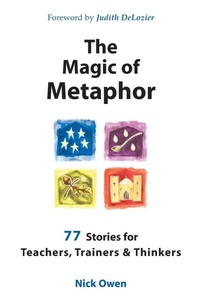
The Magic of Metaphor
77 Stories for Teachers, Trainers and Therapists
Published on 8. January 2001
Book
Paperback/Softback
256 pages
978-1-899836-70-3 (ISBN)
Description
The Magic of Metaphor also gives you 16 suggestions for effective story telling, and advice on organization, style, and story-telling skills. This is an excellent resource for teachers.
Reviews / Votes
"The Magic of Metaphor is one of the most richly rewarding books I have read in a very long time - every page you turn brings a new revelation, a new insight, a new understanding, in a simple and beautiful way. Images come tumbling out, and with them truths about ourselves: who we are, what we are, and most importantly, how the tools we need for life are to be found within each and every one of us." Richard Reed - Better BusinessMore details
Language
English
Place of publication
United Kingdom
Target group
College/higher education
Professional and scholarly
Dimensions
Height: 234 mm
Width: 156 mm
Thickness: 15 mm
Weight
398 gr
ISBN-13
978-1-899836-70-3 (9781899836703)
Copyright in bibliographic data and cover images is held by Nielsen Book Services Limited or by the publishers or by their respective licensors: all rights reserved.
Schweitzer Classification
Other editions
Additional editions
E-Book
01/2001
Crown House Publishing
€21.59
Available for download
Person
What are we called to do in our lives and how can we discover and express our personal and professional genius and purpose? Not easy questions but Nick has been struggling with and exploring them for himself and with others through his writing, editing, and storytelling, as well as in workshops, seminars and coaching sessions with individuals, educational institutions, professional bodies, organisations, and the arts for the last several decades. These days his primary professional passions catalyse around two areas. Firstly, the development of shared narratives that explore how schools, NGOs, and large organisations would do well to be more fully human, more self-organising and self-managing and less stuck in the old paradigms of autocracy, hierarchy, ego, power and control. Secondly, how can people entering the Third Act of their lives see their future less as a surrender into retirement and more as an opportunity to transition into a generative and creative period of contribution and personal exploration of their life's true purpose? In a whole variety of exciting ways, these two areas are both evolutionary and deeply interconnected.