

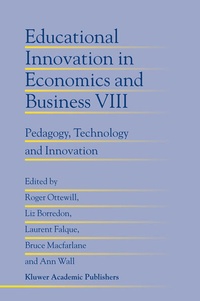
Educational Innovation in Economics and Business
Pedagogy, Technology and Innovation
Published on 31. December 2003
Book
Hardback
XXIII, 401 pages
978-1-4020-1787-2 (ISBN)
Description
Like previous volumes in the "Educational Innovation in Economics and Business" series, this one is genuinely international in terms of its coverage. With contributions from ten different countries and four continents, it reflects the worldwide interest in, and commitment to, innovation in business education with a view to enhancing the learning experience of both undergraduates and postgraduates. It should prove of value to anyone engaged directly in business education, defined broadly to embrace management, finance, economics, informational studies and ethics, or who has responsibility for fostering the professional development of business educators. The contributions have been selected with the objective of encouraging and inspiring others as well as illustrating developments in the sphere of business education.
More details
Series
Edition
2004 ed.
Language
English
Place of publication
Dordrecht
Netherlands
Target group
Professional and scholarly
Research
Product notice
sewn/stitched
Cloth over boards
Illustrations
1686 s/w Abbildungen
XXIII, 401 p. 1686 illus.
Dimensions
Height: 251 mm
Width: 161 mm
Thickness: 12 mm
Weight
889 gr
ISBN-13
978-1-4020-1787-2 (9781402017872)
DOI
10.1007/978-94-017-1386-3
Schweitzer Classification
Other editions
Additional editions
Roger Ottewill | Liz Borredon | Laurent Falque
Educational Innovation in Economics and Business
Pedagogy, Technology and Innovation
E-Book
03/2013
1st Edition
Springer
€149.79
Available for download
Roger Ottewill | Liz Borredon | Laurent Falque
Educational Innovation in Economics and Business
Pedagogy, Technology and Innovation
Book
12/2010
Springer
€160.49
Shipment within 15-20 days
Content
I: The Business Context.- How E-Learning Businesses Meet Client and End User Needs: Analysing the Collaborative Contexts.- Business Process, Experience and Memory: Educational Approaches and Technology Tools for a Global Workforce.- II: Challenges for the Academy.- From High Level Clarity to Ground Level Confusion: Exactly Where do IT-Mediated Education Policies Fit?.- Moving a University Toward On-line Learning: Opportunities, Challenges, and Technologies.- Linking Pedagogical Innovation and Information Technology to Enhance Business Education.- The Experience of Self-Organized Learning Through the Use of Learning Plans for Knowledge Management.- III: Team and Collaborative Learning.- Using Student Consulting Team Assignments as a Vehicle to Teach a Systems Development Course.- Using Team Learning in the Classroom: Experiences and Lessons.- Using Teams in the Classroom: Meeting the Challenge of Evaluating Students' Work.- International Management: Early Experience in Multicultural Virtual Team Interaction.- IV: Problem Based Learning.- PRAXIS: A Practice-Based Instructional System in the First Year of an Industrial Engineering Program.- Using the Web for Problem-Based Learning.- Effects of Problem-Based Learning in Business Education: A Comparison Between a PBL and a Conventional Educational Approach.- Learning about Teaching Information Systems in a Problem-Based Curriculum: An Exploratory Study of the Impact of Students' Individual Differences on their Conception and Perception of Problem Tasks.- V: Distance and On Line Learning.- The Use of a Virtual Learning Environment to Support Learners on Work-Based Learning Programs.- Distance Learning: The Experience of Accounting at the University of Natal (Durban), South Africa.- Creating and Improving a "VirtualObject" Through Web-Mediated Discourse.- Testing Social Information Processing Theories in Distance Education.- VI: Specific Applications of Learning Technology.- Electronic Tutorial for Moral Reasoning in Business Education: A Technological Learning Tool to Facilitate Students' Moral Reasoning.- The Five Key Benefits of On-line Final Examinations (with Three Free Bonus Benefits).- Assertion-Reason Assessment in Formative and Summative Tests: Results from Two Graduate Case Studies.- Exploring the Implications of Videoconferencing for Management Learning.