

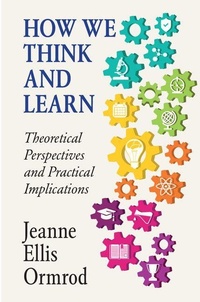
How We Think and Learn
Theoretical Perspectives and Practical Implications
Published on 13. February 2017
Book
Hardback
238 pages
978-1-107-16511-3 (ISBN)
Description
Written in a conversational and engaging manner, How We Think and Learn introduces readers to basic principles and research findings regarding human cognition and memory. It also highlights and debunks twenty-eight common misconceptions about thinking, learning, and the brain. Interspersed throughout the book are many short do-it-yourself exercises in which readers can observe key principles in their own thinking and learning. All ten chapters end with concrete recommendations - both for readers' own learning and for teaching and working effectively with others. As an accomplished researcher and writer, Jeanne Ellis Ormrod gives us a book that is not only highly informative but also a delight to read.
Reviews / Votes
'... complements basic knowledge of cognitive processes with suggestions for application.' Alisha Francis, PsychCRITICSMore details
Language
English
Place of publication
Cambridge
United Kingdom
Target group
College/higher education
Professional and scholarly
Dimensions
Height: 235 mm
Width: 157 mm
Thickness: 19 mm
Weight
543 gr
ISBN-13
978-1-107-16511-3 (9781107165113)
Copyright in bibliographic data and cover images is held by Nielsen Book Services Limited or by the publishers or by their respective licensors: all rights reserved.
Schweitzer Classification
Other editions
Additional editions
E-Book
02/2017
Cambridge University Press
€23.49
Available for download
Book
02/2017
Cambridge University Press
€44.00
Shipment within 15-20 days
E-Book
01/2017
Cambridge University Press
€27.99
Available for download
Person
Jeanne Ellis Ormrod received her AB degree in psychology from Brown University, Rhode Island and her MS and PhD degrees in educational psychology from Pennsylvania State University. She was Professor of Educational Psychology at the University of Northern Colorado (UNC) until 1998 and is now Professor Emerita in UNC's School of Psychological Sciences. Although she no longer conducts her own research on learning and cognition, she remains an avid reader of psychological and educational research, stays in touch with many of her professional colleagues around the world, and continues to update her popular college textbooks in human learning, educational psychology, and research methodologies.
Content
1. The general nature of human cognition and learning: probably not quite what you think; 2. The human brain: the hardware of our thinking and learning; 3. Cognition and learning as constructive processes: finding order in chaos; 4. Key components of the human memory system: an overly simplistic yet useful model; 5. In-depth cognitive processing: maximizing the 'long-term' in long-term memory; 6. Remembering, forgetting, and misremembering: why long-term memory isn't always dependable; 7. Metacognition: thinking about thinking; 8. Conceptual change: revising our understandings when revisions are called for; 9. Bringing other factors into the picture: how emotions, dispositions, and attributions affect thinking and learning; 10. Self-regulating our behavior: turning intentions into actions; Appendix; References; Index.