

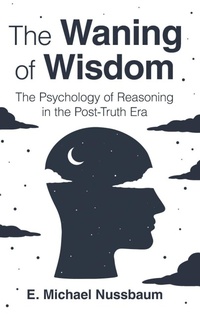
The Waning of Wisdom
The Psychology of Reasoning in the Post-Truth Era
Will be published approx. on 31. May 2026
Book
Hardback
274 pages
978-1-009-50289-4 (ISBN)
Description
In an era of rampant misinformation, conspiracy theories, and political polarization, this book confronts the paradox between rational models of human cognition and seemingly irrational behavior. Drawing on cutting-edge research in psychology and other social sciences, it explores practical tools such as fostering digital literacy and cultivating 'wise deliberative spaces' grounded in argument, perspective taking, and moral inquiry. Written for graduate students, researchers, and general readers, E. Michael Nussbaum provides an accessible introduction to contemporary models of reasoning, motivation, and dialogue. With chapters on truth, talk, trust, and thinking, the volume presents a revised model of dual-process theory, linking it to deliberative dialogue while integrating insights from education, communication studies, philosophy, and political science. The result is a timely vision of cautious optimism for navigating today's post-truth challenges.
More details
Language
English
Place of publication
Cambridge
United Kingdom
Illustrations
Worked examples or Exercises
Dimensions
Height: 235 mm
Width: 157 mm
Thickness: 20 mm
Weight
577 gr
ISBN-13
978-1-009-50289-4 (9781009502894)
Copyright in bibliographic data and cover images is held by Nielsen Book Services Limited or by the publishers or by their respective licensors: all rights reserved.
Schweitzer Classification
Other editions
Additional editions
Book
approx. 05/2026
Cambridge University Press
€40.60
Not yet published
Person
E. Michael Nussbaum is a professor of educational psychology at the University of Nevada, Las Vegas, USA. He combines expertise in educational and cognitive psychology, public policy, and political studies to advance critical thinking for social reform. Dr Nussbaum has previously served as President of the Educational Psychology Division of the American Psychological Association and is author of Categorical and Nonparametric Data Analysis (2024).
Content
1. Introduction; 2. The theorem; 3. Themes, memes, and cognitive biases; 4. Talk; 5. Truth; 6. Trust; 7. Thinking; 8. Tinkering; 9. Conclusion.