

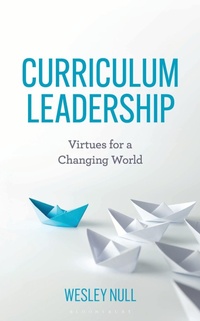
Curriculum Leadership
Virtues for a Changing World
Will be published approx. on 9. July 2026
Book
Hardback
368 pages
979-8-8818-0536-4 (ISBN)
Description
Curriculum Leadership provides much-needed guidance and inspiration for today's curriculum leaders. Building on his Curriculum: From Theory to Practice, now in its 3rd edition, Null provides readers with a companion text that makes the quality of the people who do curriculum work the heart of all good curriculum making.
Often working within extremely challenging if not toxic environments, modern-day curriculum decision makers too often receive shallow "trainings" or pre-packaged "solutions" that promise to "fix" schools once and for all. Ready-made solutions to the complex social, political, and moral challenges that face today's schools, however, do not exist. What leaders need is a robust philosophical and practical text that, instead of seeking to tell leaders how they must act, respects them as the professionals they are. Curriculum Leadership does that while at the same time providing those who lead curriculum discussions with a solid humanistic foundation that empowers them to lead with integrity, imagine a bright future for their schools, and make decisions that strengthen the institutions they serve.
To achieve these ends, Curriculum Leadership connects the field of curriculum to recent developments within moral philosophy. For too long, the field has distanced itself from the moral problems that are the essence of all curriculum decision-making. Instead of running from this reality, Curriculum Leadership embraces the ethical aspect of curriculum and argues for an integration of curriculum deliberation with virtue theory, an approach to moral philosophy that has grown considerably during the last fifty years. The time has come for curriculum to catch up.
After discussing how curriculum can benefit from the work of virtue theorists, Null focuses on ten virtues that he contends are essential for good curriculum making. They are humility, courage, compassion, justice, wisdom, practical wisdom, perseverance, faith, hope, and love. The selection of these ten virtues grows out of Null's thirty years in education, including fifteen years as Vice Provost for Undergraduate Education at Baylor University.
Null dedicates one chapter to each of these virtues. Each chapter begins with a philosophical, psychological, and, in some cases, theological discussion of that virtue before turning to two role models who serve as moral exemplars for that virtue in their personal lives. Some of the exemplars highlighted include, for example, Mother Teresa for humility, Martin Luther King, Jr., for justice, Abraham Lincoln for perseverance, Eleanor Roosevelt for practical wisdom, and Malala Yousafzai for hope. In each chapter, Null then connects that virtue to curriculum leadership and decision making.
Whether they are classroom teachers, district superintendents, or university administrators, readers of Curriculum Leadership will develop a better understanding of the unique nature of curriculum problems. They also will gain a richer understanding of how the formation of these ten virtues not only improves our lives personally but also results in stronger institutions that, of course, exist to serve the public good. Only through the formation of people who possess these ten virtues can our institutions of curriculum weather the storm that has already arrived.
Often working within extremely challenging if not toxic environments, modern-day curriculum decision makers too often receive shallow "trainings" or pre-packaged "solutions" that promise to "fix" schools once and for all. Ready-made solutions to the complex social, political, and moral challenges that face today's schools, however, do not exist. What leaders need is a robust philosophical and practical text that, instead of seeking to tell leaders how they must act, respects them as the professionals they are. Curriculum Leadership does that while at the same time providing those who lead curriculum discussions with a solid humanistic foundation that empowers them to lead with integrity, imagine a bright future for their schools, and make decisions that strengthen the institutions they serve.
To achieve these ends, Curriculum Leadership connects the field of curriculum to recent developments within moral philosophy. For too long, the field has distanced itself from the moral problems that are the essence of all curriculum decision-making. Instead of running from this reality, Curriculum Leadership embraces the ethical aspect of curriculum and argues for an integration of curriculum deliberation with virtue theory, an approach to moral philosophy that has grown considerably during the last fifty years. The time has come for curriculum to catch up.
After discussing how curriculum can benefit from the work of virtue theorists, Null focuses on ten virtues that he contends are essential for good curriculum making. They are humility, courage, compassion, justice, wisdom, practical wisdom, perseverance, faith, hope, and love. The selection of these ten virtues grows out of Null's thirty years in education, including fifteen years as Vice Provost for Undergraduate Education at Baylor University.
Null dedicates one chapter to each of these virtues. Each chapter begins with a philosophical, psychological, and, in some cases, theological discussion of that virtue before turning to two role models who serve as moral exemplars for that virtue in their personal lives. Some of the exemplars highlighted include, for example, Mother Teresa for humility, Martin Luther King, Jr., for justice, Abraham Lincoln for perseverance, Eleanor Roosevelt for practical wisdom, and Malala Yousafzai for hope. In each chapter, Null then connects that virtue to curriculum leadership and decision making.
Whether they are classroom teachers, district superintendents, or university administrators, readers of Curriculum Leadership will develop a better understanding of the unique nature of curriculum problems. They also will gain a richer understanding of how the formation of these ten virtues not only improves our lives personally but also results in stronger institutions that, of course, exist to serve the public good. Only through the formation of people who possess these ten virtues can our institutions of curriculum weather the storm that has already arrived.
More details
Language
English
Place of publication
London
United Kingdom
Publishing group
Bloomsbury Publishing PLC
Target group
College/higher education
Illustrations
3 b/w figures
Dimensions
Height: 229 mm
Width: 152 mm
Thickness: 25 mm
Weight
454 gr
ISBN-13
979-8-8818-0536-4 (9798881805364)
Copyright in bibliographic data and cover images is held by Nielsen Book Services Limited or by the publishers or by their respective licensors: all rights reserved.
Schweitzer Classification
Person
Wesley Null, Ph.D., is a Professor of Education in the School of Education and the Honors College at Baylor. He is currently serving as Vice Provost for Undergraduate Education and Academic Affairs. Previously, Dr. Null served as Associate Dean within Baylor's Honors College, Acting Director of the University's Honors Program, and founding Director of Baylor's Ph.D. in Curriculum & Teaching program.
Dr. Null is curriculum scholar and educational historian whose work is driven by the ideal of liberal education for all. Now with more than 30 years of experience in the field of education, Dr. Null began his career as a middle school teacher in Artesia, New Mexico, before moving to Pflugerville ISD where he taught social studies. In addition to conducting research on the history of education (specifically the history of teacher education), Dr. Null has published extensively in the field of curriculum. His books include Curriculum: From Theory to Practice (2023, 3rd edition), American Educational Thought: Essays from 1640 to 1940 (2010), Peerless Educator: The Life and Work of Isaac Leon Kandel (2007), Forgotten Heroes of American Education: The Great Tradition of Teaching Teachers (2006) (with Diane Ravitch), and A Disciplined Progressive Educator: The Life and Career of William Chandler Bagley (2003).
Dr. Null served as president of the American Association for Teaching and Curriculum from 2010 to 2011 and as editor of the American Educational History Journal from 2006 to 2011. He was named a Fellow with the Dallas Institute of Humanities and Culture in 2012.
Since joining the Baylor faculty in 2001, Dr. Null has taught numerous courses in the Department of Curriculum & Instruction, the Baylor Interdisciplinary Core, the Honors Program, and the Great Texts Department. Courses he's taught regularly include Curriculum Theory and Practice, History of American Education, American Educational Thought, Social Foundations of Education, The United States in the World, Social Issues in Education, Great Texts on Education, and Intellectual Tradition of the Ancient World.
From 2004 to 2011, Dr. Null served as principal investigator for two $1 million Teaching American History grants from the U.S. Department of Education (jointly operated by the School of Education and the Department of History).
As Vice Provost for Undergraduate Education and Academic Affairs, Dr. Null manages all aspects of the university's SACSCOC accreditation efforts, supervises the process of undergraduate curriculum revision, oversees the management of numerous student services offices on campus, coordinates with all academic units on campus to achieve goals related to student success, collaborates with other universities/colleges to establish articulation and exchange agreements, and works to provide a common vision for undergraduate education at Baylor.
Dr. Null holds a Ph.D. degree from the University of Texas at Austin and B.S.Ed. and M.Ed. degrees from Eastern New Mexico University.
Dr. Null is curriculum scholar and educational historian whose work is driven by the ideal of liberal education for all. Now with more than 30 years of experience in the field of education, Dr. Null began his career as a middle school teacher in Artesia, New Mexico, before moving to Pflugerville ISD where he taught social studies. In addition to conducting research on the history of education (specifically the history of teacher education), Dr. Null has published extensively in the field of curriculum. His books include Curriculum: From Theory to Practice (2023, 3rd edition), American Educational Thought: Essays from 1640 to 1940 (2010), Peerless Educator: The Life and Work of Isaac Leon Kandel (2007), Forgotten Heroes of American Education: The Great Tradition of Teaching Teachers (2006) (with Diane Ravitch), and A Disciplined Progressive Educator: The Life and Career of William Chandler Bagley (2003).
Dr. Null served as president of the American Association for Teaching and Curriculum from 2010 to 2011 and as editor of the American Educational History Journal from 2006 to 2011. He was named a Fellow with the Dallas Institute of Humanities and Culture in 2012.
Since joining the Baylor faculty in 2001, Dr. Null has taught numerous courses in the Department of Curriculum & Instruction, the Baylor Interdisciplinary Core, the Honors Program, and the Great Texts Department. Courses he's taught regularly include Curriculum Theory and Practice, History of American Education, American Educational Thought, Social Foundations of Education, The United States in the World, Social Issues in Education, Great Texts on Education, and Intellectual Tradition of the Ancient World.
From 2004 to 2011, Dr. Null served as principal investigator for two $1 million Teaching American History grants from the U.S. Department of Education (jointly operated by the School of Education and the Department of History).
As Vice Provost for Undergraduate Education and Academic Affairs, Dr. Null manages all aspects of the university's SACSCOC accreditation efforts, supervises the process of undergraduate curriculum revision, oversees the management of numerous student services offices on campus, coordinates with all academic units on campus to achieve goals related to student success, collaborates with other universities/colleges to establish articulation and exchange agreements, and works to provide a common vision for undergraduate education at Baylor.
Dr. Null holds a Ph.D. degree from the University of Texas at Austin and B.S.Ed. and M.Ed. degrees from Eastern New Mexico University.
Content
Preface
Introduction: Curriculum and Virtue: An Integration Long Past Due
Chapter 1: Humility and Curriculum
Chapter 2: Courage and Curriculum
Chapter 3: Compassion and Curriculum
Chapter 4: Justice and Curriculum
Chapter 5: Wisdom and Curriculum
Chapter 6: Practical Wisdom and Curriculum
Chapter 7: Perseverance and Curriculum
Chapter 8: Faith and Curriculum
Chapter 9: Hope and Curriculum
Chapter 10: Love and Curriculum
Conclusion: Virtue and Curriculum Leadership: Why They Matter to Each Other
References
Index